Since the model was introduced, the city has moved quickly to restructure and streamline its organizational system. However, after more than seven months of implementation, an imbalance has emerged at the commune level, with civil servants facing a situation described as being “both surplus and short-handed”.
    |
 |
|
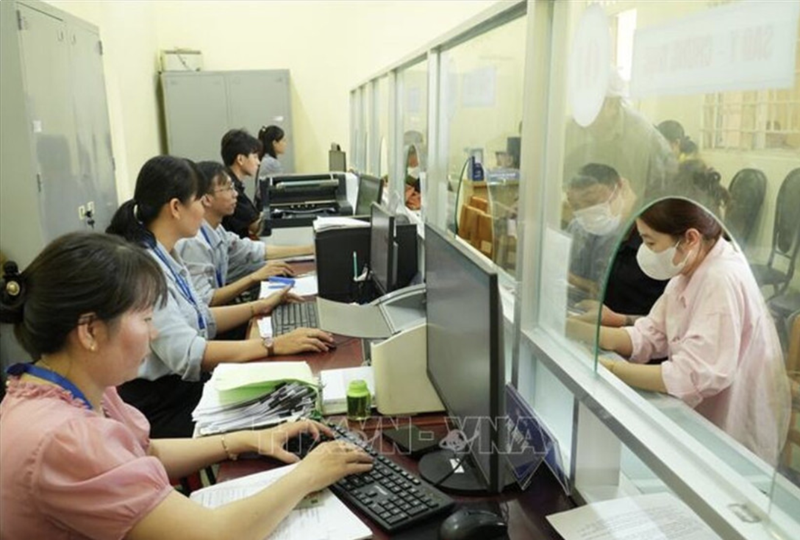
Officials and civil servants in Thai My commune, Ho Chi Minh City process administrative documents for the people. |
According to Pham Thi Thanh Hien, Director of the municipal Department of Home Affairs, the city currently has a surplus of more than 1,000 civil servants while lacking nearly 1,000 personnel across 27 job positions. Some localities have dozens of surplus staff while others face significant shortages.
She noted that commune-level staffing already exceeds the assigned quota by 103 positions, meaning no additional recruitment is allowed. As a result, personnel must be rearranged and transferred from areas with surplus staff to those facing shortages.
Since recruitment beyond the quota is not permitted, in late 2025 the city carried out a large-scale reassignment and reorganization of personnel among localities and across Party organizations, the Vietnam Fatherland Front (VFF) and administrative bodies. At the same time, training and capacity-building programs have been intensified to help civil servants meet new requirements. Although the organizational structure has gradually stabilized, work pressure at the commune level remains high, especially in densely populated or special areas where officials often have to take on multiple roles.
In Thanh An island commune, for example, civil servants have taken on additional duties previously handled at the district level. Vo Thanh Nha, a justice–civil status officer, said many new procedures, including those involving foreign elements, have been transferred to the commune. Besides his main duties, he is also responsible for receiving and returning documents at the public administration unit, requiring careful prioritization to avoid affecting residents’ rights.
Many civil servants are also required to handle tasks outside their original areas of expertise. Truong Thi Ngoc Thao, a public servant at the People’s Committee Office of Can Gio commune, said that self-learning, studying legal regulations and improving digital skills have become essential to cope with the increasing workload in the digital environment.
Administrative pressure remains high as the number of procedures continues to rise. In January 2026 alone, the city processed more than 400,000 dossiers. Despite a high on-time processing rate, civil servants still face difficulties due to uneven technical infrastructure and occasional system glitches, forcing some stages to be handled manually.
Le Thi Kim Hien, Director of the Public Administration Service Centre of Can Gio commune, said that besides professional competence, dedication to public service is vital. Civil servants guide residents in using online public services and support vulnerable groups to ensure equal access.
These efforts have contributed to the city’s strong administrative performance, with 97.9% of dossiers processed on time in the first month of 2026.
Nguyen Van Ngan, Deputy Director of the Public Administration Service Centre of Binh Khanh commune, said that while digital skills are important, public trust ultimately depends on the friendliness and approachability of civil servants. He emphasized that modern digital governance must go hand in hand with centered governance.
The versatility and multi-tasking capacity of civil servants have also helped unlock resources for socio-economic development. In 2025, many communes and wards recorded budget revenues far exceeding targets. Binh Khanh commune, for instance, surpassed its revenue target by more than 25 times, partly thanks to efforts to streamline procedures, support businesses, promote OCOP products on e-commerce platforms and advance infrastructure projects.
Source: VNA