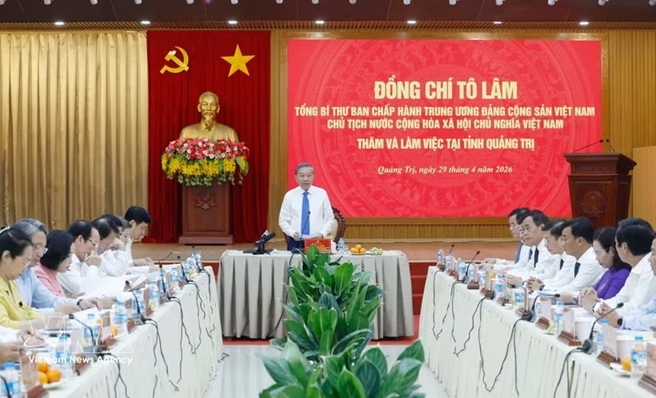
Speaking at a working session with the Standing Board of the provincial Party Committee on April 29 as part of his working trip to Quang Tri, the top leader emphasized the need for a more decisive mindset, clearer priorities, and stronger performance.
    |
 |
|
Party General Secretary and State President To Lam speaks at the meeting. |
He said that the East–West axis must serve as the backbone for reorganizing production space, logistics, urban development, and regional linkages, while enabling strategic connectivity with Laos, Thailand, Myanmar, and the Greater Mekong Subregion. It will integrate Lao Bao and La Lay, border gates, seaports, economic zones, and cross-border trade into a unified ecosystem. Meanwhile, the North–South axis will function as the integrative spine, consolidating and connecting the nation’s overall strength.
The local authorities were urged to re-design their development space across coastal, forest, and border areas with a more integrated, region-based approach. Priority should be given to synchronizing infrastructure and investment across the Southeast Quang Tri Economic Zone, My Thuy Port, Hon La, and coastal industrial, energy, and urban systems. Growth poles and key projects must be clearly identified, avoiding fragmentation, environmental trade-offs, or land speculation.
The leader highlighted key sectors for accelerated development, including the maritime economy, energy, tourism, high-tech agriculture, and processing industries. Seaports and coastal areas should become core growth hubs, capitalizing on Quang Tri’s role as a gateway to the sea along the East–West corridor. At the same time, the province must remove bottlenecks in connectivity, administrative procedures, human resources, and the investment climate, he said.
It is necessary to build Quang Tri’s brand as a destination of history, peace, spirituality, ecology, caves, sea, and border culture by transforming it from a place of remembrance into a place of discovery and experience, he said, noting that high-quality tourism products, stronger regional linkages, and strategic investors are essential, alongside preserving cultural and environmental values.
In agriculture, the province should shift from small-scale production to commodity-based, organic, circular, and climate-resilient models, closely linked with processing, branding, traceability, and markets to integrate farmers more deeply into value chains, he noted.
General Secretary and President Lam requested the locality to maximize the advantages of the Phong Nha - Ke Bang National Park to create "the capital of adventure tourism in Asia."
The province needs to change its mindset and small-scale production practices, prioritizing commercial, organic, circular, and climate-adaptive agriculture; linking production with processing, quality, branding, traceability, and markets, so that farmers become more actively involved in the value chain; improving the quality and transparency of the production process; and enhancing the efficiency of aquaculture and seafood processing, the leader said.
To achieve a growth target of 10.6% in 2026, the leader stressed the need for sustainability based on productivity, efficient investment, and new growth drivers. Public investment must lead, focusing on strategic infrastructure, while improving the business environment and supporting private sector development. Quang Tri cannot rely solely on natural resources and low-cost labor, he stated.
He underlined the need for Quang Tri to effectively implement the Politburo's Resolution No. 57 in governance, production, public services, and key economic sectors; improve digital infrastructure down to the grassroots level, enhance digital skills, build shared databases on land, businesses, investment, planning, public assets, and administrative procedures; innovate working methods, service delivery, and decision-making, helping citizens and businesses complete procedures faster, more transparently, and at lower costs.
Finally, the leader emphasized inclusive development by promoting culture development, improving social welfare, education, healthcare, and living standards, especially in border and disadvantaged areas, while integrating economic growth with national defense and security.
Quang Tri province, once a frontline in wartime, must now become a hub of connection, cooperation, and sustainable development in peacetime, the top leader stressed.
Source: VNA