Chairing a working session with MAE on April 29, the PM commended the ministry for its proactive, exemplary role in advancing institutional reform and strictly implementing directives to cut administrative procedures and business conditions under Conclusion 18 of the second meeting of the 14th Party Central Committee. It was among three ministries recognized by the Government and the Prime Minister.
    |
 |
|
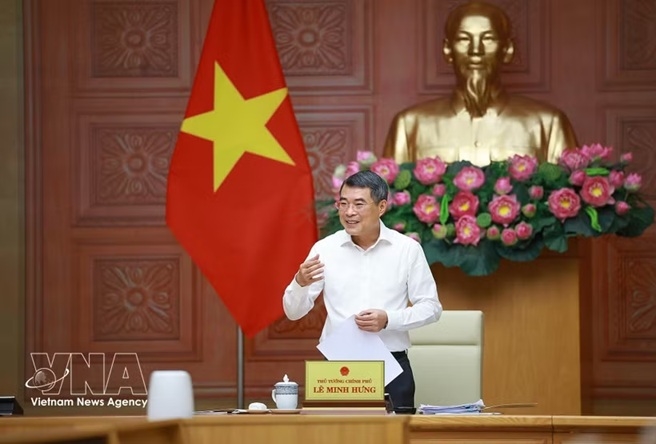
Prime Minister Le Minh Hung orders bold reforms to unlock resources, drive double-digit growth at the working session with the Ministry of Agriculture and Environment on April 29, 2026. |
He highlighted persistent bottlenecks in mobilizing and unlocking land, natural resources and forest assets for development, calling for further administrative simplification, decentralization, and stronger action to address air pollution in urban areas, water pollution in river basins, and environmental issues in craft villages. Faster implementation and disbursement of national target programs were also stressed.
The PM pointed to major challenges facing the sector, including extreme climate change, natural disasters, tightening green barriers and international standards, and limitations in resources, infrastructure, technology and workforce. These require urgent transformation of production models to maintain competitiveness and mitigate negative impacts. With global conditions evolving rapidly, he called for more agile thinking, policymaking and response.
Key tasks include building a strong and pure Party organization, urgently finalizing working regulations, and enhancing accountability. Relevant stakeholders are required to conduct thorough research and swiftly translate the 14th National Party Congress Resolution, Conclusion No. 18, strategic resolutions of the Politburo, National Assembly resolutions, and the Government’s action program into concrete actions, ensuring timely implementation.
He instructed that guidelines for allocating public investment capital based on output results must be completed within the week, linked to socio-economic accounting and efficiency evaluation.
In May 2026, the ministry is to submit proposals on carbon credit management and a review of Resolution 24-NQ/TW of the 11th-tenure Party Central Committee regarding climate change response, natural resources management and environmental protection, propose the law amending and supplementing a number of articles of the Law on Environmental Protection, and accelerate decentralization for national target programs.
In Q2 it will complete and submit for approval by competent authorities the adjustment of the national land-use plan, refine sectoral planning, address idle land and delayed projects, and consolidate the legal framework on rare earths and standards.
In Q3, the ministry will review the implementation of Resolution 18-NQ/TW on continuing to innovate and perfect institutions and policies, improving the effectiveness and efficiency of land management and use; amend the Land Law; optimize agricultural land use; and strengthen incentives to attract investment and develop by-product markets. It will also submit a decree to resolve long-standing project and land issues.
The PM called for continued streamlining of the apparatus, improved governance, and deeper decentralization, alongside reforms to address bottlenecks in land, environment and minerals. He also urged more flexible rice land policies to allow conversion of inefficient areas while safeguarding food security.
The ministry was tasked with drafting a unified decree to encourage investment in agriculture and rural areas, while directing production, ensuring food security, monitoring global and domestic developments, and expanding markets.
Other priorities include accelerating sector restructuring, digital transformation, and the application of science and technology, developing large-scale, value chain-based production linked to branding, traceability and raw material zones.
Additionally, the ministry must strengthen core State management tasks such as combating illegal, unreported, and unregulated (IUU) fishing, forest fire prevention, and disaster response. Further areas include climate change response, disease control, water security, energy, and air pollution and urban flooding control in Hanoi and Ho Chi Minh City, and improving environmental quality in urban areas, industrial zones and craft villages.
Despite numerous challenges, the agriculture and environment sector has made strong efforts to fulfil its mandates, contributing to national achievements. The ministry has led in institutional reform, issuing decrees effective from January 1, 2026, and cutting administrative procedures and business conditions.
It has also coordinated with relevant agencies to resolve projects and land management, national target programs on new rural development, poverty reduction, and socio-economic development in ethnic minority and mountainous areas.
Source: VNA