Quang said that amid increasingly complex domestic and international challenges to national construction and defense, the 14th Congress for the first time formally established the concept of comprehensive security, giving security an important role across all areas of national development.
    |
 |
|
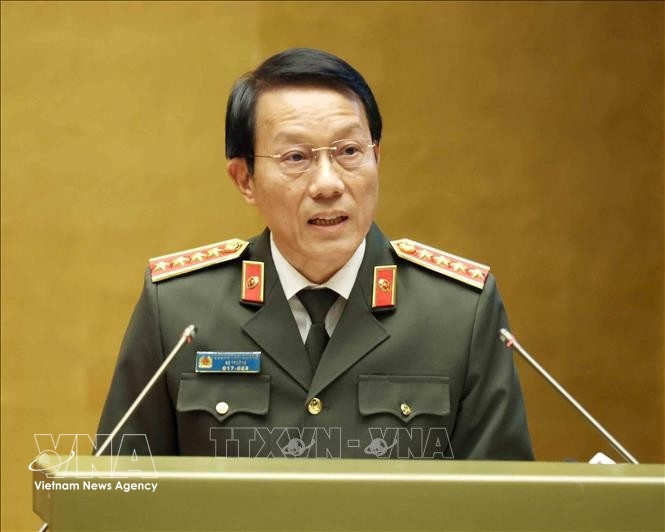
General Luong Tam Quang, Politburo member and Minister of Public Security, speaks at the national conference in Hanoi on February 7. |
In the new period, national security extends beyond border and territorial protection to include regime security, ruling security, cultural-ideological security, economic and financial security, data security, environmental security, energy security, water security, food security, human security, digital security, nuclear security, transmission and fiber-optic security, satellite security, and low-altitude economic-space security, among others.
He noted that strategic autonomy in security represents a new line of thinking reflected throughout the congress’s documents. The principle of "development for stability, and stability for fast and sustainable development" serves as a guiding thread in the national security mindset in the new era.
For the first time, maintaining a peaceful and stable environment is placed at the forefront of development objectives, reflecting the Party’s view that ensuring national security and stability is both the prerequisite, a driving force and a foundation for achieving other development goals.
He also noted that compared with the 13th National Party Congress, the principle of ensuring national interests at the highest level is not only emphasized in guiding viewpoints, national defense and security objectives, and the country’s development orientation for the 2026–2030 period, but has also been expanded to include the requirement to "ensure and safeguard national interests at the highest level" and practice "proactive defense."
According to Quang, the mindset and methods for protecting national security in the new era emphasize proactive security, comprehensive security, development-oriented security, and discipline in implementation.
The Party identified the task of "building a disciplined, healthy, civilized, secure, safe, and developed society with welfare ensured" while demanding concerted efforts to drastically reduce crime and move towards a society free from crime, accidents, social evils, and corruption, and a truly civilized and happy society.
These are new and very high requirements, with the ultimate goal of ensuring a peaceful life and happiness for the people, the minister said.
The Congress also highlighted the need to closely and effectively combine national defense and security with economic, cultural, social, and foreign-affairs development, thereby promoting Vietnam’s soft power and creating new strengths for the nation.
It set the orientation to build a revolutionary, regular, elite, and modern People’s Public Security force that is absolutely loyal to the Fatherland, the Party, the State, and the people, stays steadfast in the Party's goals and ideal, and serves as the core force in safeguarding national security.
Quang added that the Party Central Committee’s action plan for implementing the Resolution identifies nine groups of tasks, including developing special mechanisms and policies to combine economic development with national defense and security in islands and maritime special zones such as Phu Quoc, Con Dao, Van Don, Con Co, Ly Son, and Hon Khoai; building a modern, self-reliant, dual-use security industry integrated into global value chains; and ensuring national digital sovereignty and a safe, stable cyberspace environment for development.
Source: VNA