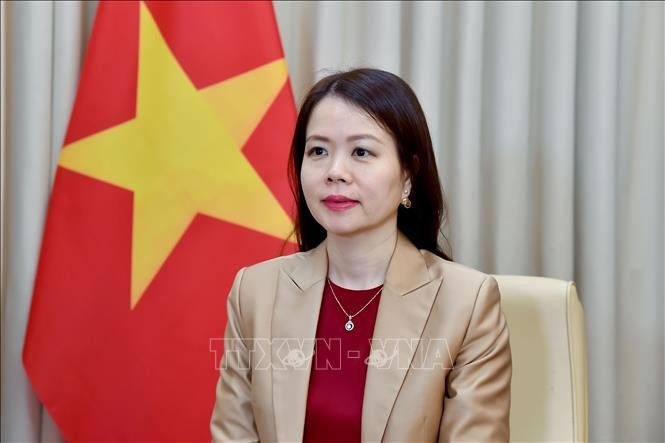
The insights were shared by Deputy Minister of Foreign Affairs Nguyen Minh Hang while talking to the press on this breakthrough journey.
    |
 |
|
Deputy Minister of Foreign Affairs Nguyen Minh Hang |
According to her, in 2025, the world continued to experience rapid, profound, and unpredictable changes. Global economic growth slowed, instability risks increased, strategic competition intensified, and tariff policies and trade protectionism expanded. The restructuring of supply chains and value chains, along with fragmentation trends in trade, technology, and green and digital development standards, became increasingly evident. Domestically, unprecedented natural disasters and floods caused severe damage, making development challenges demand stronger governance capacity and adaptability than ever before.
In that context, Hang said that economic diplomacy closely followed the leadership of the Party, the State, and the Government, and was implemented in a synchronized, methodical, and decisive manner - both in breadth and depth - achieving many important results described by Prime Minister Pham Minh Chinh at the conference reviewing economic diplomacy in 2025 on January 10, 2026 as a process of “transforming the state of play and turning the tide.”
Last year, economic diplomacy maintained proactive positioning amid volatility, generated momentum amid difficulties, and laid the groundwork for breakthroughs, she said, adding it contributed effectively to growth objectives, strengthened confidence, and expanded development space.
“Economic diplomacy shifted its mindset from accompanying growth to pioneering the creation of development opportunities, generating strategic space, mobilizing resources, and laying the foundation for deeper integration into global value chains,” she held.
The most notable imprint, Hang noted, was the elevation of Vietnam’s strategic position, creating political and diplomatic leverage and opening up new cooperation opportunities.
Over the past year, 75 foreign activities by key leaders were carried out, relations with 17 countries were upgraded, and a record 350 cooperation agreements were signed - 2.5 times higher than in 2024, focusing on economic, trade, investment, science and technology, innovation, and digital transformation.
These were not merely documents, but the establishment of unprecedented favorable political-economic space with leading partners, providing a critical basis for attracting high-quality investment, expanding sustainable markets, improving access to and ownership of technology, and enhancing the economy’s capacity and competitiveness.
Second, she said economic diplomacy contributed breakthroughs to strengthening domestic economic capacity. In 2025, Vietnam officially entered the group of the world’s 15 largest trading nations, with total import-export turnover exceeding 930 billion USD.
Diplomacy played a “path-opening” role in enabling key agricultural exports such as durian, edible bird’s nest, and passion fruit to penetrate deeply into the Chinese market; addressing tariff issues with the United States; placing Vietnam in a priority group for negotiating fair trade agreements; expanding into promising new markets such as Latin America, the Middle East–Africa, Central Asia, Central and Eastern Europe, and Halal markets. It also advocated for the opening of numerous new international direct air routes despite complex geopolitical conditions, contributing to a record 21.5 million international tourist arrivals, the highest ever.
Third, an important “state transformation” highlight was science and technology diplomacy, promoted across multiple dimensions from policy formulation and framework establishment to business and investment connectivity both domestically and internationally, multilateral cooperation enhancement, and mobilization of knowledge networks. This contributed to building 11 strategic technology groups and substantively implementing Politburo Resolution 57.
According to the Deputy FM, economic and science-technology content became central to foreign affairs activities, especially high-level diplomacy, generating strong momentum for Vietnam’s economic, trade, and technological relations with partners. As a result, Vietnam has gradually forged strategic linkages in future-oriented technology sectors.
The establishment of AI and semiconductor R&D centers in Vietnam by corporations such as NVIDIA, Qualcomm, and Samsung; Dassault Systèmes launching its R&D Center and Center of Excellence for digital twin and AI; ASML considering opening a representative office and committing to support semiconductor training and development; and Viettel commencing construction of Vietnam’s first high-tech semiconductor chip manufacturing plant - all demonstrate recognition of Vietnam’s potential and new standing in the global value chain, she stressed.
Institutionally and strategically, Hang stated that the Ministry of Foreign Affairs has issued an Action Plan for science and technology diplomacy through 2030 and is submitting to the Government a strategy for international cooperation on strategic technologies to 2030, with a vision to 2045. The overarching spirit is to make science, technology, and innovation diplomacy a priority pillar of foreign affairs in service of development.
She said that economic diplomacy has become more substantive in supporting and connecting localities and businesses. Efforts to promote the Vietnamese brand have seen clear progress. In 2025, Vietnam’s overseas representative missions organized nearly 500 trade, investment, and tourism promotion activities; supported localities in hosting over 150 events; and facilitated the signing of around 100 cooperation agreements between localities and international partners.
Diplomacy has accompanied local authorities and enterprises in removing bottlenecks, opening access channels, and bringing Vietnamese goods, brands, and products closer to key and emerging markets, she added.
Predicting some major international trends in 2026, Hang pointed out growth slowdown, potential instability triggered by conflicts, tariff policies, policy adjustments by various countries, and competition for resources, markets, technology, and high-quality human resources. She also mentioned rapid technological innovation and the trend of technological decoupling, which concurrently facilitate accelerated development and make it difficult for countries to access advanced technologies, posing a significant risk of lagging behind.
Globalization and international integration continue, but protectionism, fragmentation, clustering, and inequality are growing while geo-economic and political competition becomes increasingly fierce, especially in the Asia-Pacific and Southeast Asia, heaping pressure on small and medium-sized countries. Besides, traditional and non-traditional security issues have an increasingly profound impact on the security and development of many countries, she noted.
The official described 2026 as a strategically significant year for Vietnam as it marks the first year of implementing the Resolution of the 14th National Party Congress and the 2026–2030 socio-economic development plan, initially establishing a long-term development model and growth trajectory for the country on the path towards the two strategic centenary goals.
The Resolution of the 14th National Party Congress states that foreign affairs and international integration must play a pioneering and creative role and, alongside national defense and security safeguarding, serve as a "key and regular" task. It says a comprehensive foreign affairs strategy must be strongly implemented at a new level, contributing to the world economy, global politics, and human civilization.
The new context, new potential, and new expectations present new tasks and requirements, demanding that economic diplomacy or, more broadly, foreign affairs serving development must constantly reform thinking, be sharp and decisive in implementation, be creative and groundbreaking in approach, and remain consistent with the principle of placing national interests first and above all else, with businesses and people at the center of service.
Given this, Hang said, the guiding principle for economic diplomacy in 2026 is to create new development spaces; connect strategic resources and verify them through implementation effectiveness; resolutely accelerate the realization of the Party’s new viewpoints and guidelines and the State’s policies, especially the orientations set at the 14th National Party Congress and the resolutions of the Party, National Assembly and Government, the Politburo’s Resolution No.59, and the National Assembly’s Resolution No.250 on international integration; and transform strategic orientations into concrete, substantive, and measurable results.
Highlighting five priorities of economic diplomacy in 2026 and the following years, she said that first, new growth drivers will be promoted, with science – technology diplomacy, semiconductor diplomacy, and digital economy diplomacy as central and breakthrough drivers of economic diplomacy in the new era. Vietnamese businesses’ capabilities of researching, accessing, and mastering technology will be enhanced while support given to the formation of R&D clusters, innovation centers, high-tech human resources training cooperation programs, and digital ecosystem connectivity.
Vietnamese technology companies will also receive assistance in expanding to foreign markets, seeking opportunities for mergers and acquisitions, and connecting with multinationals, especially large technology corporations worldwide. Efforts will also be made to attract overseas Vietnamese scientists.
Second, the Deputy Minister went on, breakthroughs will be made in expanding markets and supply chains with potential partners in the Middle East, Africa, Latin America, Eastern Europe, and Central Asia. At the same time, cooperation with major and traditional partners will be consolidated and expanded, and new cooperation frameworks leveraged to broaden development opportunities.
Vietnamese-branded products will be further promoted and marketed abroad. Negotiations on free trade agreements (FTA) with Bangladesh, Pakistan, the Gulf Cooperation Council (GCC) members, African countries such as Egypt and Algeria, and the Southern African Customs Union (SACU) are set to gain speed, and the signing of an FTA with the Southern Common Market (MERCOSUR) expedited.
Third, priority will be given to supporting localities and businesses, especially small and medium-sized enterprises, to enhance the effectiveness of international economic integration and leverage commitments. Businesses will be helped to expand investment and operations in international markets and participate more deeply in global value chains. The potential, strengths, and new development spaces of localities will be maximized following the launch of the two-tiered local administrative system, according to Hang.
Fourth, the quality and practicality of research will be further improved to stay connected with real-life situations and promptly propose "accurate" and "correct" policies, simultaneously creating strategic space and promoting the pillars of domestic development.
Fifth, she added, Vietnam will strengthen and elevate multilateral diplomacy and international economic integration, proactively engage in the shaping of new rules and norms and, at the same time, prepare well to chair important multilateral mechanisms, with high priority given to completing all-round preparations for APEC Year 2027.
The Deputy Minister said that 2026 will be the year when economic diplomacy shifts sharply from "paving the way" to "facilitating development", from "connecting opportunities" to "connecting strategic resources", and from "making commitments" to "verifying effectiveness."
She underlined the network of 17 free trade agreements and diplomatic relations with 194 countries, including comprehensive or higher-level partnerships with 42 countries, 17 of which are G20 members, and comprehensive strategic partnerships with all five permanent members of the United Nations Security Council.
However, she perceived that this foundation is only meaningful when it is transformed into concrete values, high-quality investment projects, sustainable export markets, technology and knowledge to support innovation, secure supply chains, enhance Vietnamese businesses’ competitiveness, and improve the country’s stature in the region and the world.
The official expressed her belief that with the attention, leadership, and guidance from the Party, State, and Government, together with solidarity, concerted efforts, the determination to innovate and the strong involvement of the entire political system, economic diplomacy in 2026 will create new impetus for Vietnam to accelerate, break through, and advance quickly, strongly, and steadily in the era of the nation’s rise, contributing to the realization of the aspiration for a strong and prosperous Vietnam.
Source: VNA