A report presented at the meeting highlighted the success and several new features of the congress. It not merely reviewed the past term or set targets for the next five years, but also shaped development thinking, identified a new growth model and laid the institutional foundation for the nation’s long-term trajectory towards the mid-21st century.
    |
 |
|
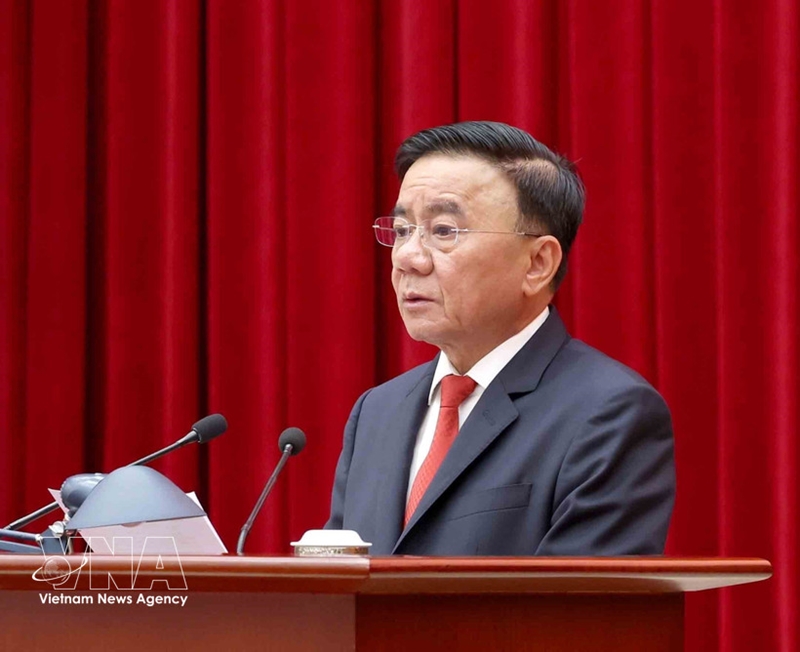
Politburo member and Permanent member of the Party Central Committee’s Secretariat Tran Cam Tu speaks at the conference on March 17. |
The congress introduced innovations in guiding viewpoints, objectives, methods, implementation approaches and outputs. A notable change was the consolidation of three major reports into a single political report, enhancing the document's strategic coherence, comprehensiveness and practicality while making it more concise, accessible and easier to implement. The congress’s resolution was also paired with an action plan to ensure swift and decisive execution.
Personnel work was reformed in both procedures and methodology, with clearer delineation of authority and responsibility for Party committees, organizations and leaders in evaluating, vetting and recommending candidates.
Communications efforts were conducted in a concerted and wide-ranging manner with numerous innovations, while the duration of the congress itself was shortened. Documents, speeches and presentations were more intellectually substantive yet concise. For the first time, presentations from Party organizations at the commune level were delivered, bringing grassroots perspectives directly into national discussions.
Digital transformation was also boosted, with tablet computers used to distribute materials instead of printed copies, not merely a technical upgrade but a step towards more modern and professional governance.
The report further pointed out lessons learned from the preparation and organization process and offered recommendations for future congresses.
In his remarks, Tu emphasized that the 14th Congress was a political event of special significance, opening a new phase of national development in the new era. He affirmed that based on organizational practice, the review report and participants’ assessments, it could be affirmed that the big event had been highly successful in the three key areas of documents, personnel and organizational work.
He noted that these achievements stemmed primarily from close, decisive and scientifically grounded leadership by the Party Central Committee, the Politburo and the Secretariat, headed by General Secretary To Lam.
Agreeing broadly with the report’s content, he urged the Party Central Committee’s Office to coordinate with relevant bodies to compile and archive documentation comprehensively for future reference in organizing subsequent congresses and major national events. Relevant agencies were also asked to review and update themselves with Party regulations to ensure consistency in implementation.
The official asked competent authorities to commend and reward officials, soldiers and employees who contributed to the congress, including those in quiet and behind-the-scenes roles whose efforts were vital to its overall success.
In recognition of outstanding achievements in congress organization, the Permanent member presented the first-class Labor Order from the State President to six bodies, namely the Party Central Committee's Organization Commission, Commission for Information, Education and Mass Mobilization, and Office; the Ministry of Public Security; the Ministry of Culture, Sports and Tourism; and the Party organization, administration and people of Hanoi.
The second-class Labor Order was awarded to four agencies – the Party Central Committee's Inspection Commission, the Ministry of Foreign Affairs, the Vietnam News Agency, and the Vietnam Television.
The third-class Labor Order was presented to four agencies, namely the Ministry of Health, the Ministry of Finance, Nhan dan Newspaper, and Radio the Voice of Vietnam.
Source: VNA