The two leaders informed each other about the situation of each Party and country, and activities of their respective legislative bodies. They expressed satisfaction at the positive momentum in relations between the two Parties and countries, with steady progress in parliamentary exchanges and cooperation.
    |
 |
|
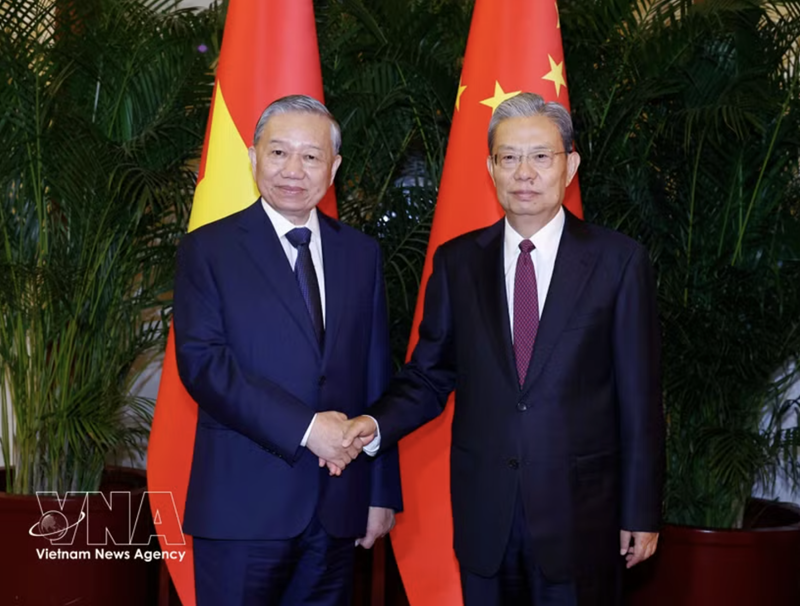
General Secretary of the Communist Party of Vietnam (CPV) Central Committee and State President To Lam (left) and Chairman of the Standing Committee of the National People’s Congress of China Zhao Leji |
The Vietnamese leader affirmed that his visit aims to inherit and carry forward the consistent policy, strategic choice, and top priority of the Vietnamese Party and State regarding Vietnam–China relations. Together with Chinese leaders, including Zhao, the visit seeks to elevate strategic cohesion between the two Parties and countries to a higher level in the new era.
He congratulated China on its notable achievements and the successful fourth session of the 14th National People’s Congress and the 14th Chinese People's Political Consultative Conference (CPPCC), praising the country’s theoretical and practical advances in building a socialist rule-of-law state and whole-process people’s democracy. He voiced his confidence that China will effectively realize its 15th five-year socio-economic development plan oriented toward quality development.
Welcoming the Vietnamese leader on his state visit to China, his first following Vietnam’s recent consolidation of State leadership positions, Zhao congratulated Vietnam on the success of the 14th National Congress of the CPV and the first session of the 16th National Assembly (NA).
He described Vietnam and China as neighboring socialist countries sharing long-standing tradition of friendship and similar political regimes, development paths, and socio-cultural traditions. China steadfastly supports Vietnam in building socialism suited to its own national conditions, Zhao said.
Underscoring the importance of institutional and legislative work, General Secretary and State President To Lam proposed deeper friendly exchanges and cooperation between the two legislatures. He called for effective implementation of the cooperation mechanism between the two legislatures; more frequent exchanges of all-level delegations, particularly among border localities; and stronger collaboration among specialized committees, friendship parliamentary groups, female and young parliamentarians. He also urged mutual support at global and regional inter-parliamentary forums.
He expressed his hope that the two legislatures would uphold their roles in lawmaking and supervision, thereby expanding and improving the effectiveness of substantive cooperation in such key areas as diplomacy, national defense - security, trade, investment, and tourism.
Priority should be given to rebalancing bilateral trade, moving beyond traditional commerce toward deeper integration in supply and production chains, improving transport connectivity, particularly through concrete railway cooperation mechanisms, ensuring energy security and making science-technology a new highlight of the bilateral relationship, he said.
The Vietnamese leader stressed the role of elected bodies in representing the people's will and aspirations, contributing to enhancing public communication and mutual understanding, as well as promoting better control and settlement of differences at sea in accordance with international law, thereby maintaining a peaceful and stable environment for each country’s development and preserving the bilateral friendship.
|
|
 |
|
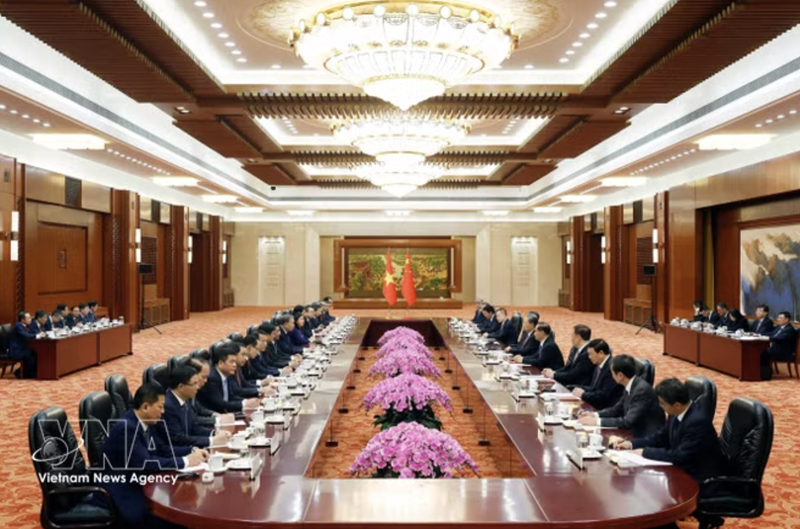
At the meeting between the Vietnamese Party General Secretary and State President, and the top Chinese legislator |
Agreeing with the General Secretary and State President’s proposals, Zhao affirmed that the National People’s Congress of China stands ready to further foster friendly exchanges and practical cooperation with the Vietnamese N.A.
He extended an invitation to N.A. Chairman Tran Thanh Man to visit China at an early date to co-chair the second meeting of the joint legislative cooperation committee. This would allow both sides to share legislative and supervision experiences, better align development strategies, and boost cooperation in culture, education, and people-to-people exchanges, actively contributing to building a China–Vietnam Community with a shared future that carries strategic significance.
Source: VNA