Having attended the event in person and listened to the important message delivered by the Vietnamese leader, Assoc. Prof., Dr. Neak Chandarith, Director of the Institute for International Studies and Public Policy (IISPP) at the Royal University of Phnom Penh (RUPP), expressed particular interest in the six proposals outlined in the opening keynote. In his view, these proposals demonstrate that Vietnam has firmly positioned itself as an active contributor to peacebuilding and stability in an increasingly volatile world.
    |
 |
|
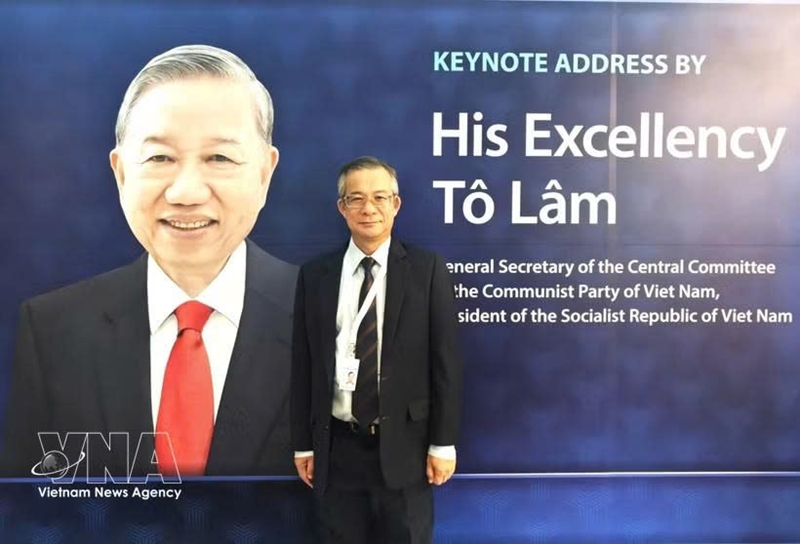
The Cambodian scholar is impressed by Party General Secretary and State President To Lam's keynote address. |
Chandarith said the six proposals reflect the vision of an outstanding leader and add substantial weight to a sustainable regional security architecture while safeguarding the interests and stances of small and medium-sized countries.
First, on making rules and dialogue effective tools for genuine risk reduction, Vietnam stressed that a rules-based order is not the exclusive domain of any group of countries but a shared foundation allowing nations, large and small alike, to coexist peacefully under international law and the U.N. Charter. Legal principles should be translated into practical mechanisms, such as early warning systems, hotlines, and incident management procedures.
Second, Vietnam called for an open, inclusive regional architecture with ASEAN at its core, insisting that all new initiatives be transparent, respect international law, complement one another, and avoid undermining ASEAN centrality or turning Southeast Asia into an arena for great power rivalry. It expressed full support for and readiness to cooperate with the Philippines - ASEAN Chair 2026.
Third, on placing human security and social resilience at the center of sustainable security, Chandarith noted that the speech made clear security cannot rest solely on military might or descend into an arms race. Instead, it must build resilient development foundations through open supply chains and substantive cooperation in food security, energy security, climate change, national defense, health care, and disaster relief.
Fourth, on developing responsible norms for emerging technologies and the defense industry, the Vietnamese leader’s address noted that with artificial intelligence, big data, and cyberspace, humans must retain control and bear ultimate responsibility for decisions with serious human security consequences. Vietnam therefore underscored that the defense industry should serve legitimate self-defense and regional stability, not fuel an arms race.
Fifth, on strengthening social foundations and resilience, protecting the information space, and raising public awareness, Chandarith strongly endorsed the observation that in a hyperconnected digital world, crises can spring from the erosion of social trust caused by misinformation, incitement, and division. Safeguarding peace thus requires safeguarding truth, sharpening strategic communications, promoting digital citizenship education, and raising accountability among technology networks.
Finally, on boosting capacities for preventive diplomacy, mediation, and regional conflict settlement, Chandarith praised the view that the Asia-Pacific should treat preventive diplomacy as a strategic capability, not merely a post-crisis response. He proposed hybrid consultation networks and communication mechanisms linking defense agencies, maritime law enforcement, academia, and business to create diplomatic off-ramps before parties become trapped in escalating cycles of conflict.
Vietnam’s proposals help shape a framework in which all countries, including smaller states, have a voice and an equal right to participate, with no nation excluded from the collective security system, he said.
Under the leadership of an outstanding statesman pursuing a profound, strategic, and forward-looking foreign policy, Vietnam has clearly affirmed two important points, Chandarith added.
First, Vietnam recognizes that its national interests are inseparable from peace and prosperity across the wider Asia-Pacific. Contributing to regional peace serves as a long-term safeguard for Vietnam's own interests while also fulfilling its international responsibilities.
Second, Vietnam has established itself as an independent player and bridge builder, representing the interests of smaller countries such as Cambodia as well as middle powers.
Chandarith further observed that during the Q&A session, Vietnam reaffirmed its “Four No’s” defense policy of no military alliances, no alignment with one country against another, no foreign military bases on Vietnamese territory, and no use or threat of force in international relations. In doing so, Vietnam demonstrated a firm resolve not to become an instrument in confrontations among competing power blocs.
From this standpoint, he stressed that Vietnam’s message to major powers was both clear and compelling: the region welcomes a transparent and responsible presence committed to respecting international law and ASEAN centrality.
Source: VNA