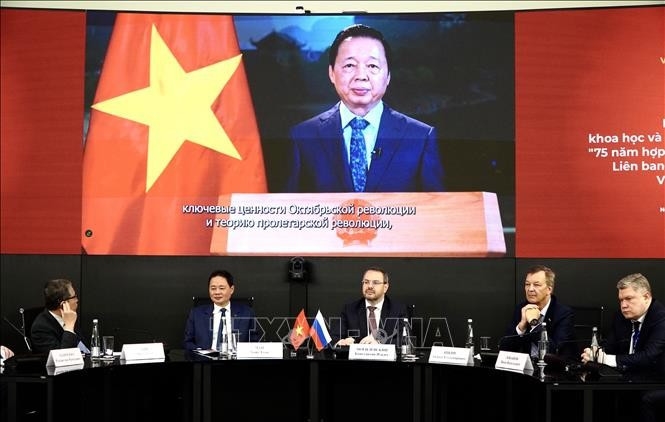
In a recorded message to the event, Deputy Prime Minister Tran Hong Ha reflected on his study years in Russia. He described human-resources training in the former Soviet Union as an invaluable strategic contribution to Vietnam’s development, likening it to a “golden key” to knowledge. He noted that generations of Vietnamese scientists, leaders and managers educated in the former Soviet Union and Russia today have become a priceless asset and the enduring “red thread” connecting the two peoples.
    |
 |
|
Deputy Prime Minister Tran Hong Ha delivers his remarks to the forum via a recorded message. |
He stated that, on this historical foundation, both countries aim to strengthen trusted, sustainable and effective cooperation in the digital era and knowledge economy, jointly shaping a prosperous future and contributing to global progress. Beyond traditional strengths in fundamental sciences, he said Vietnam and Russia have ample opportunity to broaden collaboration into strategic technological domains.
Vietnamese Ambassador to Russia Dang Minh Khoi underscored that scientific and educational cooperation has long been, and will continue to be, a firm bridge between the two countries, established from the earliest days of diplomatic ties when President Ho Chi Minh sent the first Vietnamese officials to study in the former Soviet Union.
The forum’s opening day featured a plenary session on the strategic partnership, the signing of a marine research roadmap, and thematic discussions covering hydrology, ecology, biomedicine and pharmacology.
Speaking to the Vietnam News Agency in Russia, Prof. Dr. Tran Hong Thai, Standing Vice President of the Vietnam Academy of Science and Technology (VAST), highlighted science and technology as a pillar of long-term cooperation. Over the past 75 years, he said, collaboration with the former Soviet Union and Russia today has built a strong foundation enabling Vietnam to absorb technologies from Russia and globally.
With 2026 designated as the Year of Science and Training, he emphasized that both sides are entering a new phase for long-term strategic cooperation. Future collaboration, he added, will expand from basic sciences into areas of strategic relevance to Vietnam, including nuclear energy, high-speed rail technology, heat-resistant materials and ecological technologies.
On the same day, Prof. Thai and Prof. Yuri Kulchin, Vice President of the Far Eastern Branch of the Russian Academy of Sciences, signed a cooperation agreement between their respective academies.
On the financial aspect of cooperation, Ngo Si Quoc, Deputy Executive Director of the National Foundation for Science and Technology Development (NAFOSTED), reported that the foundation recently signed a memorandum of understanding with the Russian Science Foundation (RSF) on the joint selection and funding of advanced research projects in natural sciences, engineering, and the social sciences and humanities.
Under the MoU, the RSF will provide Russian research teams with 4–7 million RUB annually depending on project scale, while NAFOSTED will fund Vietnamese teams with up to 10 billion VND for a three-year cycle, with the possibility of increased support for projects of exceptional academic merit or strong application potential. These commitments, he said, demonstrate both sides’ confidence in advancing effective cooperation.
The forum also featured a series of discussions on social and humanitarian cooperation, inter-university partnerships and cultural dialogue.
Source: VNA