During the visit, the delegation toured VGU’s automation and water technology laboratories and met with its representatives, students and members of the business community. A key highlight is the Green Hydrogen Hub Vietnam, which was inaugurated in October 2025 on the university campus.
    |
 |
|
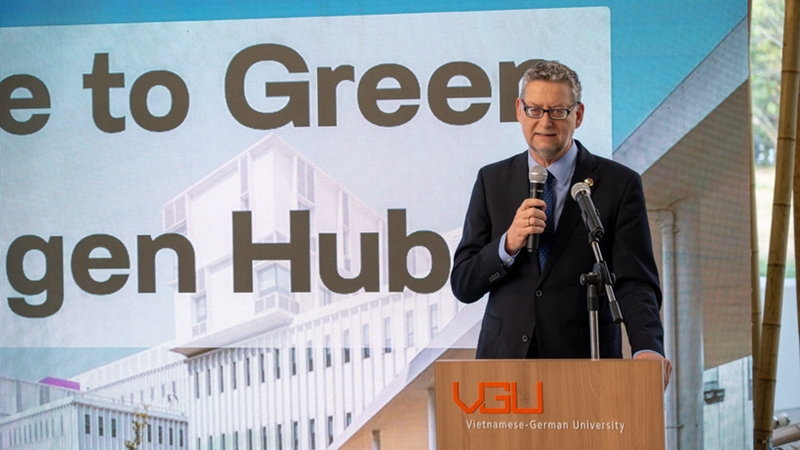
The German Agency for International Cooperation's Managing Director Thorsten Schäfer-Gümbel speaks at the working session with the Vietnamese - German University. |
The hub has been developed under a public–private partnership model within the H2Uppp program, an initiative to promote international hydrogen cooperation implemented by GIZ with funding from Germany’s Federal Ministry for Economic Affairs and Energy.
Professor René Thiele, President of the Vietnamese - German University, said sustainability is one of the institution’s core values, integrated across teaching, research and operations. As a provider of high-quality human resources for the energy and green growth sectors, VGU has been identified as an important academic partner in scientific, technological and innovation cooperation between Vietnam and Germany.
The Green Hydrogen Hub Vietnam aims to support the development of a green hydrogen economy through three main pillars: linking businesses with technology transfer, providing training and capacity building for the workforce, and demonstrating and testing advanced green hydrogen technologies. It is expected to serve as a nucleus for shaping a national hydrogen ecosystem and supporting Vietnam’s sustainable energy transition.
Speaking at the working session, Schäfer-Gümbel praised the strong commitment of Vietnamese partners to sustainable energy goals. He noted that the long-standing development cooperation between Germany and Vietnam is evolving, with energy transition emerging as a strategic area of collaboration in addressing global challenges.
According to Schäfer-Gümbel, green hydrogen plays a crucial role in achieving climate neutrality and reducing industrial carbon emissions. For a fast-growing economy such as Vietnam, it offers an opportunity to balance economic growth with environmental responsibility.
He stressed that international cooperation in green hydrogen is essential, requiring coordinated efforts in policy, technology, finance and innovation, with a focus on concrete and feasible projects.
The GIZ leader also suggested that the Green Hydrogen Hub Vietnam could act as a catalyst by connecting stakeholders, identifying priority applications and supporting the development of future hydrogen projects. While immediate results may not be expected, the hub will provide a space for learning, collaboration and innovation, gradually scaling up sustainable energy solutions.
Schäfer-Gümbel added that GIZ will focus on creating favorable conditions and policy frameworks for green hydrogen development, including strategic planning, capacity building, and strengthening confidence among state regulators and private investors. He also welcomed the active participation of German and Vietnamese businesses across the renewable energy value chain, from electrolysis technology to industrial applications and system integration.
Source: VNA