Lynetteholm is one of Denmark’s largest urban development and climate change adaptation projects. Located in the Copenhagen harbor area, facing the Øresund Strait, the project was approved by the Danish Parliament in 2021, with construction commencing in 2022. Covering an area of approximately 2.75 square kilometers (275 hectares), the project is expected to be fully completed by 2070.
The project aims to achieve three main objectives: protecting Copenhagen against the risks of rising sea levels, storms and flooding; developing a modern, green urban area capable of meeting housing needs for nearly 50,000 people and creating approximately 30,000 jobs; and expanding urban space while developing public transport, green infrastructure and coastal ecological areas.
    |
 |
|
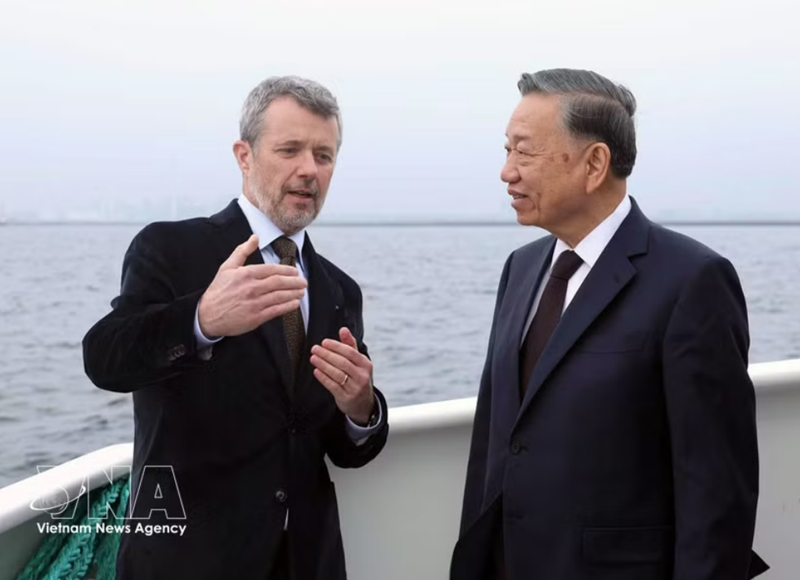
Danish King Frederik X briefs General Secretary of the Communist Party of Viet Nam Central Committee and President To Lam on the Lynetteholm artificial peninsula project during a boat trip to the site. |
Lynetteholm is considered a symbol of Denmark’s long-term vision of combining sustainable urban development with climate change adaptation, offering valuable lessons for Viet Nam’s coastal cities.
General Secretary and President Lam noted that Viet Nam has a long coastline, with many cities, economic zones and important infrastructure systems located in coastal areas and low-lying deltas. Rapid urbanization, together with the increasingly evident impacts of climate change, makes it necessary to bring about a strong shift in thinking on urban planning and development, as well as infrastructure development, towards greener, more integrated and more resilient approaches.
To create opportunities to expand development space, particularly towards the sea, Viet Nam has undertaken the restructuring and reorganization of administrative units at all levels. As a result, 21 of its 34 provinces and centrally-run cities now have coastlines.
This represents a major advantage for tapping the potential and strengths of the sea to promote socio-economic development in individual localities and throughout the country. This includes the establishment and development of urban areas and economic zones, seaport infrastructure and logistics systems, as well as other functional areas along the coast and offshore.
The General Secretary and President said that the experience of Lynetteholm showed that a climate change adaptation project could be designed to simultaneously create new development space, enhance coastal landscapes, generate ecological value and deliver socio-economic benefits.
This approach offers valuable lessons for Viet Nam as it studies solutions for coastal urban development and the protection of major economic centers against climate-related risks, he said.
The leader called on relevant agencies to exchange views and study the possibilities for cooperation and learning from Denmark’s experience, turning the discussions held during the visit into concrete cooperation programs suited to Viet Nam’s conditions.
Building on the strong foundation of Viet Nam-Denmark relations, particularly the similarities in their orientations towards green growth and sustainable development, General Secretary and President Lam expressed his confidence that cooperation between the two countries in urban planning, infrastructure development and climate change adaptation still holds considerable potential.
Source: VNA