The Port of Antwerp-Bruges is Europe’s second-largest port and a key hub for international trade and industry. It hosts around 1,400 companies and employs 162,000 people, contributing approximately 4.5% of Belgium’s GDP directly.
Formed in 2022 through the merger of the ports of Antwerp and Zeebrugge, the port has strengthened its position in global logistics chains and laid the groundwork for its development into a major European hub for logistics, industry and energy.
    |
 |
|
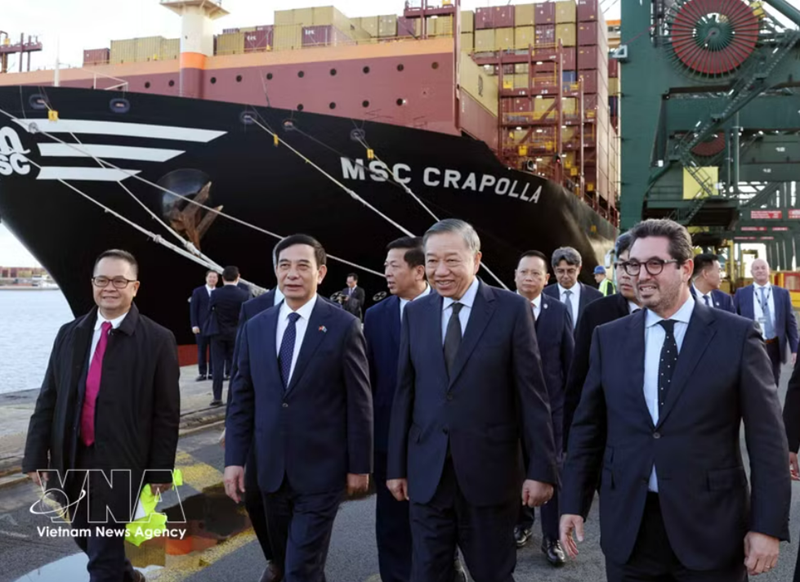
General Secretary of the Communist Party of Viet Nam Central Committee and President To Lam (second, right) and a high-ranking Vietnamese delegation visit the Port of Antwerp-Bruges on the afternoon of October 22 (local time). |
The port handles a diverse range of cargo, including containers, general cargo, breakbulk, dry bulk, liquid bulk and roll-on/roll-off (RoRo) cargo, as well as cruise passengers. It has particular strengths in breakbulk and steel cargo, serves as a major hub for vehicle handling and distribution, and is home to Europe’s largest integrated chemical cluster.
General Secretary and President To Lam expressed his sincere appreciation for the warm reception, goodwill and highly practical insights shared by the authorities of the Flanders region, Antwerp province, and the Port of Antwerp-Bruges, and Belgian partners with the Vietnamese delegation.
He emphasized that Belgium as a whole, and Flanders in particular, had long been close friends and partners of Viet Nam, with effective cooperation in maritime affairs, seaports, inland waterways and logistics. Flanders’ achievements and experience in port development, multimodal transport connectivity, logistics, digital transformation, green transition and human resource development were valuable lessons that Viet Nam was keen to learn from and exchange further experience on.
According to the General Secretary and President, maritime and waterway cooperation between Viet Nam and Flanders has been built up over decades on the foundation of the 1995 Friendship Agreement and cooperation documents signed by the two sides at various stages. In particular, regular training programs, professional exchanges and experience-sharing initiatives have served as important bridges connecting agencies, experts and businesses on both sides.
The Ministry of Construction and the Viet Nam Maritime and Waterway Administration have played an active role in maintaining and advancing this cooperation, particularly by advising on and coordinating annual training programs for Vietnamese officials, as well as participating in professional exchanges, workshops and experience-sharing activities on seaports, logistics, green ports and sustainable transport, the leader added.
These activities have not only strengthened professional capacity but also fostered mutual understanding, trust and lasting connections between the agencies and professional communities of both sides, he said.
General Secretary and President To Lam emphasized that these cooperation achievements were a valuable asset in Viet Nam-Flanders relations and should be further built upon in the new period.
Viet Nam is accelerating the development of a modern, integrated infrastructure system, with seaports and logistics playing a particularly important role in developing the marine economy, promoting trade and enhancing the economy’s competitiveness, the leader said.
He noted that Viet Nam aimed to develop a modern, green and smart seaport system; strengthen connections between seaports, inland waterways, railways and other modes of transport; and gradually improve integration with global supply chains and trade networks.
|
|
 |
|
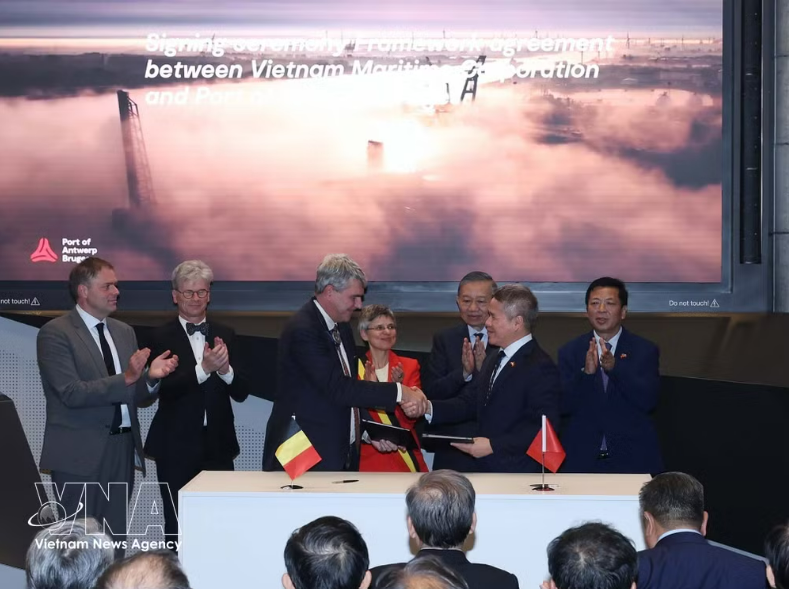
Party General Secretary and President To Lam witnesses the signing of a framework agreement between Viet Nam Maritime Corporation (VIMC) and the Port of Antwerp-Bruges. |
In this regard, Viet Nam hopes to deepen cooperation with Belgium and Flanders through concrete programs and projects that deliver tangible benefits to both sides, he said.
The General Secretary and President expressed confidence that stronger transport links would make it easier for Vietnamese goods to reach markets in Belgium and Europe, while facilitating access to Viet Nam for European goods, technologies, services and investment opportunities. This would enable transport infrastructure to serve as a true bridge for trade, cooperation and development.
Looking ahead, he called on the relevant agencies of both sides to make more effective use of existing cooperation frameworks and proactively explore new, concrete and long-term cooperation programs.
The two sides could focus on areas where their strengths complement each other and their needs align, including seaport planning and management, seaport connections with waterways and railways, logistics and supply chains, digital transformation, green port development, emissions reduction, and human resource development, he suggested.
Agencies, businesses and training institutions from both sides should continue to meet and exchange views more regularly, deepen mutual understanding and jointly explore concrete cooperation opportunities, the General Secretary and President continued.
These connections between people, businesses and specialized agencies will provide a sustainable foundation for long-term cooperation, he said.
The leader stressed that Viet Nam-Belgium relations had been built and nurtured over the years on the foundations of friendship, trust and mutually beneficial cooperation. Flanders and the Port of Antwerp-Bruges are important partners in this relationship, particularly in maritime affairs, seaports and logistics.
General Secretary and President To Lam expressed confidence that, building on the strong foundations of cooperation and their complementary strengths and potential, Viet Nam, Belgium and Flanders would usher in a new phase of deeper, more substantive and effective cooperation.
Viet Nam would remain a trusted friend and active partner of Belgium and Flanders, working together to strengthen connectivity, expand trade and deepen cooperation, while making practical contributions to the development and prosperity of both countries and to Viet Nam-E.U. relations, he affirmed.
On this occasion, General Secretary and President To Lam witnessed the signing of an agreement between Viet Nam Maritime Corporation (VIMC) and the Port of Antwerp-Bruges establishing a comprehensive cooperation framework to promote collaboration in maritime affairs, seaports and logistics, while strengthening trade links between Viet Nam and Belgium and Europe.
Under the framework agreement, the two sides will focus on exchanging information, sharing experience and exploring solutions to develop logistics gateways and strengthen trade and maritime connectivity between Viet Nam and Belgium and Europe. Key areas of cooperation will also include green and smart port development, the application of technology and digital transformation in port management and operations, and stronger multimodal transport links to improve supply chain efficiency and port competitiveness.
Later that afternoon, General Secretary and President To Lam visited the Royal Museum of Fine Arts Antwerp, the largest and oldest art museum in Flanders, which houses an invaluable collection spanning seven centuries of art history. The leader also attended a reception hosted by Antwerp Governor Cathy Berx.
Source: VNA