General Secretary and President To Lam, his spouse, and a high-ranking Vietnamese delegation will pay a state visit to Russia from September 7 to 9 at the invitation of Russian President Vladimir Putin.
    |
 |
|
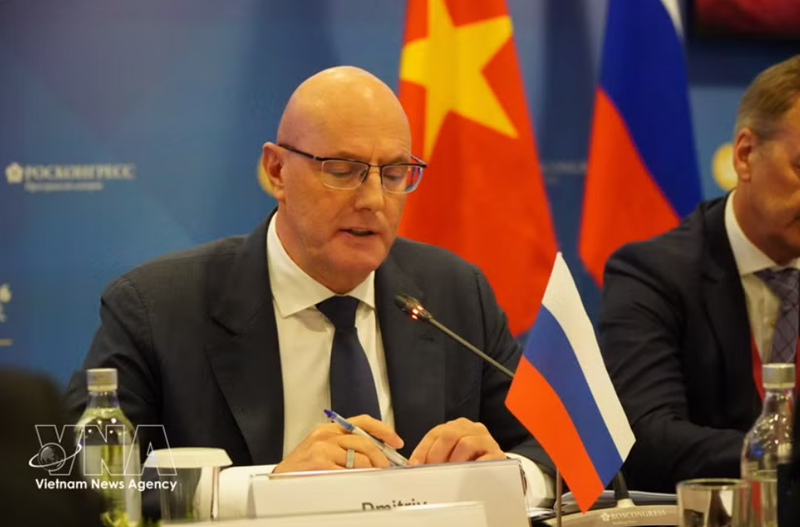
Russian Deputy Prime Minister Dmitry Chernyshenko |
In an interview with the Viet Nam News Agency, Chernyshenko, who is also head of the Russian section of the Viet Nam–Russia Intergovernmental Committee, cited President Putin as saying that Viet Nam is a longstanding and trusted partner of Russia.
The Deputy PM affirmed that bilateral relations are rooted in a longstanding tradition of friendship and mutual support.
Regular contacts and trust at the high level have played an important role, he said, adding a key milestone came in June 2024, when the two countries adopted a joint statement on further deepening their comprehensive strategic partnership, setting out new directions for cooperation in the years ahead.
This momentum continued in 2025, when President Putin held talks with General Secretary To Lam. Subsequently, 2026 was designated as the Year of Science and Education Cooperation between Viet Nam and Russia, an area that has long served to bring the two peoples closer together and where both sides have developed unique experience in cooperation.
Given this, General Secretary and President To Lam’s visit is an event of particular significance. It is not merely a continuation of the tradition of regular high-level contacts, but also an opportunity to inject fresh momentum into bilateral cooperation, from trade, economic, scientific and technological cooperation to people-to-people ties and education collaboration — areas that are at the forefront of the Year of Science and Education Cooperation.
Chernyshenko stressed that Russia and Viet Nam have long placed strong emphasis on scientific and educational dialogue.
The Viet Nam-Russia Committee on Educational, Scientific and Technological Cooperation is functioning effectively, while the Intergovernmental Committee on Trade, Economic, Scientific and Technical Cooperation meets regularly. The Joint Viet Nam–Russia Tropical Science and Technology Research Center serves as a leading platform for joint research, with its development strategy through 2035 already approved.
Chernyshenko said he believed there is still significant untapped potential for cooperation. He highlighted the need to expand funding for joint research and establish regular, planned calls for research proposals open to scientists from both countries. The official noted that the two sides had signed an inter-ministerial agreement in May 2025 to organize annual calls for joint research projects.
He also stressed the importance of strengthening academic exchanges and human-resource training, including for technical experts, through alliances among technical universities. In addition, the Deputy PM called for greater cooperation in high-tech and innovation fields, such as artificial intelligence, cybersecurity and renewable energy, which he said are increasingly shaping the technological development of both countries.
Chernyshenko emphasized the need to continue strengthening the institutional framework for cooperation among universities and research organizations in the two countries, adding that more than 500 cooperation agreements are currently in effect.
The Deputy PM said October will mark the 10th anniversary of the free trade agreement between Viet Nam and the Eurasian Economic Union (EAEU) taking effect.
The agreement’s transition period has ended and much of its potential to rapidly boost trade has already been tapped, the official said.
It is therefore important for the two countries to establish a new foundation for developing trade and investment cooperation, he stressed.
This was also reflected in the Russia–Viet Nam comprehensive cooperation plan through 2030, signed in 2025, which sets a target of raising bilateral trade to 15 billion USD.
The official said are promising areas for bilateral trade, while stressing the importance of looking beyond exports to expand technological and industrial cooperation. He noted that this would serve both Viet Nam’s interest in strengthening its technological sovereignty and Russia’s need to increase exports.
He identified energy and power engineering as the first area, describing it as a traditional field of cooperation between Russia and Viet Nam with potential far beyond existing projects. He said cooperation could extend beyond oil and gas to include power equipment, electricity grids, power generation, services and localized production.
Other areas include rail and metro transport, mining and mineral processing, agriculture and food production, pharmaceuticals and medical equipment, and digital technologies.
Chernyshenko also highlighted e-commerce as an area with significant potential. The official explained that Russia is currently among the world’s leaders in e-commerce development, with online marketplaces becoming one of the main channels for small and medium-sized enterprises to promote their products. In Viet Nam, e-commerce is also expanding at the fastest pace in Southeast Asia, averaging 15% to 20% annually.
Against this backdrop, promoting cooperation between e-commerce platforms in the two countries could significantly benefit Russian producers, he said.
He expressed confidence that the development of bilateral economic cooperation would further strengthen friendship and mutual trust between the two countries.
According to the Deputy PM, one area that is emerging as a foundation for deeper cooperation is nuclear energy. Russian universities are also involved in training engineers for Viet Nam’s nuclear industry. This academic year, the Vietnamese Government allocated 59 of its Russian Government scholarships to train nuclear industry specialists at Russian universities. Universities in Russia and Viet Nam are actively cooperating across a range of fields, including nuclear and hydrogen energy, renewable energy, power generation and electrical engineering, as well as aircraft manufacturing and information technology.
In addition, student exchanges, joint scientific and educational projects, youth forums and cultural programs help young people from the two countries better understand each other and build direct connections, which can later serve as a foundation for cooperation across a wide range of fields.
Twining relations between Hanoi and Moscow, Ho Chi Minh City and St. Petersburg and Vladivostok, and Da Nang and Yaroslavl, among others, play an important role in enhancing people-to-people ties.
Source: VNA