Japanese media have consistently highlighted the growing importance of economic security cooperation with Vietnam amid increasingly volatile regional and global conditions, viewing the country as a key link in advancing Japan’s Free and Open Indo-Pacific (FOIP) strategy.
    |
 |
|
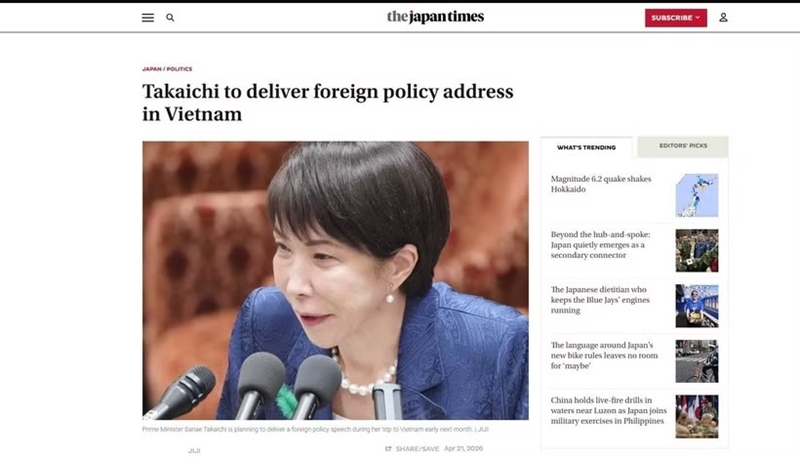
A screenshot of an article on Prime Minister Takaichi Sanae’s upcoming May 1-3 visit to Vietnam published by The Japan Times |
Major outlets including Kyodo News, NHK, Asahi Shimbun, Nikkei and The Japan Times agreed that the visit is not merely a routine diplomatic engagement, but carries strategic significance in restructuring supply chains and ensuring Japan’s energy security. This is particularly important as tensions in the Middle East, export control measures, and intensifying global technological competition create increasingly visible risks for Japan’s import-dependent economy.
Kyodo quoted Chief Cabinet Secretary Kihara Minoru as saying at a press conference that with regard to Vietnam, Japan hopes to reaffirm the strengthening of the two countries’ comprehensive strategic partnership, including in areas of economic security such as energy and critical minerals.
According to NHK and Asahi Shimbun, Kihara stressed that Vietnam stands out in Southeast Asia for its strong economic growth.
Japanese media noted that Vietnam is regarded as one of the fastest-growing economies in the region and holds a favorable geopolitical position that allows Tokyo to diversify supplies of strategic resources such as energy and critical minerals. This would help reduce dependence on a limited number of markets and strengthen Japan’s long-term economic resilience.
Japanese media also paid particular attention to the foreign policy speech PM Takaichi is expected to deliver in Vietnam, viewing it as an important milestone in renewing and adjusting the FOIP strategy after a decade of implementation since it was first introduced by the late Prime Minister Abe Shinzo. The shift is expected to place greater emphasis on practical priorities such as economic security, strategic autonomy and resilience against external shocks.
According to government sources cited by the press, PM Takaichi is expected to state in her speech that Japan will “renew” the FOIP diplomatic initiative, with a stronger focus on economic security, including strengthening supply chains for critical goods and expanding energy security.
Japanese media analyses suggested that this adjustment reflects a more flexible approach to adapting to a new international environment in which economic, technological and security factors are increasingly interconnected. It also signals Tokyo’s intention to strengthen its leadership role in the region by deepening cooperation with like-minded partners such as Vietnam and Australia.
Many reports also noted that choosing Vietnam as the destination for this working trip carries symbolic significance, reflecting Japan’s priority for Southeast Asia and affirming Vietnam’s increasingly important role in the regional architecture.
Asahi Shimbun also quoted Vietnamese Ambassador to Japan Pham Quang Hieu as stressing the need to strengthen cooperation among middle powers to avoid excessive dependence on major powers amid rising geopolitical competition, thereby creating a more balanced and stable space for cooperation. These assessments come as Vietnam pursues ambitious long-term growth goals and seeks to elevate its economic standing, with expectations that cooperation with Japan will help advance industrial development, technology and energy capacity.
Overall, Japanese media viewed PM Takaichi’s visit as a positive and strategic step, not only for deepening bilateral relations but also for reinforcing Japan’s role in shaping a rules-based regional order, in which Vietnam is seen as a central partner in building a sustainable and flexible economic-security cooperation network amid today’s global uncertainties.
Source: VNA