France’s AFP news agency underscored the congress’s pivotal significance, highlighting priorities for the next five years such as spurring the private sector, digital transformation and technological progress, and targeting annual economic growth of 10% or higher during the 2026–2030 period. AFP also noted that collective leadership remains a defining feature of Vietnam’s political system.
    |
 |
|
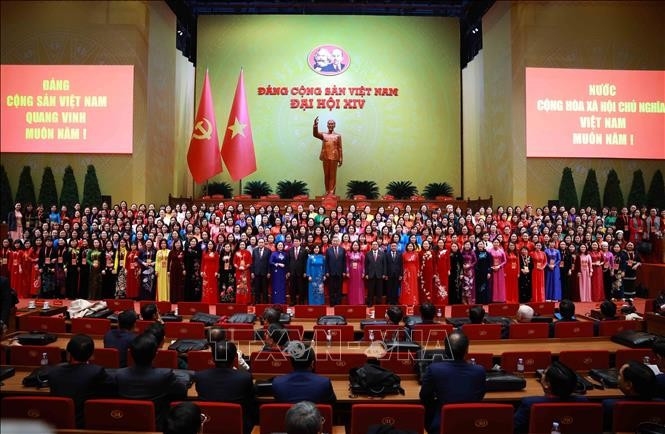
Party and State leaders pose for a group photo with female delegates attending the 14th National Party Congress. |
Meanwhile, the U.S.-based Associated Press (AP) reported on the landmark event, outlining its importance and the key issues set to be discussed by delegates.
The U.K.’s BBC emphasized that the 14th National Party Congress is the forum where the most consequential decisions of Vietnam’s political system for the next five years are made, spanning economic and foreign policies as well as personnel affairs.
The Financial Times (FT) observed that the congress is taking place as Vietnam, one of the world’s fastest-growing economies, adapts to global trade tensions and profound shifts in the international economic environment. According to the FT, the event comes at a crucial time for export-reliant Vietnam, an Asian manufacturing powerhouse adapting to global trade tensions and profound changes in the international economic environment. State apparatus reforms, an enhanced role for the private sector and the pursuit of double-digit growth were seen as reflecting the leadership’s efforts to realize Vietnam’s aspiration of becoming a developed nation by 2045.
From the perspective of economic prospects, China Daily described the 14th National Party Congress as being held at a time when Vietnam is emerging as a “growth bright spot” in Southeast Asia. Citing data showing GDP growth of over 8% last year, the highest in ASEAN, the paper noted that for the first time, the congress's documents place science, technology and innovation at the core of Vietnam’s national growth strategy for the next five years.
According to the international media, the 14th National Party Congress plays a decisive role in shaping Vietnam’s political and economic direction for the remainder of the decade. Large-scale administrative reforms, efforts to streamline the state apparatus and the push for infrastructure investment in recent years underscore a development approach that prioritizes rapid growth alongside security and political stability. Beyond its domestic political significance, the congress is being closely watched by the international community, with decisions and personnel choices expected to shape Vietnam’s development trajectory for the years to come amid both major opportunities and complex external challenges.
The 14th National Party Congress is attended by 1,586 delegates representing more than 5.6 million members of the CPV. It will discuss and adopt four key documents: the Political Report; the Report reviewing theoretical and practical issues over 40 years of Doi Moi (Renewal) process; the report summarizing 15 years of implementation of the Party Statutes; and the report reviewing the leadership and direction of the 13th Party Central Committee. A central task of the congress is the election of members of the 14th Party Central Committee.
Source: VNA