HIC is envisioned as a central “brain” connecting data, resources, policies, technology and culture to address urban development challenges, operate the national innovation ecosystem, promote a sustainable digital economy and digital society, improve the quality of life for local residents, and foster creative industries, particularly cultural industries linked to Hanoi’s identity.
    |
 |
|
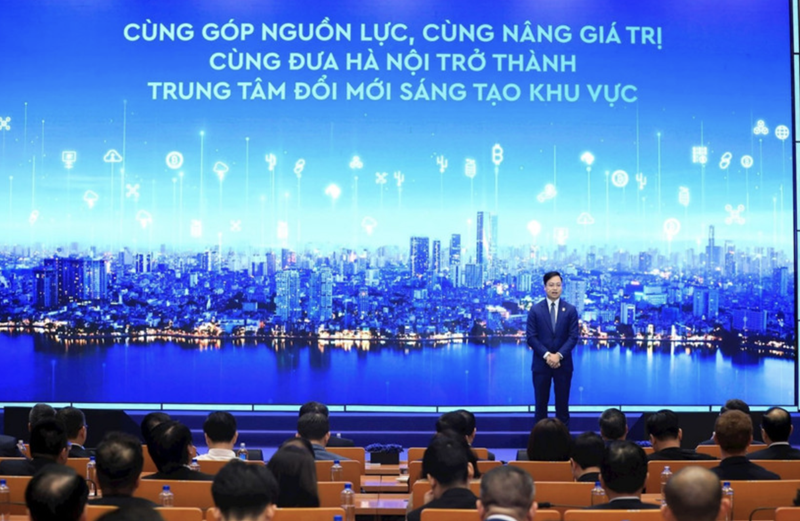
Tran Quang Hung, Chairman of the Board of Directors of HIC, presents the company’s operating model at the launch event. (Photo: hanoimoi.vn) |
The launch comes as Hanoi enters an accelerated digital transformation period, facing rapid urbanization while benefiting from a young population, a large market and strong capacity to absorb new technologies.
The center is expected to serve as a controlled testing ground for emerging technologies and new business models, and as a mechanism for shaping and implementing innovation initiatives, contributing to implementing the Politburo’s Resolution No.57-NQ/TW on breakthroughs in science and technology development, innovation and national digital transformation, as well as smart urban development programs.
It will help attract talent, international capital and technologies, creating an environment for young founders to grow and contribute to sustainable medium- and long-term growth.
Tran Quang Hung, Chairman of Board of Directors of HIC said the center will focus on supporting young innovators through computing infrastructure, data resources and experimental spaces; coordinating incubation activities and building value chains from ideas to commercialized products through technology marketplaces and platforms.
HIC’s clients will include not only Hanoi-based enterprises, but also ministries, sectors, localities and international partners, he said, adding that in the initial phase, HIC will prioritize the application of AI and big data to administrative reform and the improvement of public service quality.
HIC operates under a “triple-helix” cooperation model involving the State, academia and businesses, with founding partners including the Hanoi People’s Committee, Hanoi University of Science and Technology, and CMC Corporation. The model aims to better align research and policy with market demands, creating knowledge-based growth motivation.
Nguyen Trung Chinh, Chairman & Executive Chairman of CMC Corporation, said the establishment of HIC translates major policies on science, technology and private-sector development into concrete action.
He noted that drawing on more than three decades of technological development, CMC committed to supporting the effective operation of the center, helping position Hanoi as a regional innovation hub.
Vice Chairman of the municipal People’s Committee Truong Viet Dung said HIC follows a model in which the State sets direction while enterprises handle operations, with the aim of reorganizing the city’s innovation flows.
The capital city pledged to provide favorable mechanisms, infrastructure and resources for the center’s effective operation, he went on.
According to Lieutenant General Nguyen Thanh Tung, Director of the Hanoi Police, said that based on a licensed digital mapping system received in late 2025, the agency is working with HIC to develop a real-time integrated platform enabling location tracking and patrol coordination, while integrating images, video and GPS data to support remote command.
HIC has identified strategic priorities to mobilize public–private resources and foster new productive forces for the capital. The pilot of digital security ecosystem is seen not only as a technological advance but also as a modern urban governance solution, laying the groundwork for a smarter and safer Hanoi that better serves its residents.
The center is expected to help position the city as a leading destination for creative and cultural–technology industries in Asia, contributing to the goals of increasing the share of cultural industries in GDP under the development strategy to 2030, with a vision to 2045.
Source: VNA