This strategic shift, prompted by difficult export conditions and increasing trade defence measures, aims to capitalise on previously overlooked growth segments within the domestic market.
At the end of 2025, the strategy to realign focus towards domestic sales showed some effectiveness, illustrating how major companies managed to grow their domestic revenue.
    |
 |
|
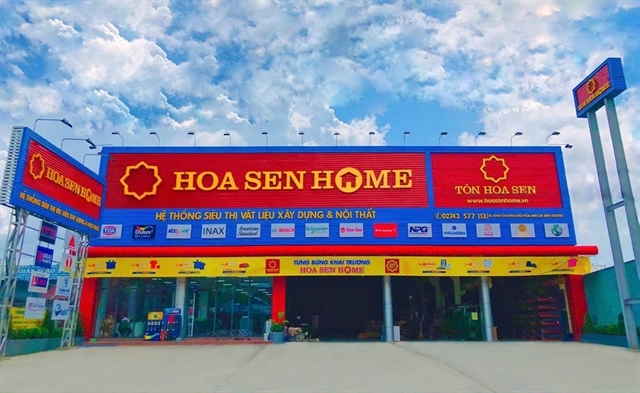
A store of Hoa Sen Group (Photo: hoasengroup.vn) |
However, this shift has also highlighted the downside: overall industry gross margins have contracted due to fierce competition, which is increasing pressure on selling prices and negatively impacting the financial results of numerous firms.
For instance, Nam Kim Steel JSC (NKG) reported a 21% increase in domestic revenue for 2025, amounting to nearly 8.83 trillion VND (340 million USD), with domestic sales now accounting for 59.2% of its total revenue.
Conversely, export sales plummeted by 54.7%, dropping to 6.07 trillion VND and comprising just 40.8% of total revenue, down from 64.8% at the year’s start. This substantial decline has led to an overall revenue drop of 28.1% for Nam Kim, with profit after tax falling by 56.5%.
In light of these challenges, Nam Kim Steel also reported a loss of 9.34 billion VND in the fourth quarter of 2025, marking the first quarterly loss after ten consecutive profitable quarters, underscoring the impact of domestic competition and lower selling prices.
The company has responded by cautiously managing its short-term assets, reducing inventory by nearly 1.39 trillion VND, while increasing long-term construction costs significantly, reflecting investments in new projects.
Similar trends are observed across other major firms.
Hoa Sen Group (HSG) reported an 18% revenue decline to more than 8.38 trillion VND, with profit after tax down 62.3%.
Conversely, Tien Len Steel Corporation (TLH) faced even steeper challenges, with a staggering revenue drop of 53.2% in Q4 2025, resulting in a quarterly loss after three profitable quarters.
Analysts at BIDV Securities noted a clear disparity in the financial results of steel companies in 2025, where trading firms continue to find themselves at the lower end of profitability as steel prices remain at the bottom of the cycle, compounded by weak export demand and trade barriers.
In response to the domestic market’s competitive pressures, companies like Nam Kim are aggressively expanding their production capacity.
In 2025 alone, Nam Kim Steel’s long-term construction costs jumped to 4.44 trillion VND, primarily for the new Phu My Steel plant, scheduled to start operations in Q1 2026. This new facility is expected to boost Nam Kim’s production capacity significantly.
However, the challenges are not limited to production capacities.
As competitors like VNSteel and Dong A Steel also expand their operations, the oversupply in the domestic market may hinder the industry’s return to equilibrium.
Mirae Asset Securities has also highlighted the potential limits on achieving a supply-demand balance in the face of simultaneous capacity expansions by leading companies.
As the market evolves, firms are faced with increased operating costs as new plants come online, which will directly impact profitability in the initial stages of operation.
The financial pressures may be exacerbated by rising depreciation expenses that are typically recorded in the profit and loss statements once the plants become operational.
Source: VNA