For central Khanh Hoa province, whose coastline stretches nearly 500 kilometers following its merger with neighboring Ninh Thuan, the vision provides fresh momentum to accelerate the marine economy in line with the Party's Resolution No.36-NQ/TW on the strategy for the sustainable development of Vietnam's marine economy to 2030, with a vision to 2045. The province aims to become one of the country's leading maritime economic hubs.
    |
 |
|
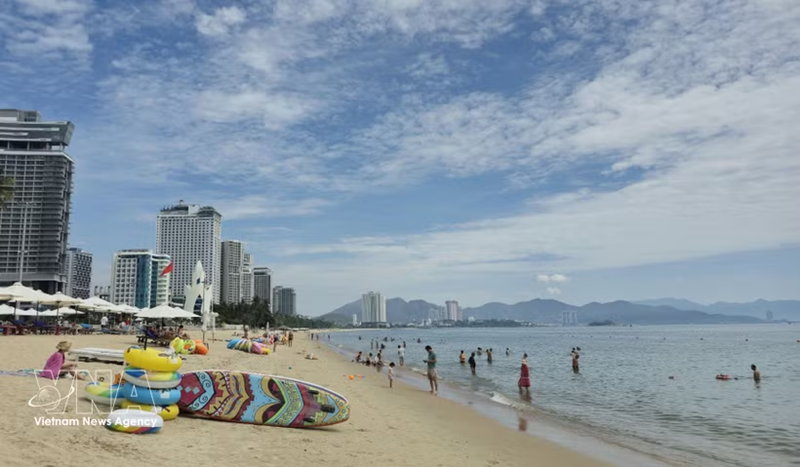
Tourists on Nha Trang beach in Khanh Hoa province |
Building prosperity from the sea
Located in the heart of the south-central coast and close to major international shipping routes, the newly expanded Khanh Hoa enjoys exceptional maritime advantages. Its coastline extends from Vung Ro Bay to Ca Na, encompassing four renowned bays – Nha Trang, Cam Ranh, Van Phong and Vinh Hy – as well as three deep-water seaports at Cam Ranh, Nha Trang and Ca Na.
The province is also home to more than 200 islands, including Truong Sa special zone, which has been designated to develop into Vietnam's national maritime economic and cultural center.
Khanh Hoa has positioned itself as the renewable energy industrial and service hub for the south-central and Southern regions. Its economic development strategy identifies four key growth drivers, all built on the foundation of the marine economy.
Marine and coastal industries now account for around 80% of its gross regional domestic product (GRDP), led by marine tourism, fisheries, shipbuilding, seaport and logistics services, and the energy sector. Aquatic exports alone contribute about 44.8% of the province's total export value.
The first Party Congress of Khanh Hoa for the 2025–2030 term reaffirmed that the province's development will be built on fully harnessing its marine potential, while integrating economic growth with national defense and security safeguarding.
Under its adjusted provincial master plan for 2021–2030, with a vision to 2050, Khanh Hoa aims to become one of Vietnam's major marine economic centers and a smart, environmentally friendly city with a distinctive identity and regional standing in Asia.
The province also aspires to rank among Asia's most attractive coastal destinations, supported by modern infrastructure, well-preserved marine ecosystems and secure maritime sovereignty, while serving as a model for balancing socio-economic development with defense and security.
Chairman of the provincial People's Committee Nguyen Viet Hung said that today, the sea opens up new opportunities for tourism, ports, logistics, high-tech aquaculture and renewable energy, he said.
Khanh Hoa has chosen to grow through the sea while remaining committed to preserving its blue environment. He said that vision will support Khanh Hoa's goal of becoming a centrally governed city by 2030 and an internationally recognized center for tourism, services and the marine economy.
Strengthening institutions for sustainable development
One of the four major issues highlighted by General Secretary and President To Lam at the opening of the Party Central Committee's third plenum on July 20 was the implementation review of Resolution No.36-NQ/TW, dated October 22, 2018, and the formulation of a new resolution on building Vietnam into a strong sea-based nation through a unified approach to territorial governance.
To implement the provincial Party Congress resolution, the Khanh Hoa Party Committee is drafting its own resolution on marine economy development to 2030, with a vision to 2045, positioning the marine economy as a strategic pillar of overall socio-economic development.
Drawing on its experience in implementing Resolution No.36-NQ/TW, the province has proposed a range of institutional reforms as well as special policies and mechanisms to help maximize its maritime potential.
Khanh Hoa has recommended maintaining the five guiding principles established under Resolution No.36-NQ/TW while adding greater emphasis on investment in coastal infrastructure. It has also called for revising development targets to reflect the goals set in the Resolution of the 14th National Party Congress and changes resulting from the recent administrative unit mergers.
The province has further proposed that central authorities update key national plans, including marine spatial planning, coastal resource management, national power development, seaport and provincial master plans, to align with the new administrative boundaries and provide a consistent framework for marine investment projects.
It has also urged the issuance of tailored policies to attract investment and promote marine industries based on the comparative advantages of each coastal locality.
Source: VNA