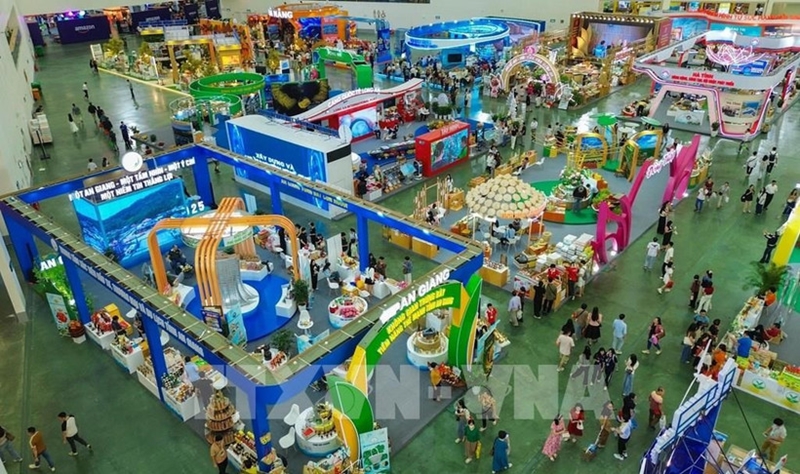
Organized on a large scale, with clearly structured exhibition zones and coordinated participation from ministries, localities and the business community, the fair is set to present a comprehensive picture of Vietnam’s production capacity, creativity and consumer market.
    |
 |
|
The National Spring Fair 2026 will take place at the Vietnam Exposition Center from February 2 to 8. |
A key highlight of the event will be the Vietnam International Exhibition on Textiles, Leather and Footwear, Furniture and Handicrafts Value Chain (VIVC 2026). Held under the theme “From Materials to Markets – One Completed Value Chain,” the exhibition will connect enterprises across upstream and downstream segments, from materials and design to manufacturing and distribution. The combination of business-to-business (B2B) and business-to-consumer (B2C) activities reflects a strategic shift towards strengthening entire value chains rather than promoting individual stages in isolation, thereby enhancing the ability of Vietnamese firms to integrate more deeply into global supply networks.
The proactive engagement of Vietnam’s trade offices overseas is also expected to contribute to the success of the fair. From mid-January, these offices have launched coordinated promotion and matchmaking efforts, inviting foreign partners to attend the fair as a gateway to Vietnam’s market, manufacturing capacity and investment environment.
From Japan, Quyen Thi Thuy Ha, head of the Vietnam Trade Office branch in Osaka, said her office moved quickly to draw up plans to organize delegations of Japanese companies once official information about the fair was released. She noted that Vietnamese goods currently account for only around 3–5% of Japan’s total import-export turnover, pointing to significant growth potential.
She added that for the textile and footwear sectors, free trade agreements such as the Comprehensive and Progressive Agreement for Trans-Pacific Partnership (CPTPP) and the Regional Comprehensive Economic Partnership (RCEP) offer advantages in rules of origin through regional input sourcing, helping improve the competitiveness of Vietnamese products in the Japanese market.
Do Ngoc Hung, trade counsellor and head of the Vietnam Trade Office, said the four Vietnamese trade offices in the U.S. are coordinating closely to promote the fair and attract U.S. businesses. Participation is being selected carefully, with priority given to sectors such as textiles, footwear, furniture and handicrafts, where mutual demand and capacity align, he added.
Alongside overseas outreach, domestic businesses are also placing high expectations on the Spring Fair 2026. Many see it as a key platform to showcase production capabilities, introduce products, seek partners and expand export markets, amid growing pressure to move up the value chain and strengthen Vietnamese brands.
Dang Thi Tuoi, director of external relations at CT Group, said the group plans to present a range of core technologies developed in-house, including drones, semiconductors, artificial intelligence and quantum computing, as well as solutions for new energy, green digital currencies and carbon credit trading. She said the fair is not merely an exhibition space but an opportunity for Vietnamese enterprises to demonstrate a shift from contract manufacturing to mastering technology, design and value chains under the “Made by Vietnam” imprint.
Sharing similar expectations, Nguyen Ba Doan, sales director of the Viet Han High-Tech Manufacturing Plant, said the fair would serve as a hub for production and trade linkages between domestic firms and international partners.
Source: VNA