This presents significant opportunities for Vietnamese exports. However, experts noted that translating potential into tangible gains requires businesses to meet standards and adopt well-defined market strategies.
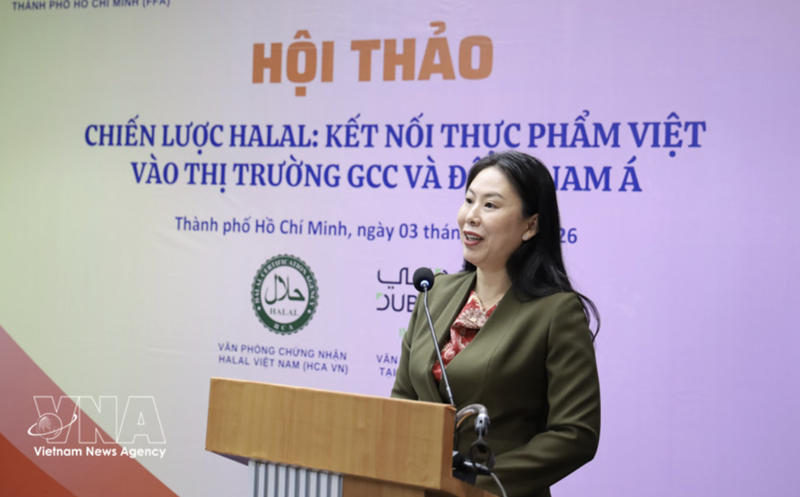
The assessment was shared at a seminar on a Halal strategy to connect Vietnamese food to the Gulf Cooperation Council (GCC) and Southeast Asian markets, jointly organized by the Ho Chi Minh City Investment and Trade Promotion Center and the Food and Foodstuff Association of Ho Chi Minh City on April 3.
    |
 |
|
Deputy Director of the Ho Chi Minh City Investment and Trade Promotion Center (ITPC) Ho Thi Quyen addresses the seminar on April 3. |
ITPC Deputy Director Ho Thi Quyen said the global Muslim population has surpassed 1.9 billion, accounting for roughly 25% of the world’s total. About 63% of Muslim consumers regularly use Halal products, with the GCC and Southeast Asia emerging as key markets with strong demand. Notably, Halal consumption is expanding beyond Muslim consumers, driven by the strict standards on food safety, traceability and ethical production.
Despite this potential, she noted, Vietnamese participation in the Halal market remains limited. Currently, only about 0.2% of Vietnamese enterprises have Halal-certified products, with fewer than 1,000 certified firms nationwide. Many businesses still face challenges in accessing information, certification systems and market strategies. Moreover, Vietnam’s Halal exports largely consist of raw or semi-processed goods with relatively low added value.
Truong Xuan Trung, Vietnam’s Trade Counsellor in the UAE, estimated the global Halal economy at around 5 trillion USD, potentially reaching 10 trillion USD by 2028. The Middle East, particularly GCC countries, plays a central role, with food imports accounting for up to 85–90% of demand, offering substantial room for exporters like Vietnam.
Beyond food, the Halal ecosystem is rapidly expanding to pharmaceuticals, cosmetics, fashion, packaging, finance, and logistics. Emerging segments such as Halal fashion and eco-friendly packaging are projected to reach hundreds of billions of dollars in the coming years.
The Comprehensive Economic Partnership Agreement (CEPA) between Vietnam and the UAE, effective from February 3, 2026, is expected to eliminate tariffs on 99% of Vietnamese goods, creating a significant competitive advantage. In addition, the UAE’s strategic location and advanced logistics infrastructure offer a gateway for Vietnamese firms to access broader markets across Asia, Europe and Africa, added Trung.
In Southeast Asia, where more than 40% of the population is Muslim, the region serves as both a major export destination and a strategic springboard for deeper integration into global Halal supply chains, according to Nguyen Thi Ngoc Hang, Marketing Director of the Halal Certification Agency Vietnam.
Ly Kim Chi, President of the Food and Foodstuff Association of Ho Chi Minh City, emphasized that Vietnamese enterprises need comprehensive preparation to move up in the Halal value chain, including improving compliance with certification standards, investing in production processes, building brands and enhancing competitiveness. Strengthening partnerships with trade promotion agencies, certification bodies and international organizations is also critical to minimizing risks and optimizing opportunities.
Trung highlighted the rise of the “green Halal” trend, which prioritizes plant-based products, biodegradable packaging and carbon reduction. To succeed, businesses must invest in dedicated production lines, localize products to meet cultural preferences and diversify market access channels, including both retail systems and e-commerce platforms.
Source: VNA