Growth momentum spreads across sectors
According to the Ministry of Agriculture and Environment, agro-forestry-fishery export turnover in February was estimated at 4.71 billion USD, down 28.4% from the previous month due to seasonal factors but still up 1.9% year-on-year.
In the first two months, total export value reached approximately 11.3 billion USD, marking a 17.1% increase compared with the same period last year. China, the US and Japan remained Vietnam’s largest export markets, accounting for 22.9%, 18.7% and 7.2% of market share, respectively.
    |
 |
|
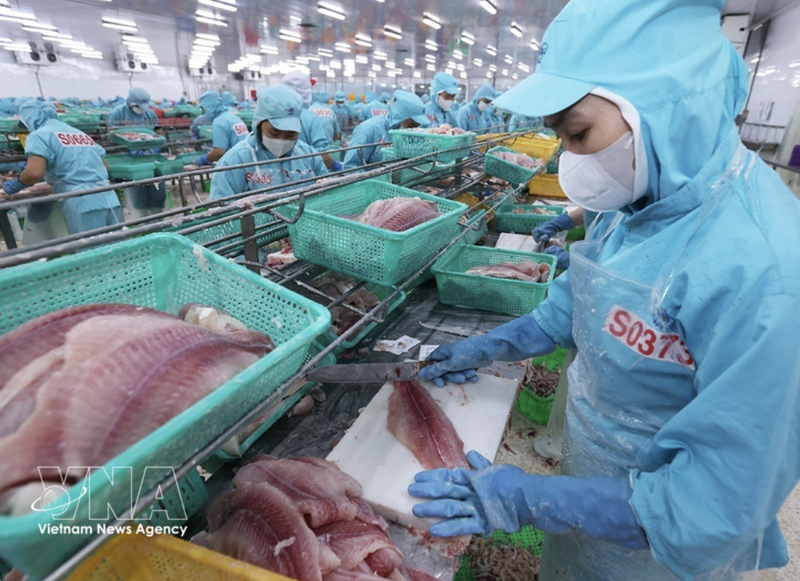
Workers process pangasius fillet for export at Sao Mai Group's factory in An Giang province. |
Export structure data shows relatively balanced recovery across commodity groups. Agricultural products continued to lead with 6.09 billion USD, up 17.1%; fishery exports reached 1.76 billion USD, rising 23.3%; and forestry products totaled 2.82 billion USD, up 7.4%.
Notably, smaller sectors recorded remarkable growth. Livestock product exports hit 140.7 million USD, surging 84.3% year-on-year – the fastest pace among all sectors. Exports of agricultural production inputs rose 51.7%, while salt exports soared 69%.
These figures indicate that export recovery is no longer concentrated in traditional key commodities but is expanding across multiple segments of the agricultural value chain.
Growth has been driven by many factors. Demand in major markets has gradually recovered following a period of global tightened consumption, while Vietnamese enterprises have become more proactive in organizing contract production, improving product quality and expanding export markets.
Exports face trade and transport headwinds
Deputy Minister of Agriculture and Environment Tran Thanh Nam said the positive results recorded in the first two months signal market recovery, providing a favorable foundation for expanding production and markets and striving toward the 2026 export target of 73–75 billion USD.
Nevertheless, significant risks remain, particularly non-tariff barriers, trade defense measures and complex geopolitical developments that could affect transport, payment systems and global trade flows.
Industry associations warned that geopolitical tensions in the Middle East pose a notable risk. According to the Vietnam Association of Seafood Exporters and Producers (VASEP), fishery exports are especially vulnerable to supply chain disruptions.
Le Hang, VASEP Deputy General Secretary, noted that the Middle East crisis could have impacts at both regional and global levels. Regionally, rising freight and insurance costs may increase import prices and cause temporary shortages of fresh products. Globally, impacts will depend on how long tensions persist. If the situation stabilizes quickly, supply chains could recover relatively fast. However, prolonged instability may keep logistics and maritime insurance costs elevated for months.
Recent geopolitical fluctuations are also affecting the fruit and vegetable sector. Dang Phuc Nguyen, General Secretary of the Vietnam Fruit and Vegetable Association, said the Middle East tensions are creating three major pressures – sharply rising transport costs, longer delivery times and increased payment risks.
Freight rates for 40-foot containers to major markets such as Europe and the US have risen two to three times compared to normal levels, in some cases exceeding 5,000 USD per FEU. Shipping times on certain routes have extended by 10–15 days as vessels adjust routes, posing risks to product quality and increasing preservation costs for perishable fresh produce, he noted.
Strengthening resilience of export supply chains
To sustain export growth, the Ministry of Agriculture and Environment plans to implement synchronized solutions. Deputy Minister Nam stressed that management directions must move beyond market expansion or price advantages toward proactive forecasting and scenario planning to respond to international trade volatility.
He also called on associations, businesses and banks to strengthen coordination and share information early to enable timely policy responses and avoid disruptions caused by sudden market changes.
Nguyen recommend diversifying transport routes, securing stable freight contracts, prioritizing safe payment methods, purchasing war risk insurance and expanding deep processing to reduce dependence on fresh exports. He also urged government support through logistics cost reductions, appropriate credit policies and better utilization of free trade agreements.
For aquatic product exporters, Hang stressed the need to diversify shipping routes, increase cold-storage reserves and prioritize long-term shipping contracts. Effective transport risk management and insurance will be key to maintaining stable export supply chains amid growing global uncertainty, particularly risks surrounding strategic chokepoints such as the Strait of Hormuz.
Source: VNA