The program aims to identify and support youth-led solutions to real-world community challenges across the country. Through the initiative, young innovators will receive support to develop their ideas, test their solutions in real-life settings, and create lasting, positive impacts for society.
    |
 |
|
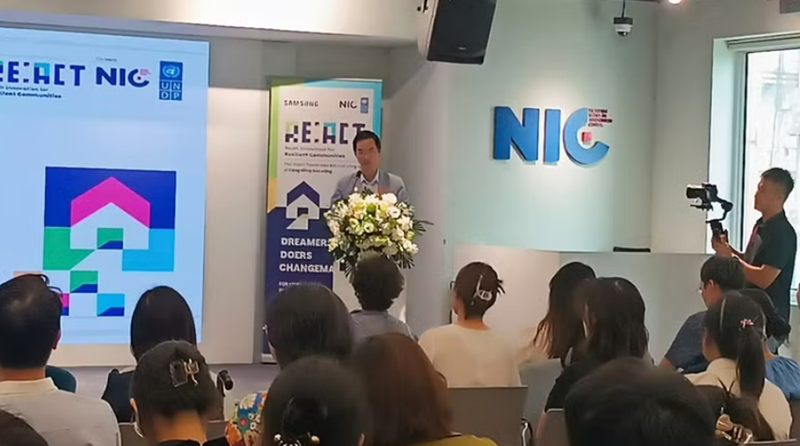
Deputy Director of the Vietnam National Innovation Center (NIC) Do Tien Thinh speaks at the launch of RE:ACT in Hanoi on August 7. (Photo: NIC) |
Unlike conventional idea-based competitions, RE:ACT focuses on deploying solutions that have already reached the minimum viable product stage through Living Labs – community-based pilot environments where innovations are tested under real-world conditions.
At the launch, NIC Deputy Director Do Tien Thinh said that as Vietnam speeds up science – technology development, innovation, and digital transformation, it is important to create practical ways to turn innovative ideas into real-world applications.
He stressed young people are the driving force behind innovation and that the program is designed to move beyond paper-based competitions by bringing solutions directly into communities through the Living Labs model, helping prevent promising ideas from becoming "shelved projects".
As the agency responsible for promoting Vietnam's national innovation ecosystem, NIC expects RE:ACT to support youth-led initiatives throughout the entire innovation journey – from identifying problems and generating ideas to developing prototypes, piloting them in real-world settings, and refining them for practical application, Thinh said.
Participating teams will focus on solutions in two key areas: inclusive economy, including bridging the digital divide and supporting people with disabilities, and sustainable community development such as energy conservation, safe chemical management, and the circular economy.
Following the application period, which runs until September 15, organizers will select 20 teams to join a six-month mentoring and pilot program. In addition to receiving grants of up to 15,000 USD per team, participants will benefit from monthly mentoring by technology experts and access to a network of partner organizations.
As the initiator and implementing partner of RE:ACT, UNDP in Vietnam remains committed to promoting people-centered innovation for sustainable development while ensuring that no one is left behind, said Francesca Nardini, Deputy Resident Representative at UNDP Vietnam.
Pham Thu Trang, UNDP Vietnam's National Youth Coordinator, noted that alongside the pilot phase, representatives of the most outstanding teams will join a study visit to the Republic of Korea's innovation ecosystem in February and March 2027.
Trang said the greatest value for participating start-ups lies not only in the seed funding of up to 15,000 USD, but also in the opportunity to connect with a network of experts who can help bring their products into practical use.
Eligible teams would have one to five members, with founders, co-founders, or key members aged between 18 and 35, and at least one founding member being a Vietnamese citizen. Entries will be assessed against six criteria: relevance to community needs, solution readiness, technology and innovation, impact potential, feasibility, and team capability.
Source: VNA