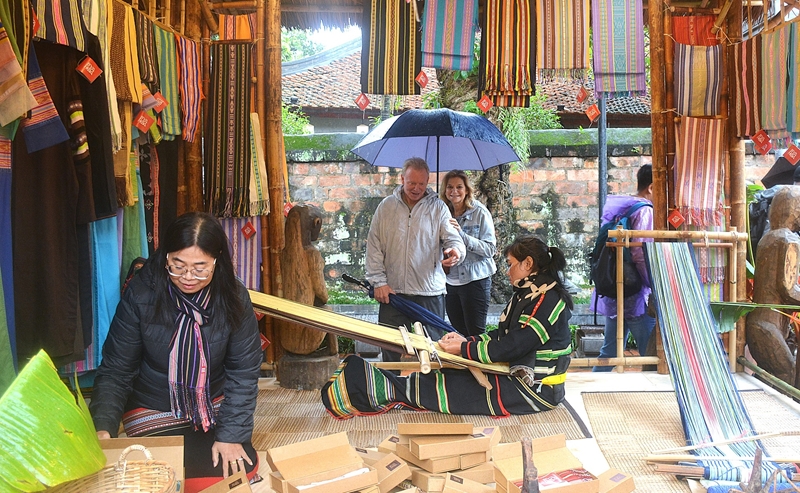
Amidst the lively atmosphere, visitors must listen carefully to catch the rhythmic clacking of wooden looms. Right at the entrance to the exhibition area, the sight of M’nong women dressed in traditional attire, patiently weaving fabric by hand, immediately draws attention and curiosity. With swift and skillful movements, they spin each thread evenly and interlace each strand with care, gradually forming patterns that are unmistakable characteristic of the Central Highlands.
    |
 |
|
The exhibition space for traditional M’nong weaving products at the Temple of Literature - Quoc Tu Giam |
According to Hbo Hmok from Lien Son Lak commune, Dak Lak province, the uniqueness of M’nong brocade lies in its strong visual and artistic quality. The textiles are often vivid in color and expressive in composition, resembling spontaneous paintings rather than simple decorative designs. Set against a black fabric background are bold color blocks of white, yellow, and red, repeated and interwoven with lively motifs. Alongside traditional patterns, such as opposing triangles, wave shapes, images of birds and animals, and elements of grass and trees, the M’nong also incorporate symbols from modern life, including guns, airplanes, flower vases, and commemorative lettering. Each motif carries meaning related to nature and humanity, reflecting daily life as well as the cultural identity and beliefs of the people of the Central Highlands.
As visitors admire the wide range of brocade products on display, such as clothing, scarves, bags, and accessories, few realize that this traditional craft has only recently been revived. In modern life, traditional M’nong attire is rarely worn, and the number of people practicing brocade weaving has steadily declined. As a result, many original patterns have gradually disappeared.
The revival of the M’nong weaving craft has been strongly supported by H’Kim Hoa Bya, former Head of the Mass Mobilization Commission of the Dak Lak Provincial Party Committee. During a working trip to Le village in 2023, she saw M’nong women working diligently at their looms and was determined to help restore the traditional craft. She worked with local authorities to arrange a community house as a shared weaving space, invited artisans to pass on their skills, and provided support for weaving materials.
After careful consideration of how to sustain the craft and find markets for the products, H’Kim Hoa Bya introduced innovations in materials. Instead of wool yarn, she encouraged the use of silk, bamboo fiber, and coffee fiber. These new materials, combined with traditional motifs, help create products that retain a strong M’nong identity while becoming softer, more durable, and more suitable for practical use in daily life.
M’nong brocade products presented at the Thang Long–Hanoi Festival 2025 attracted considerable attention from both domestic and international visitors. Many foreign guests expressed admiration for the beauty of the products and for the craftsmanship and cultural depth they represent. Through this exhibition, the artisans aimed to convey a clear message that every detail woven into a brocade textile tells a story of ethnic culture, and these stories deserve to be preserved, shared, and passed on to future generations so that traditional crafts can continue to thrive.
Translated by Tran Hoai