Trung highlighted ASEAN’s centrality as the foundation for bringing together EAS leaders to engage in frank dialogue on strategic issues, manage differences, build trust and seek common interests.
    |
 |
|
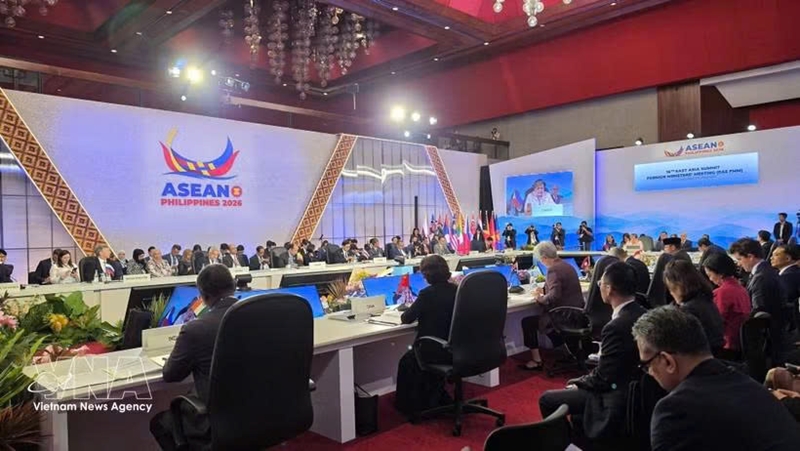
An overview of the 16th EAS Foreign Ministers’ Meeting |
On peace and security, he stressed the importance of maintaining peace and stability and upholding international law and commonly accepted norms of conduct across all regions, including the East Sea. He also commended the Philippines, as ASEAN Chair, for its regular consultations and close coordination with other member states in formulating timely common responses to urgent situations and crises.
Regarding the East Sea (aka South China Sea), the Vietnamese representative reaffirmed that all parties should continue exercising restraint, remain committed to resolving disputes through peaceful means, and respect diplomatic and legal processes in line with international law, including the 1982 United Nations Convention on the Law of the Sea (UNCLOS).
At the meeting, held within the framework of the 59th ASEAN Foreign Ministers’ Meeting (AMM-59) and related meetings, the participating ministers reaffirmed the EAS’s role as a forum for leaders to discuss strategic issues and advance cooperation in political-security and economic areas of common interest. They welcomed positive progress in implementing the EAS Plan of Action 2024–2028, particularly in priority areas such as peace and security, sustainable development, climate change, energy, digital transformation, the digital economy, connectivity, education, health care, disaster management, food security, maritime cooperation and tourism.
In the context of an increasingly complex and unpredictable regional and global landscape, ministers agreed to further strengthen the EAS as an open, transparent and inclusive forum that contributes to promoting multilateralism, upholding international law, maintaining a peaceful, stable and predictable environment and enhancing practical cooperation in line with the EAS’s objectives and principles as well as ASEAN priorities. They also agreed to continue improving the EAS’s effectiveness to ensure the mechanism remains relevant and strengthens its resilience and adaptability.
Ministers underscored the importance of enhancing dialogue, building trust, narrowing differences, and expanding practical cooperation to address emerging challenges, including maritime security, cybersecurity, transnational crime, particularly cybercrime and online scams. They reaffirmed support for an open, rules-based multilateral trading system and called for stronger cooperation to enhance the region’s resilience through collaboration in digital transformation, the circular economy, green growth, connectivity, sustainable supply chain development, and ensuring energy and food security. They also stressed the need to deepen cooperation in education, health care, mental health, disaster management, human resources development, and the empowerment of women, youth and vulnerable groups.
The meeting devoted considerable time to discussing regional and international issues of common concern, including the East Sea, Myanmar, the Korean Peninsula and the Middle East.
Recognizing the East Sea’s strategic importance as a vital international maritime route, the ministers reaffirmed the need to maintain peace, stability, security, safety, and freedom of navigation and overflight in accordance with international law, particularly UNCLOS 1982. They called on all parties to restrain, avoid actions that could complicate the situation or lead to misunderstanding and miscalculation, and address disputes peacefully in accordance with international law, including UNCLOS. Participants also noted the progress of ASEAN-China negotiations on a Code of Conduct in the East Sea (COC) and expressed hope that the code would be substantive, effective and consistent with international law, especially UNCLOS.
Source: VNA