Speaking at the event, Ngo Quang Hung from the Vietnam Trade Office in Malaysia said Malaysia remains Vietnam’s largest trading partner in the Association of Southeast Asian Nations (ASEAN), with two-way trade hitting 7 billion USD in the first four months of 2026.
He noted that the strong trade momentum puts both countries on track to realize the 20 billion USD bilateral trade target set by their Prime Ministers during talks late last year.
    |
 |
|
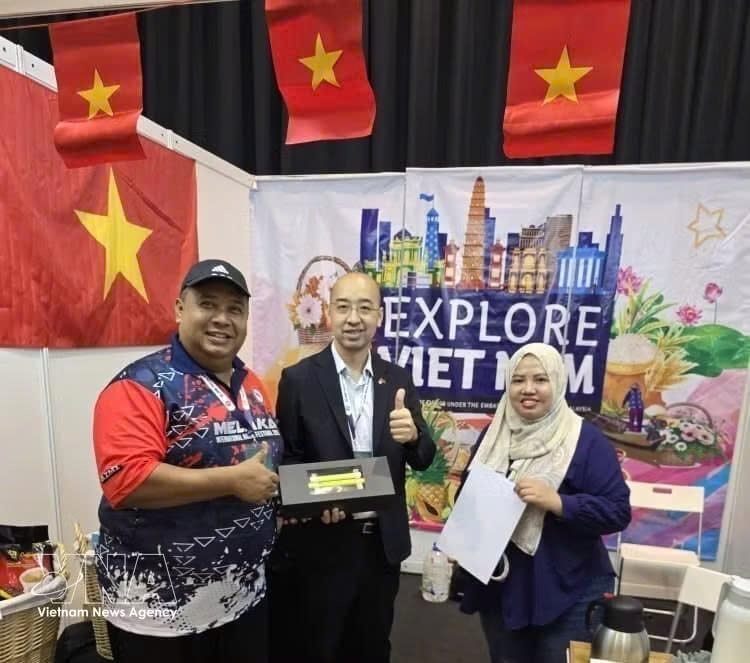
Ngo Quang Hung, representative of the Vietnam Trade Office in Malaysia, introduces Vietnamese products at the Melaka International Halal Fair, held from May 16-19, 2026. |
Hung stressed that the two economies are highly complementary, with Vietnam excelling in agricultural produce, seafood, processed food and textiles, while Malaysia has strengths in manufacturing technology, chemicals, logistics and the Halal sector.
Focusing on regional supply chains, Hambali Mukhlas, Vice Chairman of the Vietnam Malaysia Business Association (VMBIZ), said ASEAN nations must build more resilient value chains amid geopolitical tensions and rising logistics costs.
He said closer strategic coordination among ASEAN members would help create stronger, more competitive regional supply networks capable of competing globally.
Hambali also pointed to the strong potential for cooperation between Vietnam’s agricultural resources and Malaysia’s established Halal certification system and logistics capabilities to tap deeper into the global Muslim market.
He added that Malaysia is paying close attention to Vietnam’s Doi Moi (Renewal) reforms, particularly in land policies, rice production technologies and seafood industry development, as both sides seek to expand practical cooperation.
Meanwhile, Suneil Dutt Sharma, Secretary-General of the International Society for Small and Medium Enterprises (ISSME), described SMEs as the driving force of the global economy, accounting for more than 90% of businesses worldwide and generating over half of global jobs.
He said SMEs must evolve into “smart enterprises” integrated into global value chains and capable of leading green growth and circular economy transformation.
According to Sharma, this transformation should be built on five pillars: digital transformation, innovation and research, deeper regional integration, adherence to ESG and sustainability standards, and stronger partnerships linking governments, academia and businesses.
He also commended Vietnamese firms for their adaptability, highlighting their rapid digitization and increasing competitiveness in global manufacturing markets.
Participants at the forum agreed that stronger trade promotion and business cooperation would help drive the Vietnam–Malaysia economic partnership forward, especially in digital economy development, green industries and sustainable supply chains, while contributing to ASEAN’s long-term prosperity.
Source: VNA