The event brought together Thai Deputy Minister of Foreign Affairs Vijavat Isarabhakdi, leaders of the Thailand-Viet Nam Business Council (TVBC), the Association of Vietnamese People in Thailand, the Federation of Thai Industries, the Thai Chamber of Commerce, as well as business leaders, enterprises and scholars from both countries.
In his opening remarks, Vietnamese Ambassador to Thailand Pham Viet Hung stressed that the elevation of bilateral ties to a Comprehensive Strategic Partnership in May 2025 has provided fresh impetus for deeper cooperation.
    |
 |
|
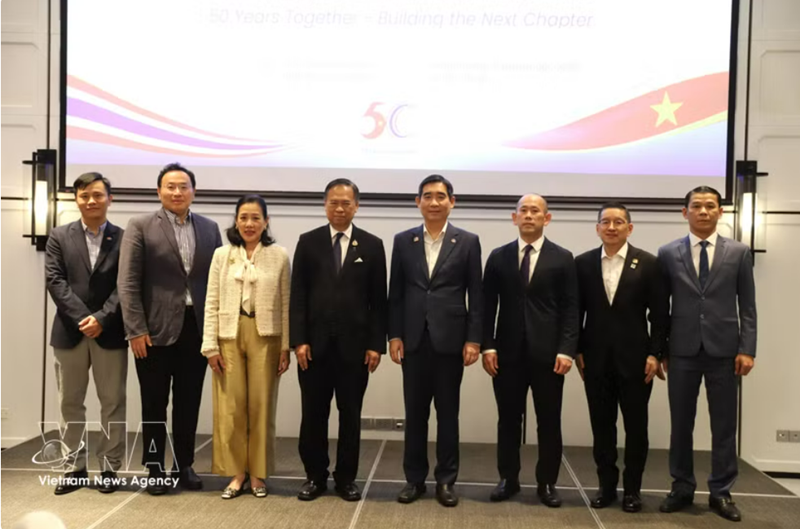
Vietnamese Ambassador to Thailand Pham Viet Hung (fourth from right) and Thai Vice Minister for Foreign Affairs Vijavat Isarabhakdi (fourth from left) pose for a group photo with delegates at the seminar. |
Describing economic, trade and investment cooperation as key pillars of bilateral relations, he said the focus should no longer be solely on investment scale, but also on building sustainable links between businesses and supply chains to strengthen the resilience of both economies against global uncertainties.
Thai Vice Minister for Foreign Affairs Vijavat Isarabhakdi highlighted the importance of translating the Comprehensive Strategic Partnership into concrete outcomes through the “Three Connects” strategy, which aims to fully tap the complementary strengths of the two economies.
The first pillar focuses on supply chain connectivity through transport infrastructure, logistics and cross-border transport via Laos, as well as high-value-added industries such as aircraft maintenance, information technology, artificial intelligence (AI) and semiconductors.
The second aims to strengthen local economic connectivity, building on a network of 20 twinning agreements and around 250 direct flights between the two countries each week. Notably, Thai Airways is scheduled to launch the Bangkok-Da Nang route on December 1, 2026.
The third focuses on linking sustainable development strategies, the digital economy and cross-border finance. Notable examples include 37 renewable energy projects by Thai investors in Viet Nam, with a combined investment of approximately 2.64 billion USD, and the bilateral QR code payment system.
During the discussion session, speakers from the TVBC, Thammasat University and the business community shared practical perspectives on bilateral cooperation. A TVBC representative highlighted considerable potential for collaboration in developing supplier networks and applying AI, digital trade and green trade across the automotive, energy and agro-food sectors.
Meanwhile, a Thammasat University expert noted that, with ASEAN attracting 244 billion USD in foreign investment, Viet Nam and Thailand should move beyond competition towards closer coordination to optimize resources, promote technology transfer and workforce training, and jointly strengthen their competitiveness.
From a business perspective, Nguyen Van Phuoc Linh, General Director of FPT in Thailand and Taiwan (China), shared experience from cooperation between FPT and Thailand's C.P. Group in applying AI and the Internet of Things (IoT) to agricultural and food value chains. The partnership demonstrates how Viet Nam's technological capabilities can be effectively combined with Thailand's manufacturing strengths.
Similarly, a representative of Kim Long Motor outlined the company's transformation roadmap in Thailand, which began in May. The plan involves moving from exporting completely built-up vehicles to assembling vehicles from synchronised component sets, with a localisation target of more than 50%. The company aims to establish Thailand as a strategic manufacturing and export hub in ASEAN during 2027-2030.
Alongside in-depth discussions on policies and investment opportunities towards the goal of raising bilateral trade to 25 billion USD, the seminar also provided an open and constructive platform for businesses and scholars from both countries to build trust and mutual understanding, paving the way for more substantive progress in the next phase of bilateral development.
Source: VNA