Captive breeding meets soft-release rewilding
The park has kicked off a large-scale wildlife rewilding push in its core zone, the first move in a long-term nature restoration strategy, with full technical backing from Save Vietnam’s Wildlife (SVW).
The release of spotted deer and other deer species marks the start of an ecological restoration effort designed to repair weakened links in the natural ecosystem, the park’s representative said.
    |
 |
|
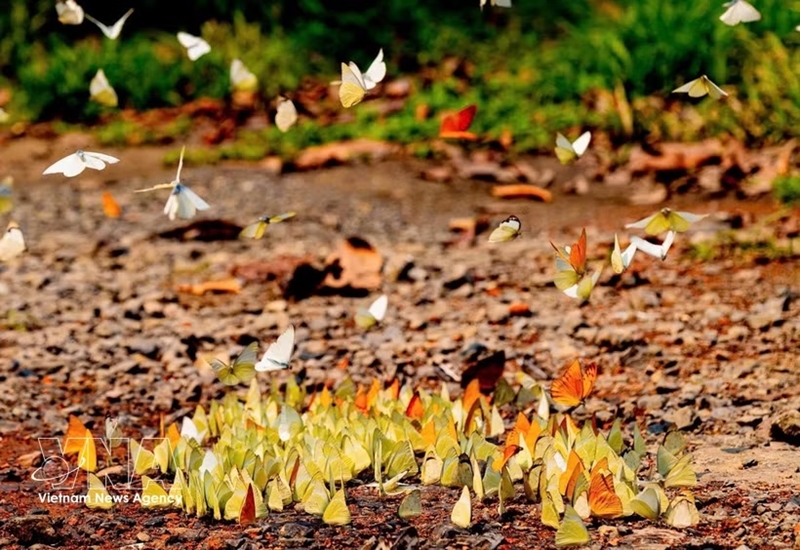
Delicate butterflies diversify tourism experiences at Cuc Phuong National Park. |
Around 60 deer will be freed in phases, with the park and SVW adopting a globally recognized soft-release model to maximize post-release survival.
Before the release, animals are trained to shed human dependence and build natural behaviors, including foraging, finding food and water inside a roughly 2,000 sq.m acclimatization enclosure for 30-40 days. Then the gate opens, and they move deeper into the forest.
Once the animals integrate, SVW experts and rangers monitor them using advanced tracking technology.
Rangers are also rolling out broad habitat protection measures under a philosophy of letting nature lead with human support, a push aimed at turning Cuc Phuong into a national model for ecological restoration.
Conservation gains fuel distinctive tourism products
Several experiential tours have become visitor favorites, including the “Journey of Revival” tour, night wildlife viewing, and seasonal butterfly and firefly photo trips.
Do Hong Hai, Deputy Director of the Cuc Phuong Environmental Education & Services Centre, said the park has imposed strict visitor management rules for seasonal butterfly and firefly experiences to ensure absolute protection for endangered primates, small carnivores, pangolins and freshwater turtles.
Visitor numbers are tightly controlled and scheduled by time slots. High-emission vehicles are restricted, and guests on night-wildlife outings must stay completely silent and avoid light pollution to prevent disruption of natural behavior.
An official from the provincial Department of Tourism said the shift from mass tourism toward tourism tied to wildlife rescue and nature conservation has gained strong momentum in recent years.
That niche is expected to draw urban residents seeking learning, exploration and healing through nature. By creating educational and immersive products, the park is effectively turning tourists into biodiversity ambassadors, the official added.
Source: VNA