Located about 9km from the center of Nha Trang along a provincial road connecting to the North–South Expressway, the tourism site officially opened to visitors on February 5.
Covering nearly 17 hectares, the site was developed largely by hand over more than three years, starting in 2017 by artisan Trinh Ba Dung and his team. The project was designed to make the most of the area’s natural terrain, particularly the stream that runs through the valley.
    |
 |
|
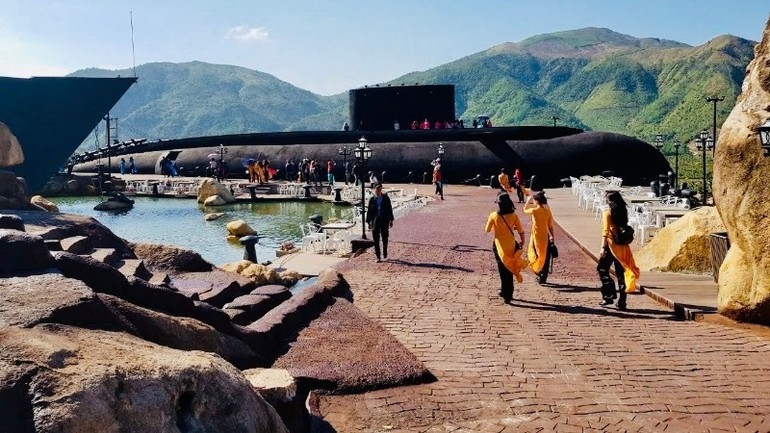
Visitors explore Nha Trang Impression Submarine Tourist Area. (Photo: vietnamtourism.vn) |
Preserving the natural landscape is the guiding principle during construction, according to the tourist area's operation director Nguyen Ngoc Chau. The aim is to maintain the raw, authentic beauty of the rocks and forests so that visitors connect emotionally with the surrounding environment.
Following that concept, the tourism complex is divided into several areas arranged along the natural flow of the terrain. These include a streamside zone featuring stone sculptures and artistic installations, a spiritual garden, a Nha Trang walking street, and a space depicting submarines and warships.
Visitors are encouraged to explore the site on foot via pathways winding along the mountainside and stream, allowing them to take time to observe the landscape and artistic detail.
Stone is used as the central element shaping the site’s aesthetic. Natural rock formations are preserved and combined with sculptures to create a space that feels rugged yet expressive, in contrast to the polished style common in many modern resorts.
One of the most striking features is a full-scale submarine model placed on a hillside, forming part of a visual recreation of a harbor with docked warships and submarines. The unusual sight of a “submarine on a mountain” creates a strong visual impression while symbolizing the historical link between the sea and inland areas in the development of Vietnam’s South-central coast.
Inside the submarine is a restaurant hall with seating for about 150 guests, offering dining experiences alongside displays of famous wines from around the world. At the center is Vietnam’s traditional ruou can (Vietnamese rice wine drunk through bamboo straws), highlighting efforts to place local culture at the heart of the visitor experience.
The site also features sculptural interpretations of cultural landmarks in Khanh Hoa, including Dien Khanh Citadel, Po Nagar Cham Towers, and Long Son Pagoda, rendered in a contemporary artistic style.
As Khanh Hoa province seeks to diversify its tourism offerings beyond beach travel, the new attraction is expected to contribute to sustainable tourism development and encourage visitors to stay longer while exploring the region’s cultural and natural heritage.
Source: VNA