According to a report from the Traffic Police Department under the Ministry of Public Security, thousands of modern specialized vehicles and technical devices have been deployed to support traffic law enforcement.
    |
 |
|
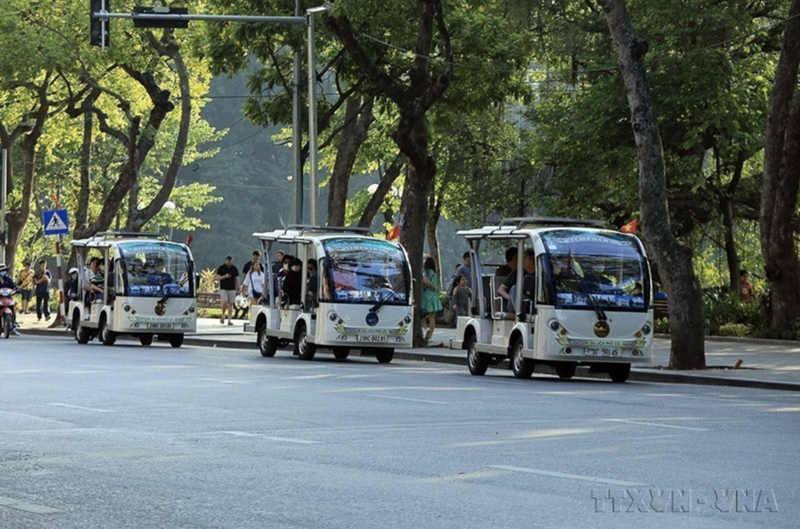
Electric vehicles are used to serve tourists in Hanoi. |
These include weight inspection systems, speed measurement devices with cameras, alcohol and drug testing equipment, radiation detectors, chemical marking tools, as well as devices for measuring exhaust emissions, smoke, and noise. The deployment of such advanced technology has helped authorities detect violations more effectively and limit the circulation of vehicles that fail to meet environmental standards.
According to Deputy Director of the Institute of Strategy and Policy for Agriculture and Environment under the Ministry of Agriculture and Environment Nguyen Dinh Tho, Vietnam already has a relatively comprehensive legal framework for controlling and handling vehicles that cause environmental pollution or exceed emission limits.
Key policy documents include the Politburo’s Resolution No.12-NQ/TW dated March 16, 2022, which aims to build a pure, strong, regular, elite and modern public security force who can meet high requirements and tasks in the new situation, and the Prime Minister’s Decision No.876/QD-TTg dated July 22, 2022 approving an action program on green energy transition and the reduction of carbon dioxide and methane emissions.
However, the rapid development of transport infrastructure has been accompanied by a sharp rise in the number of vehicles. Vietnam currently has about 7.2 million registered cars and 81 million motorcycles, many of which have been in operation for years and do not meet higher emission standards.
This situation poses growing challenges for enforcement forces, especially as Vietnam has pledged to achieve net-zero emissions by 2050 at the 2021 United Nations Climate Change Conference (COP26). At the same time, major cities are gradually implementing policies to limit vehicles powered by fossil fuels in central urban areas.
Although the Prime Minister’s Decision No.16/2019/QD-TTg on emission inspections for vehicles provides an important legal basis for handling violations, experts say several shortcomings remain.
These include incomplete technical parameters, inconsistent measurement standards, limited specialized equipment, and insufficient coordination among enforcement forces. In addition, penalties and regulations are not always fully aligned with existing technical infrastructure.
To address these challenges, authorities are calling for improvements in legal regulations, greater investment in modern equipment, and stronger coordination among relevant agencies.
According to Director of the Traffic Police Department Major General Do Thanh Binh, law enforcement agencies need clearer guidelines and breakthrough mechanisms to remove institutional bottlenecks, while also strengthening resources, technical facilities, and professional capacity.
He also emphasized the importance of accelerating digital transformation and applying advanced technologies in monitoring and enforcement.
Meanwhile, Deputy Director of the Vietnam Register Nguyen To An, said his agency is developing optimal solutions for vehicle emission inspections based on data provided by manufacturers and modern measuring equipment to ensure accurate and transparent results.
Authorities are also building an integrated command and monitoring system through a national data center for traffic management and violation handling. This system is designed to connect with databases from relevant ministries and agencies, enabling the use of big data analytics and AI to identify vehicles that exceed emission limits.
In addition, enforcement agencies plan to deploy smart sensor cameras capable of analyzing emissions at major traffic intersections and expand the use of Intelligent Transportation Systems to support real-time monitoring.
Policy proposals are also being considered to encourage the adoption of environmentally friendly vehicles. These include tax reductions, lower registration fees, and other incentives for green vehicles, while increasing taxes and fees on fossil fuel-powered vehicles to limit emissions and discourage new registrations of high-emission personal vehicles.
Authorities are also promoting communication campaigns and policy support for businesses involved in developing green transport infrastructure and clean-energy vehicles, aiming to accelerate Vietnam’s transition toward a more sustainable transport system.
Source: VNA