The issuance of Directive No.10/CT-TTg by the Prime Minister is an important policy framework for ministries, localities, businesses, and households to save energy while accelerating the development of rooftop solar systems.
The directive comes in the first year of the 2026–2030 socio-economic development plan, which sets ambitious growth targets and, in turn, raises electricity demand. Meanwhile, global energy markets remain volatile, adding to supply risks. To address these challenges, the directive outlines six key tasks, focusing on demand-side management, efficient energy use, and the expansion of self-distributed renewable energy.
    |
 |
|
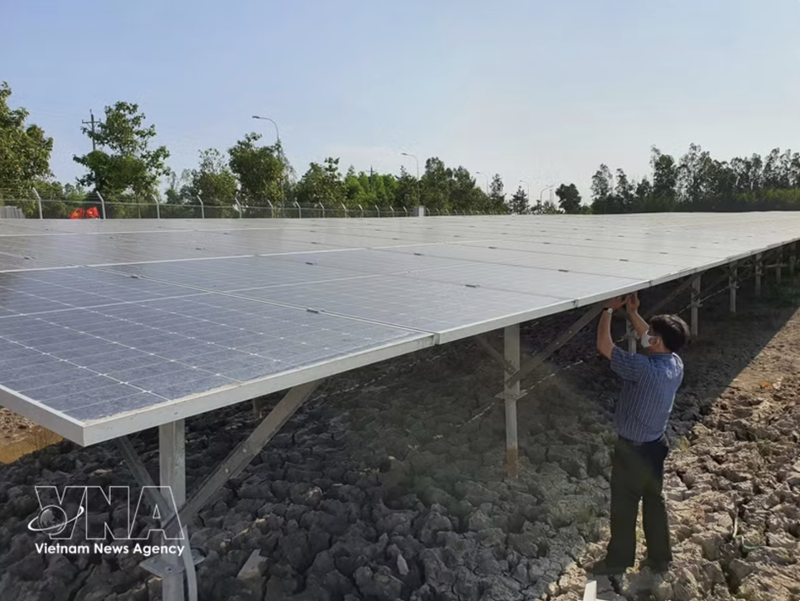
Rooftop solar panels in the Mekong Delta city of Can Tho |
Localities have moved quickly to translate the directive into action. Vice Chairman of the Thanh Hoa provincial People’s Committee Mai Xuan Liem said authorities have assigned specific responsibilities to relevant agencies and are developing detailed implementation plans. The province is also drafting a program on efficient energy use for 2026–2030, prioritizing rooftop solar installations at public offices while encouraging households to participate.
The coordinated rollout of such measures can help reduce peak load, optimize system operations, and limit the need for costly investment in new power sources, especially as baseload capacity cannot be expanded rapidly. Flexible load management and closer coordination with the power sector are also being promoted.
Energy expert Ha Dang Son described the push for rooftop solar as a “well-suited direction,” noting that it is a clean, easy-to-install energy source with a relatively short payback period. Investment costs have fallen sharply to around 40–50% of levels five years ago, allowing capital recovery within about five years, even in northern regions.
However, he cautioned that rooftop solar is weather-dependent and not a fully dispatchable source, requiring integration with energy storage systems to enhance reliability and flexibility.
At the enterprise level, the benefits are becoming increasingly evident. Nguyen Quang Tao, Deputy General Director of Ngai Cau Mechanical Company in Bac Ninh province, said the firm has installed a rooftop solar system with a capacity of around 1 MWp. In addition to boosting renewable energy use, it cools factory buildings when combined with greenery, significantly reducing air-conditioning demand. During peak summer heat nearing 40 degrees Celsius, indoor temperatures have dropped noticeably, lowering operating costs and improving work conditions.
In the service sector, businesses are also adopting energy-saving practices. A representative of Long Thanh Hotel in Thanh Hoa said electricity bills can reach 400–500 million VND per month during peak periods. To cut costs, the hotel has optimized air-conditioning operations, installed LED lighting with sensors, and tightened control over high-consumption equipment. It is also considering rooftop solar to enhance energy autonomy and reduce long-term expenses.
Households are similarly seeing tangible gains. A family in Thanh Hoa reported that its 3.1 kWp rooftop solar system has significantly reduced electricity bills, with most daytime demand now met by on-site generation.
From a system operation perspective, Nguyen Ba Hoai of the National Power System and Market Operator Company stressed the importance of data transparency. Accurate information on rooftop solar capacity is essential for forecasting output and ensuring safe, stable system operation.
Directive No.10/CT-TTg targets about 10% of public offices and 10% of households adopting rooftop solar, or achieving total installed capacity equivalent to 20% of the 2026–2030 plan, and calls for improved financial, green credit, and technical support mechanisms.
Source: VNA