The election of deputies to the 16th National Assembly and People’s Councils at all levels for the 2026–2031 tenure were successfully held, with voter turnout reaching 99.69%, a result partly attributable to the active participation of religious followers.
    |
 |
|
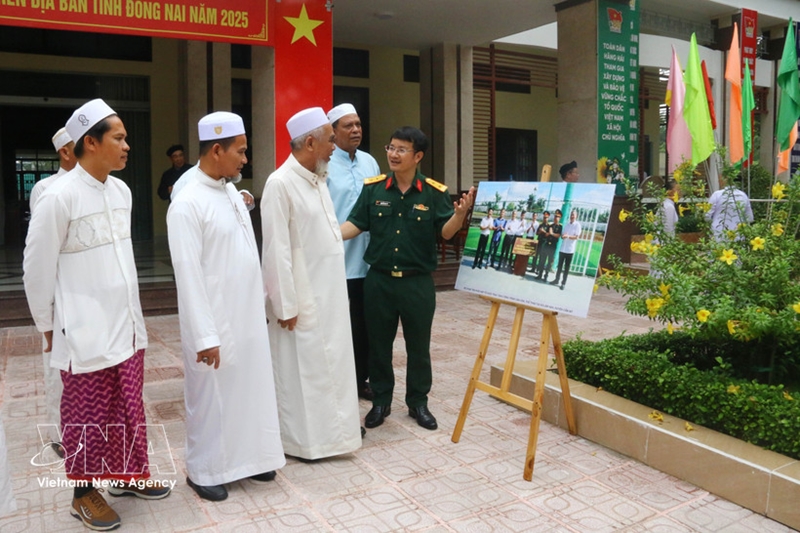
Religious dignitaries learn about activities of the armed forces in Dong Nai province. |
Ahead of the polling day (March 15), the Ministry of Ethnic and Religious Affairs issued a document requesting provincial and municipal authorities to facilitate religious followers' full exercise of citizens’ rights in nominating and electing qualified representatives to the National Assembly and People’s Councils at all levels.
Under the revised Law on Election of Deputies to the National Assembly and People’s Councils, all Vietnamese citizens, regardless of religion or belief, aged 18 and above have the right to vote while those aged 21 and above can stand for election to the National Assembly and People’s Councils at all levels.
Official results of the 16th National Assembly election are not yet available. Meanwhile, the 15th-tenure legislature included five religious dignitaries: Priest Nguyen Van Rien (who was also a deputy in the 14th tenure), Most Venerable Thich Bao Nghiem (also a deputy in the 13th and 14th tenures), Most Venerable Thich Thanh Quyet (a deputy in the 13th and 14th tenures), Venerable Ly Minh Duc (a deputy in the 14th tenure), and Venerable Thich Duc Thien.
Thanks to an open legal system and a tolerant society, about 95% of the population practice folk beliefs or follow a religion, with communities living harmoniously and often interwoven in daily life.
A survey by the U.S.-based Pew Research Centre ranks Vietnam among 12 countries worldwide and six in the Asia-Pacific region with a very high level of religious diversity.
According to the 2023 White Book on Religions and Religious Policies in Vietnam, the State has recognized 43 organizations from 16 religions, with more than 27.7 million followers, accounting for nearly 28% of the population.
Five major religions each have over one million followers. Buddhism has about 14 million followers, more than 54,000 dignitaries and officers, 47 training institutions, and over 18,500 places of worship. Catholicism counts around 7 million followers, 52 bishops, nearly 6,000 priests, 31,000 monks and nuns, over 200 congregations, 27 dioceses, more than 3,000 parishes, and about 9,000 places of worship.
Hoa Hao Buddhism has around 1.5 million followers while Protestantism about 1.2 million followers, and Caodaism over 1.1 million followers.
Religious organizations are encouraged to actively engage in socio-economic activities. They currently manage about 300 kindergartens, 2,000 pre-school facilities, 12 vocational training centers, numerous charity classes, more than 500 healthcare establishments, and 125 social assistance facilities, according to the Government's Committee for Religious Affairs.
The revised 2016 Law on Belief and Religion states that everyone has the right to freedom of belief and religion, along with the right to express their religious belief, to practice belief and religious rituals, participate in festivals, study and exercise religious teachings, and pursue religious life at religious establishments or training institutions. Religious dignitaries, monks and nuns are entitled to conduct ceremonies, preach, and disseminate teachings at lawful venues.
Religious organizations are permitted to operate in accordance with their charters, organize activities, upgrade and build facilities, and receive lawful donations from domestic and foreign entities.
The number of religious followers has increased by more than 10 million over the past 20 years, demonstrating that the Party and State not only protect but also actively promote the right to religious freedom in practice.
According to the 2023 White Book, the number of religious followers rose from 17.4 million in 2003 to 27.7 million in 2023, while the number of recognized religious organizations increased from 16 to 43; religious dignitaries from 34,200 to over 54,500; religious officers from nearly 79,000 to nearly 145,000; and places of worship from 20,900 to 29,890.
Spring, the season of festivals, offers vivid examples of this freedom and the peaceful coexistence of religions.
Vietnam hosts 544 religious festivals annually, according to the Ministry of Culture, Sports and Tourism.
Organizing and participating in religious festivals has traditionally been an internal affair of religious organizations and their followers. However, nowadays, many of such festivals have transcended places of worship and spread throughout society thanks to the tolerance and non-discrimination of Vietnamese people and the religious freedom policy of the Vietnamese Party and State.
Major religious celebrations are being organized on a larger scale, drawing wide participation from both followers and the public, with support from authorities.
Vesak, which commemorates the birth of the Great Buddha, is a major annual celebration held on the full moon day of the fourth lunar month. On this occasion, executive boards of the Vietnam Buddhist Sangha chapters across the country organize celebrations in a solemn and peaceful atmosphere, attracting not only Buddhist followers but also a large number of secular people.
Christmas, originally marking the birth of Jesus Christ, is traditionally observed by Christians such as Catholics and Protestants in Western countries. In recent years, it has become increasingly popular in Vietnam and is now widely regarded as a festive occasion enjoyed by both Christians and non-Christians alike.
Despite different origins and doctrines, religions in Vietnam coexist without conflict, often blending with folk beliefs. Individuals freely participate in various spiritual activities without discrimination.
These realities strongly refute biased claims that religious freedom in Vietnam is restricted!
Source: VNA