Residents return to buses with renewed enthusiasm
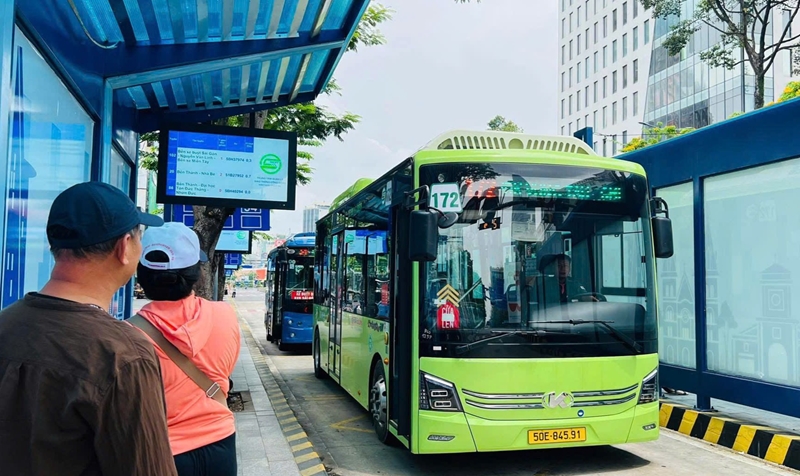
At the Saigon, Ham Nghi and Ben Thanh stations, as well as bus stops across the city center on July 1, passenger numbers were noticeably higher than usual. Many commuters paused to photograph signs announcing "Free Bus Service," marking the launch of the city's unprecedented fare-free policy across its entire bus network.
On the first day of the program, Nguyen Phuong Thy, a resident of Long Truong ward, left her motorbike at home and chose to commute by bus. Travelling from her home to her workplace in Nha Be on routes D4 and 72, she said the clean vehicles, cool air conditioning and attentive staff completely changed her perception of bus travel.
    |
 |
|
More residents are choosing buses for their daily commute. |
For many low-income workers, the fare-free policy has brought even more tangible benefits.
Phan Thi Loan, 59, who earns a living by selling lottery tickets, said she travels through different parts of the city every day. "With free buses, I can travel more safely and save a little more money every day," she said.
Only a few years ago, buses were widely regarded as a last resort when no other transport option was available. Today, that image is gradually changing.
Hundreds of electric and compressed natural gas (CNG) buses have entered service while many bus shelters have been upgraded with new roofs, seating and information boards. Electronic ticketing, cashless payment, and digital applications such as BusMap and MultiGo now allow passengers to check routes and arrival times and connect more conveniently with Metro Line No. 1, water buses, and the public bicycle network.
According to the Ho Chi Minh City Public Transport Management Center, bus ridership has risen steadily in recent months. Passenger numbers increased by around 7% year-on-year in April, 11% in May, and a further 13% during the first 25 days of June, indicating that more people are returning to buses not only because of lower travel costs but also due to significant improvements in service quality.
From the experience economy to the value economy
Dr. Duong Duc Minh, Deputy Director of the Ho Chi Minh City Institute for Economic and Tourism Development Research, said the success of a modern megacity should be measured not only by economic growth but also by improvements in residents' quality of life.
He said the free bus policy goes beyond reducing commuting costs, reflecting the city's commitment to social welfare while strengthening public confidence and encouraging greater use and protection of public services.
For Ho Chi Minh City, expanding public transport will help ease traffic congestion, reduce emissions, lessen environmental pressures and, at the same time, provide practical support for low-income residents by lowering living costs and improving access to employment opportunities.
Ha Quach, a lecturer in tourism and hospitality management at RMIT Vietnam, noted that in major cities such as Singapore, Seoul and Hong Kong, public transport has become an integral part of urban life. In contrast, buses have yet to become the preferred travel option for most residents in Ho Chi Minh City.
She said the fare-free initiative, combined with fleet modernization, the expansion of electric buses, improved service quality and wider adoption of electronic ticketing, could help reposition buses as a more modern and attractive mode of transport.
Experts believe urban development is shifting from an "experience economy" to a "value economy" in which public transport delivers benefits beyond lower travel costs by improving the urban environment, enhancing public services and creating a more efficient mobility system that supports sustainable urban transport development.
Source: VNA