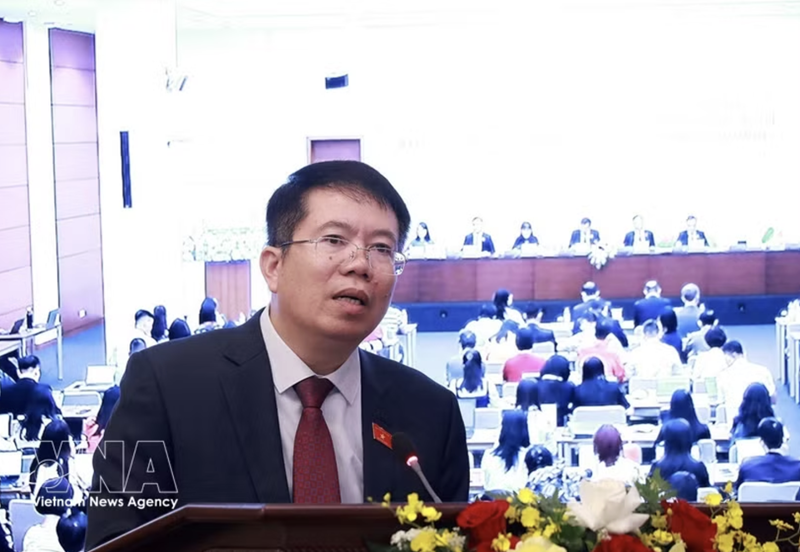
Speaking at a press briefing organized after the closing ceremony of the session, Hien noted that the session was conducted in a scientific, reform-oriented and highly responsible manner, contributing to laying an important institutional and personnel foundation for the 16th N.A. term.
    |
 |
|
Vice Chairman of the N.A. Office Nguyen Van Hien speaks at the press briefing. |
At the opening sitting of the first session, Party General Secretary To Lam delivered a key address outlining strategic orientations for the 16th legislature in the country’s new development phase. The N.A. also heard reports from the National Election Council on the outcomes of the election of deputies to the 16th N.A. and People’s Councils at all levels for the 2026–2031 tenure, along with the verification of newly elected deputies’ credentials.
A central highlight of the session was the decision-making on key state leadership positions and the organizational structure of state agencies for the new term.
Lawmakers reviewed and adopted several laws and resolutions, alongside major socio-economic and financial decisions, including five-year development plans for 2026–2030 and the establishment of Dong Nai city.
The N.A. also approved its supervision program and decided to establish a thematic supervisory delegation for 2027, while reviewing reports on citizen petitions and supervision results from the previous legislature.
According to Hien, the outcomes of the session affirmed a strong sense of responsibility, great effort, and a firm determination to innovate both in preparation and in the conduct of the meeting. The proceedings ensured strict compliance with legal procedures, maximized working time, and enhanced overall efficiency. The Presidium demonstrated flexibility and proactive management, maintaining both discipline and a democratic, open atmosphere throughout discussions.
Newly elected deputies, including first-time lawmakers, actively contributed through frank, constructive and substantive debates, helping to improve the quality of decision-making.
Regarding the election of deputies to the 16th N.A. and People’s Councils at all levels in the 2026 – 2030 tenure, the N.A. affirmed the successful organization of the nationwide vote under close leadership of the Party Central Committee, Politburo and Secretariat. A total of 500 N.A. deputies, 2,552 provincial-level People’s Council members, and 72,440 commune-level representatives were elected, meeting high standards in quality and structure, with an increased proportion of full-time deputies and higher qualifications compared to previous terms.
Voters nationwide were praised for their active and responsible participation, contributing to the overall success of the elections. The N.A. also emphasized continued accountability of deputies in connecting closely with voters and reflecting public concerns in policymaking.
|
|
 |
|
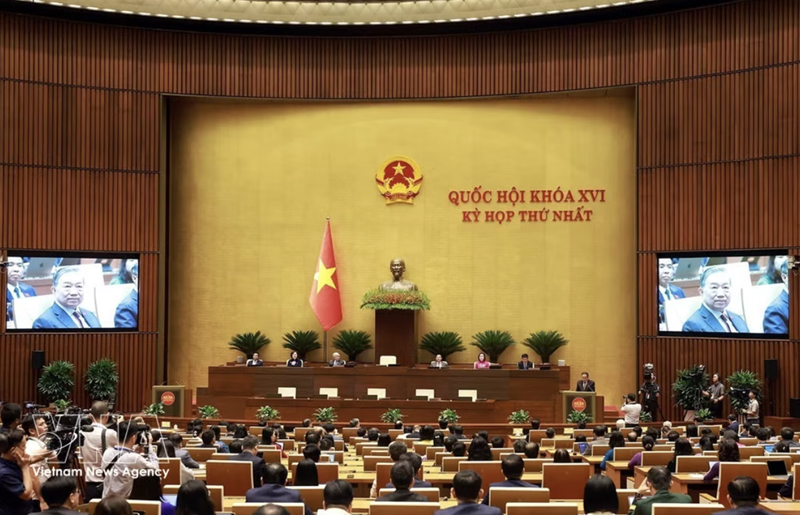
At the the closing ceremony of the first session of the 16th National Assembly |
A major focus of the session was personnel work, Hien said, stressing that the N.A. adopted 18 resolutions on state leadership appointments, including the election of senior positions such as the State President, Prime Minister, N.A. Chairman, Chief Justice of the Supreme People’s Court, and Procurator General of the Supreme People’s Procuracy.
During the session, the N.A. Standing Committee adopted 230 resolutions related to personnel arrangements across parliamentary bodies and local delegations.
In legislative work, the N.A. adopted nine laws and five resolutions aimed at institutional reforms, including revisions to laws on civil status, notarization, legal aid, emulation and commendation, capital governance, taxation, religious affairs, and access to information. Meanwhile, the resolutions focused on tax policy adjustments, investment disputes, land-related issues, and special mechanisms to resolve long-standing projects.
The N.A. also approved major socio-economic development plans, medium-term public investment, national financial strategies, and state budget settlements in the next five years. It decided on supervisory programs and the establishment of supervision mechanisms for 2027, along with policies on cultural development and international cooperation frameworks.
Source: VNA