Nguyen Thi Xuan Hue, a graduate in applied English linguistics from the University of Macau, said young intellectuals are closely tracking the congress. They expect the incoming leaders to sustain the reform agenda and a tough stance on anti-corruption, and demonstrate strategic vision to steer the country amid an increasingly complex global landscape.
    |
 |
|
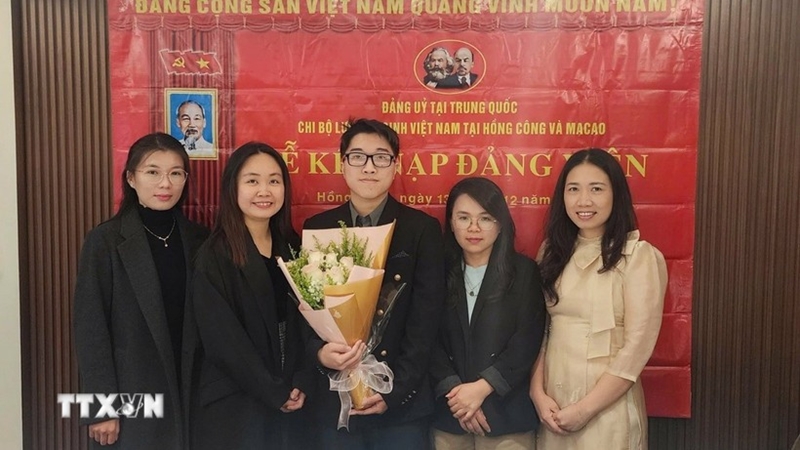
Nguyen Thi Xuan Hue (second from left), a graduate in applied English linguistics from the University of Macau |
Hue highlighted particular interest among students in policies related to deeper global economic integration, foreign investment attraction and quality workforce training. Many overseas Vietnamese students, she said, hope for more concrete and practical policies to harness talent trained abroad. These include support mechanisms for returnees, better job matching based on expertise, opportunities for intellectual contributions during studies abroad, and simplified pathways for graduates and postgraduates to support national development effectively after their studies.
In recent years, the Party and State have stepped up practical engagement with overseas Vietnamese (OV) communities, Hue continued, citing Resolution 36 on OV affairs in 2024, along with the Politburo’s similar conclusion affirming that OVs form an inseparable part of the nation.
Hue noted that students feel this shift through active outreach from the Vietnamese Consulate General in Hong Kong and Macau, including community gatherings during holidays and assistance during challenges.
Students expressed confidence in the Party’s guidelines and hoped that policies on national unity will continue to be translated into concrete actions, so that OVs feel connected and empowered to contribute to national development.
Dr. Nguyen Thi Khanh, a postgraduate at the Chinese University of Hong Kong (CUHK), expressed pride in Vietnam's Doi Moi (renewal)-era achievements under the Party’s leadership, particularly sustained economic growth and deepening global integration. She expected that the incoming leadership will blend strategic foresight with global experience to guide Vietnam through the challenges of globalization and the fourth industrial revolution, while accelerating innovation, digital and green economies, and quality investment flows. She stressed the need to continue anti-corruption efforts, improve the capacity of public officials, safeguarding democracy, and keeping citizens at the center of policymaking.
Khanh called for stronger legal frameworks for OVs, enabling them to contribute intellectual and financial resources more effectively to national development. As a researcher, she anticipated more opportunities for collaboration between overseas scholars and domestic scientists, plus greater access for foreign-based researchers to domestic research funds to address Vietnam’s development challenges.
According to her, the Vietnamese Consulate General in Hong Kong and Macau has long supported and protected citizens’ rights, fostered community ties; showcased Vietnam, its language and culture, and boosted international cooperation.
Vietnam has recently introduced a series of new, more open policies to untangle bottlenecks in recruitment procedures, compensation and working conditions, to attract overseas talent and experts to contribute at home.
In July 2025, Khanh attended the Global Forum for Young Vietnamese Intellectuals in Hanoi, an event that brought together overseas-based experts to discuss and propose solutions to Vietnam’s pressing issues.
Source: VNA