International media have paid particular attention to the new cooperation roadmap announced by Vietnam and India during the top Vietnamese leader’s visit to India, covering trade, technology, defense, connectivity, security, sustainable development, and supply chain resilience. They have also highlighted the two countries’ targets of raising bilateral trade turnover to 25 billion USD by 2030, and expanding cooperation in strategic sectors such as pharmaceuticals, energy, rare earths, and critical minerals to reinforce economic security and supply chains.
    |
 |
|
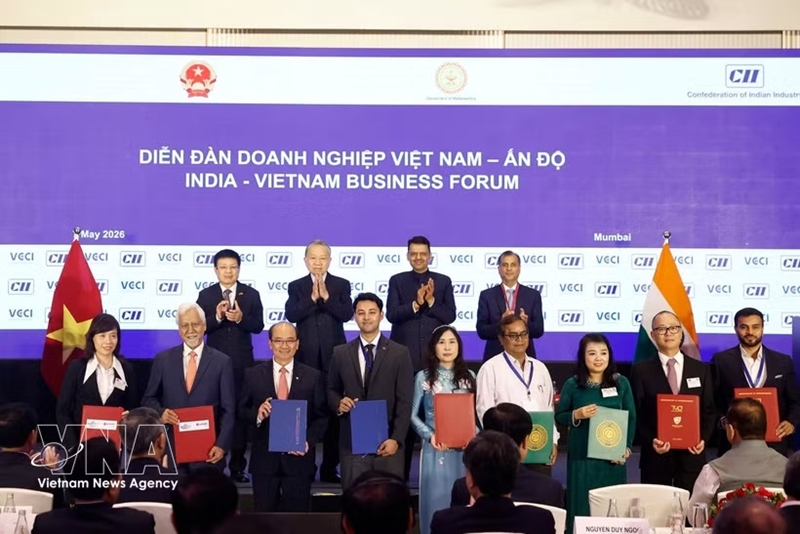
Party General Secretary and State President To Lam (second from left, back) witnesses the exchange of cooperation agreements between Vietnam and India. |
Commentaries have also focused on plans to connect the two countries’ digital payment systems, describing the initiative as a notable step forward in bilateral financial and digital economic cooperation.
According to indianexpress.com and several other international outlets, stronger cooperation in critical minerals, rare earths, energy, technology, and investment signals that Vietnam and India are broadening ties into sectors of long-term strategic importance, particularly amid intensifying global technological competition.
A report published by News.az of Azerbaijan noted that the visit could generate mutual benefits by enabling Vietnam and India to capitalize on each other’s strengths in trade and expand cooperation in emerging sectors considered comparative advantages of both sides, including technology, investment, energy, maritime cooperation, and sustainable development.
Several analyses suggested Vietnam and India together build resilient supply chains and become an important “link” in a new Asian economic model in which manufacturing is distributed among trusted hubs. From a broader perspective, India can use Vietnam as a gateway to deepen its economic presence and influence in Southeast Asia, one of the world’s fastest-growing regions. Conversely, the visit also demonstrates Vietnam’s continued pursuit of an active and dynamic foreign policy with some of the fastest-growing economies globally.
Meanwhile, commenting on the top Vietnamese leader’s visit to Sri Lanka, The Times of India on May 6 said the trip goes beyond conventional diplomacy and reflects Vietnam’s growing efforts to leverage strategic partnerships to simultaneously advance security and economic development goals.
The newspaper outlined four factors underscoring the significance of the visit. First, the trip comes shortly after General Secretary Lam was elected State President with strong support from the National Assembly, indicating Sri Lanka’s important place in Vietnam’s foreign policy. Second, the Vietnamese leader is promoting the “Vision 2045” development strategy adopted at the 14th National Congress of the CPV, which aims to connect short-term growth objectives with long-term ambitions of transforming Vietnam into a high-income and and technologically capable nation through deeper international integration.
Third, his strategic outlook reflects this vision. His approach to diplomacy integrates national security, economic growth, and long-term strategic planning, underscoring deeper international partnerships to achieve Vietnam’s economic goals and regional peace, while maintaining strategic autonomy. His grasp of global dynamics enables him to engage and manage international partnerships with confidence and strategic clarity.
Fourth, the Vietnamese leader and Sri Lankan President Dissanayake share broadly similar domestic and foreign policy priorities that could facilitate closer cooperation. Domestically both focus on anti-corruption, economic reforms and social justice. Internationally, they advocate peace, stability, security, the Global South interests and freedom of navigation based on multi-alignment policy.
The article assessed that the visit could open a new phase in Sri Lanka - Vietnam relations by expanding cooperation beyond traditional areas into sectors such as defense, maritime security, mining, construction, logistics, telecommunications, pharmaceuticals, technology, climate change, cybersecurity, and energy transition. Emerging sectors linked to Vietnam’s innovation-driven growth strategy, including artificial intelligence, biotechnology, and renewable energy, are also expected to receive greater attention.
With its multilateral and future-oriented foreign policy, Vietnam is increasingly proactive in promoting strategic partnerships to strengthen both national security and economic growth in Asia’s broader development dynamics. The visit is expected to pave the way for a new stage in Sri Lanka - Vietnam relations, creating fresh opportunities and delivering long-term benefits for both countries.
Source: VNA