The ambassador made the remarks in an interview with Vietnam News Agency correspondents in Geneva on the occasion of the 51st anniversary of the Liberation of the South and National Reunification Day (April 30, 1975 - 2026).
According to him, many international forums, including the World Economic Forum (WEF), have pointed out increasing geopolitical polarization, signs of economic fragmentation, and divisions in global value systems, making the international environment more uncertain and eroding trust among nations. In this context, a country that maintains political stability, has a clear and consistent development orientation, actively integrates internationally, and proactively engages in cooperation across all fields like Vietnam is seen as a noteworthy bright spot.
    |
 |
|
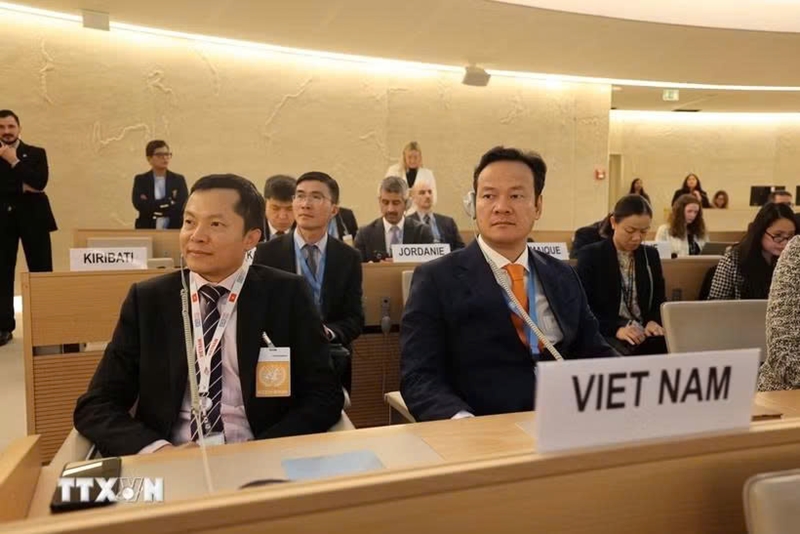
Head of the Permanent Mission of Vietnam in Geneva Ambassador Mai Phan Dung (right) at the opening of the 58th session of the U.N. Human Rights Council, February 2025 |
The ambassador noted that domestically, international partners highly appreciate Vietnam’s comprehensive, balanced, and people-centered development approach. This approach is clearly reflected in Vietnam’s persistent efforts to promote growth alongside social progress and equity, with a focus on social welfare and sustainable poverty reduction, while proactively implementing new growth drivers such as digital transformation, green transition, and innovation.
Vietnam has also succeeded in strengthening self-reliance and resilience in economic and trade development, which not only supports national development and improves people’s livelihoods but also enhances its position on the global economic and trade map, he stressed.
According to the diplomat, the combination of stability and reform has created a highly predictable development foundation, enabling Vietnam to maintain socio-political stability while enhancing its adaptability to external fluctuations - an aspect highly valued by international organizations amid current global risks.
In terms of foreign policy, he said Vietnam is recognized as a country that consistently pursues independence, self-reliance, international integration, and diversification and multilateralization of international relations, with increasingly proactive and substantive implementation. This foreign policy has helped Vietnam expand its network of partners, deepen cooperation across various fields, and maintain balance in its relations with countries.
In practice in Geneva, Dung said Vietnam has clearly demonstrated its role as an active and responsible member of the multilateral system, promoting dialogue, respecting international law, and contributing to building collective solutions to global issues. The persistence, consistency, and reliability of this foreign policy are widely regarded by the international community as sound and effective, particularly amid intensifying strategic competition and global fragmentation. In fact, Vietnam’s progressive policies and achievements across various fields are increasingly recognized positively by the international community in Geneva, with many leaders of international organizations offering specific and highly appreciative evaluations.
According to the ambassador, the trust of the international community in Geneva in Vietnam is also clearly reflected in Vietnam’s candidacies for international bodies. Vietnam’s election as a member of the United Nations Human Rights Council for the 2023–2025 term and its re-election for the 2026–2028 term with a high number of votes is strong evidence of international confidence in the country’s role and contributions.
During this term, Vietnam has proactively proposed and co-sponsored numerous initiatives welcomed by the international community, particularly in protecting the rights of vulnerable groups, promoting the right to food, advancing gender equality, and integrating human rights into climate change response.
These achievements reflect not only domestic progress but also a balanced development approach that harmonizes internal capacity with international integration, and national interests with global responsibilities.
Looking ahead, with a solid foundation of political stability, a clear development orientation, and strong international support, Vietnam is well-positioned to continue enhancing its role in multilateral forums, contributing actively to addressing global challenges, and realizing its aspiration to become a high-income, developed country by 2045, he stated.
Further elaborating on the driving forces behind multilateral diplomacy, Ambassador Dung noted that in recent years, the foreign affairs sector in general, and multilateral diplomacy in particular, has consistently received close attention and direction from the Party and State leaders.
Vietnam continues to affirm its consistent foreign policy of independence, self-reliance, peace, friendship, cooperation, and development; diversification and multilateralization of external relations; and proactive, active international integration. It remains steadfast in safeguarding independence, sovereignty, territorial integrity, and national interests, while maximizing external conditions and resources for national development.
Notably, the 14th National Party Congress identified foreign affairs and international integration as “key and regular” tasks, providing a solid political foundation and setting out more ambitious goals to further strengthen external relations, including multilateral diplomacy, he said.
At the same time, policies on international integration continue to be refined, particularly Politburo Resolution No. 59-NQ/TW on international integration in the new context, which emphasizes a shift from “participation” to “proactive contribution and shaping,” enhancing Vietnam’s role in shaping international rules while closely linking integration with rapid and sustainable development, he added.
A noteworthy new element in current foreign policy thinking, he noted, is the emphasis on “self-strengthening,” meaning strengthening internal capacity, resilience, and proactive adaptation to global changes. This approach enables Vietnam not only to integrate deeply but also to maintain strategic autonomy, thereby participating in multilateral mechanisms more pro-actively and contributing more substantively to shaping international norms and rules.
In practice, multilateral mechanisms have also served as a driving force for Vietnam’s deeper integration into the global economy, contributing to institutional reform, improving business environment transparency, and expanding trade and investment. The ambassador emphasized that participation in mechanisms such as the World Trade Organization (WTO) has significantly helped Vietnam enhance its position in international trade and global value chains. Maintaining an active and substantive presence in Geneva - one of the world’s major multilateral hubs hosting numerous international organizations and global forums is of practical importance for engagement, dialogue, mobilizing cooperation, and safeguarding national interests.
Regarding the role of the Permanent Mission of Vietnam in Geneva, the ambassador stated that it serves as a key agency for directly implementing multilateral foreign policy orientations. The mission not only actively participates in the development of international norms and rules, contributing to safeguarding national sovereignty and interests, but also acts as an important channel for connecting partners, mobilizing resources, and conveying Vietnam’s development orientations to the international community. At the same time, it helps promote dialogue, build consensus, and address common issues, thereby enhancing Vietnam’s role and position within the multilateral system.
Source: VNA