At the invitation of General Secretary of the Communist Party of China Central Committee and President of China Xi Jinping, the top leader, his spouse and a high-ranking delegation of Vietnam will pay a state visit to China from April 14–17.
    |
 |
|
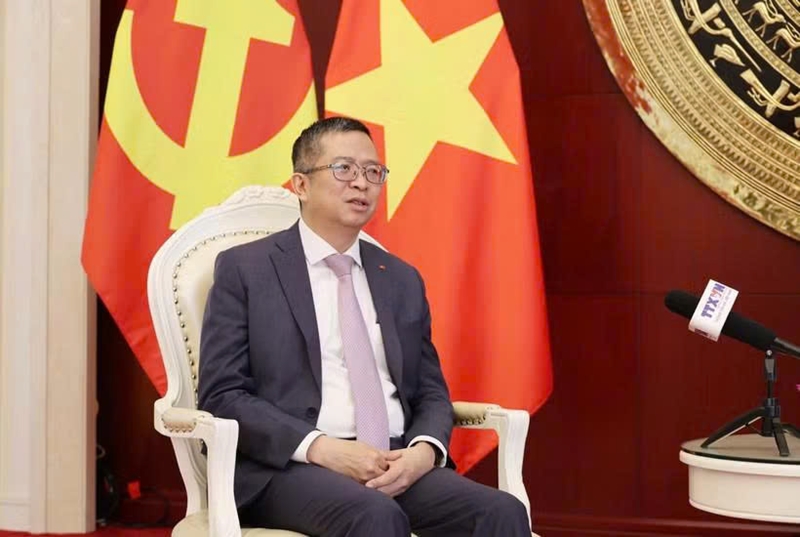
Vietnam’s Ambassador to China PhamThanh Binh |
In an interview with the Vietnam News Agency (VNA)'s reporter in Beijing, Binh described the trip as the most significant bilateral diplomatic event between the two Parties and countries in 2026. It marks General Secretary and State President To Lam’s first overseas visit since Vietnam consolidated its top leadership positions for the new term, and his first trip to China following the 14th National Party Congress. The visit also follows a series of high-level exchanges, including Xi’s state visit to Vietnam one year earlier.
The visit comes as Vietnam–China relations continue to develop positively, with expanding cooperation across multiple areas. Recent milestones include a high-level phone call between the two top leaders in early 2026, the 17th meeting of the Vietnam–China Steering Committee for Bilateral Cooperation, and the inaugural “3+3” strategic dialogue between the Ministers of Foreign Affairs, National Defense, and Public Security in March.
Binh said agreements reached during the visit will help shape the future direction of the bilateral ties, paving the way for a new phase in the Comprehensive Strategic Cooperative Partnership and the China-Vietnam Community with a shared future that carries strategic significance.
During the visit, the Vietnamese top leader is scheduled to hold talks with his Chinese counterpart and meet with other senior Chinese leaders. Both sides are expected to reaffirm the importance of strengthening relations between the two socialist countries, while discussing major directions and measures to elevate cooperation to a more stable, substantive and sustainable level.
Against a backdrop of global and regional uncertainties, the visit will also provide an opportunity for frank and constructive exchanges on issues of shared concern, enhanced coordination at multilateral forums, and efforts to address outstanding issues, contributing to peace, stability, cooperation and development in the region and the world as well.
People-to-people exchanges will also feature prominently. The two leaders are set to engage with young representatives from both countries participating in a youth program launched in 2025. The Vietnamese General Secretary and State President will deliver a policy speech at Tsinghua University and attend cultural and exchange activities aimed at strengthening public ties.
The visit will also include the signing of cooperation agreements and field trips to explore China’s development models in urban planning, transport infrastructure, railways, and innovation, including artificial intelligence, in Beijing, Hebei and Guangxi. These activities are expected to translate high-level commitments into concrete projects and partnerships.
According to the Ambassador, practical cooperation between the two countries remains a bright spot, with strong growth in trade, investment and tourism. Bilateral trade reached 256.4 billion USD in 2025, up 24.8%, and continued to rise in early 2026. China remains Vietnam’s largest trading partner, while Vietnam is China’s fourth-largest in the world.
Strategic connectivity, particularly standard-gauge railway projects, has made steady progress, alongside expanding cooperation in digital infrastructure, logistics and local-level exchanges, especially in border areas.
Both countries are also deepening cooperation in emerging sectors such as innovation, artificial intelligence, high-tech agriculture, clean energy and digital transformation, as well as in culture, education, healthcare and sports.
The diplomat expressed his confidence that Vietnam–China cooperation still holds vast potential, driven by complementary development strategies, especially as Vietnam has begun to realize the Resolution of the 14th National Party Congress and China is deploying the 15th five-year socio-economic development plan for the 2026-2030 period.
Priority should be given to strengthening economic ties, effectively leveraging free trade agreements, expanding market access for Vietnamese agricultural products, promoting more balanced trade, attracting high-quality investment, and boosting bilateral tourism, Binh said.
At the same time, both sides should enhance connectivity in infrastructure, supply chains and economic and logistics corridors, with a focus on standard-gauge railways, smart border gates and cross-border economic cooperation zones.
They should also expand collaboration in key areas such as science and technology, innovation, digital transformation, clean energy, high-tech agriculture and human resource development, thereby supporting sustainable growth and deeper international integration.
Source: VNA