The global food market, valued at roughly 10 trillion USD annually, is considered one of the most stable and high-growth sectors worldwide. However, value distribution along the supply chain remains highly uneven. Raw materials generate only about 5–10% of total value, followed by processing at 10–20% and logistics at 10–15%, while distribution and retail capture up to 50–70%.
    |
 |
|
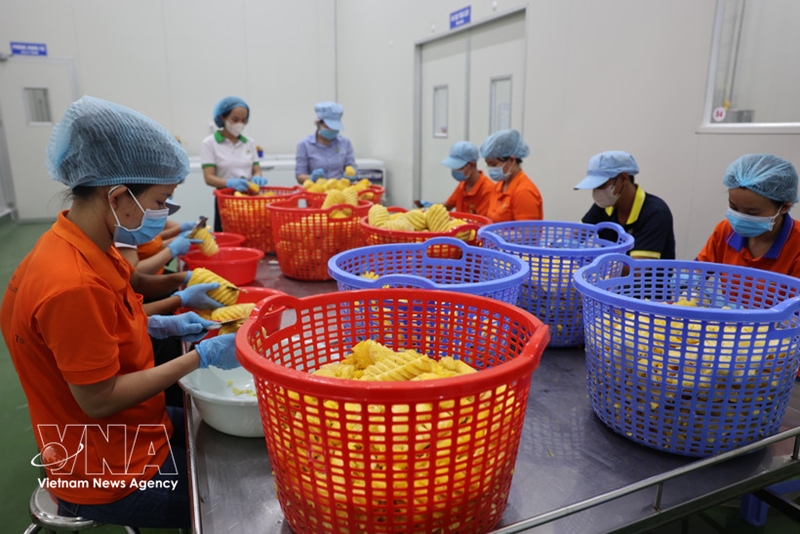
Pre-processing fruits for juice production at Wana Beverage JSC, Chau Duc Industrial Park, Ho Chi Minh City |
Dr. Dinh The Hien, Director of the Institute of Information and Business (IIB), said the industry’s core value lies not in production itself but in market access, branding and distribution control. This structural limitation continues to keep Vietnamese enterprises concentrated in lower value-added segments despite their strong participation in global supply chains.
The disparity is evident across product categories. Coffee beans priced at just 2.5–3 USD per kilogram at the raw stage can reach 40–60 USD per kilogram after processing, branding and retail distribution, and even higher in developed markets.
Within Vietnam’s food industry, only a handful of firms, including Vinamilk and Masan Group, have achieved large-scale operations, while most businesses remain small. As a result, the highest value-added gains largely belong to companies that dominate branding and downstream markets.
Phan Minh Thong, Chairman of Phuc Sinh Group, which specializes in deep agricultural processing, said businesses need to adopt more structured production models, invest in advanced processing, strengthen quality standards and develop differentiated products to enhance value and build brands. The emergence of billion-dollar enterprises, he noted, depends on modern business strategies supported by a stable policy environment.
Sharing this view, Hien emphasized the need for companies to transition from a production-focused approach to a value-chain mindset, moving away from contract manufacturing towards branded product development. Deep processing, brand building and participation in international distribution networks are three decisive factors for increasing value. If implemented effectively, the sector’s value-added output could grow three- to five-fold in the coming years.
Beyond product quality, trust is increasingly becoming a defining competitive advantage. Experts say cost competitiveness alone is no longer sufficient in the global marketplace; credibility, transparency and corporate responsibility now determine long-term value and market access. At the same time, green transformation is emerging as an unavoidable requirement.
Dinh Hong Ky, Vice President of the Ho Chi Minh City Business Association (HUBA), noted that major markets are tightening regulations on environmental standards, emissions and traceability. Companies that fail to comply risk losing orders. However, when implemented strategically, green transition can lower long-term costs while improving efficiency and product value.
Businesses have also called for stable, transparent and predictable policies to support long-term investment, particularly in deep processing and technological innovation. Experts urged the Government to expand green finance incentives, promote technology transfer and strengthen trade promotion efforts to reduce barriers for enterprises, especially small and medium-sized firms.
Such measures are expected to serve as a crucial catalyst enabling Vietnam’s food enterprises to scale up, compete more effectively with global corporations and contribute to more sustainable agricultural growth.
Source: VNA