Private passenger vehicles account for the overwhelming majority, with 369,849 battery electric passenger cars in operation, alongside 3,396 electric trucks and 1,571 electric buses.
    |
 |
|
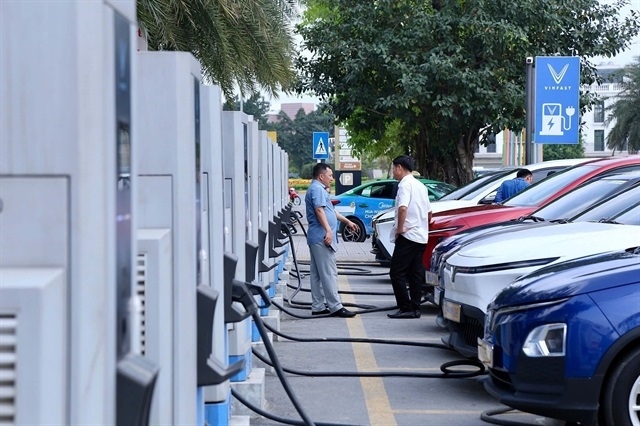
Public charging stations for electric vehicles in a residential township in Hanoi |
As personal EVs increasingly dominate the market, the key challenge facing policymakers and businesses is to optimize the supporting ecosystem before the transition to green mobility accelerates further in the next few years.
The dominance of privately owned EVs also reflects a clear market reality: individual consumers have become the primary driving force behind Vietnam’s vehicle electrification.
Their rapid adoption is not only reshaping urban transportation in major cities such as Hanoi and Ho Chi Minh City, but also making a direct contribution to the country’s long-term goals of reducing greenhouse gas emissions and improving air quality.
With nearly 375,000 electric passenger vehicles already on the road, the market has reached a scale large enough to place positive pressure on the entire automotive value chain, from maintenance and repair services to charging infrastructure, while establishing new standards for mobility in Vietnam.
This progress is the result of a coordinated policy framework designed to accelerate the transition toward greener transportation. The Prime Minister’s Decision 876/QD-TTg and the Ministry of Construction’s action plan have provided the legal foundation for Vietnam’s green transport conversion program.
Clear policy direction from the Government has strengthened confidence among both manufacturers and consumers, encouraging investment and accelerating the adoption of electric mobility.
However, from both a policy and infrastructure perspective, the growing EV fleet also highlights an emerging imbalance between demand and supporting infrastructure.
Feedback from consumers and businesses regarding the shortage of charging stations, lengthy charging times and relatively high vehicle ownership and operating costs points to structural challenges that Vietnam must address to sustain the current pace of growth.
With the EV fleet of 375,000 vehicles, charging stations can no longer be viewed as supplementary infrastructure — they have become an essential component of urban planning.
The Ministry of Construction is reviewing and updating its green energy transition action program for the transport sector, with a particular focus on expanding green transport infrastructure, placing nationwide charging networks at the center of future development.
This is a critical step, as infrastructure that fails to keep pace with vehicle adoption could quickly turn early consumer enthusiasm into frustration, ultimately slowing development of the EV market for the long term.
At the same time, the completion of Vietnam’s Smart City Criteria and the development of a Green Smart City framework will provide local governments with important tools to integrate electric mobility into sustainable urban transport systems.
In addition, unless regulators and industry stakeholders establish an appropriate pricing framework for EV charging services – supported by measures such as registration fee incentives and other non-financial benefits – the current growth momentum could gradually weaken after the initial surge in adoption.
Consequently, experts believe urban planners should prioritize two parallel objectives: expanding charging infrastructure while simultaneously developing facilities that support non-motorized transportation, thus creating a more balanced and sustainable mobility ecosystem.
Beyond charging times and vehicle costs, the transition also depends on technological advancement. Next-generation battery technologies, ultra-fast charging solutions and smarter electricity grids are expected to address many of today’s challenges. In this process, the Government will play a critical coordinating role to ensure that the transition remains affordable for mainstream consumers.
Planning for charging infrastructure should not rely solely on the strategies of individual automakers. Instead, charging networks should be developed as shared public infrastructure, comparable to fuel stations or public parking facilities within urban areas.
The Green Smart City Criteria currently being finalized by the Ministry of Construction are expected to require new residential developments and commercial buildings to incorporate EV charging facilities during the design stage, rather than relying on the fragmented approach seen today.
If Vietnam successfully addresses the challenges of infrastructure development and operating costs, it has the potential to emerge as a regional leader in green transportation.
Conversely, failing to synchronize infrastructure expansion with the rapid growth of electric vehicles would represent a missed opportunity to reshape the future of the country’s automotive industry.
Source: VNA