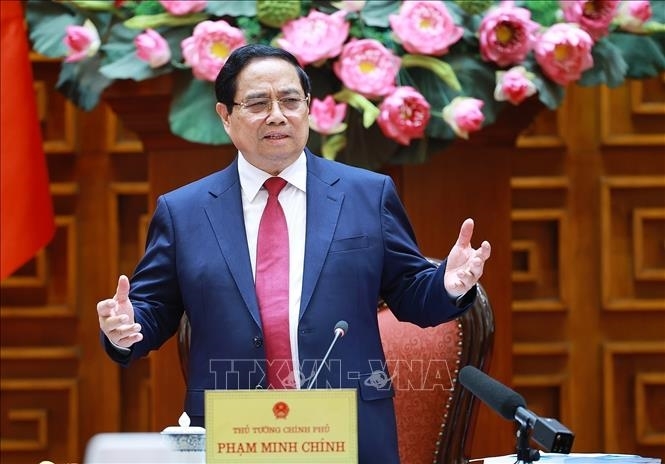
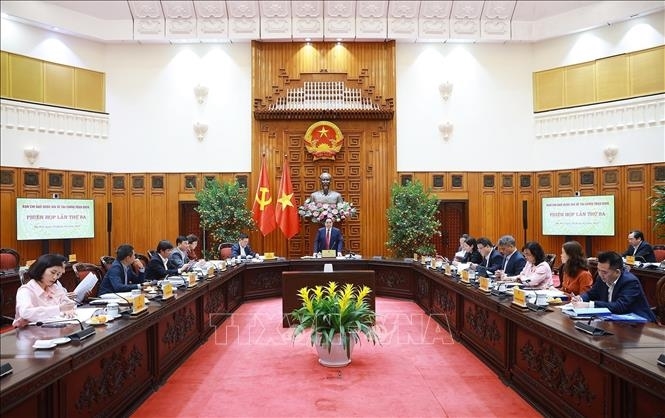
While chairing the third meeting of the National Steering Committee for Financial Inclusion in Hanoi on February 24 to review the 2020-2025 national financial inclusion strategy and oversee preparations for the next phase, PM Pham Minh Chinh, who is also its head, asked the State Bank of Vietnam (SBV) to work closely with the Government Office to incorporate feedback, finalize the 2026-2030 draft, and submit it to him for issuance.
    |
 |
|
Prime Minister Pham Minh Chinh addresses the meeting. |
He outlined a set of concrete, measurable targets for 2030: 95% of the population aged 15 and above holding a transaction account at a bank or licensed financial institution, cashless payment value reaching 30 times GDP, at least 30% of adults holding savings at credit institutions, at least 300,000 SMEs carrying outstanding loans from credit institutions, credit to agriculture and rural development accounting for around 25% of the total to the economy, at least 75% of adults having credit history data recorded in the SBV’s credit information system, and insurance industry revenue equivalent to 3.3%–3.5% of GDP.
The PM directed that the legal framework be further refined to create a supportive environment for financial inclusion goals. The strategy should foster a broad array of financial products and services, modern delivery channels, and convenient, affordable access for priority groups.
Digital financial infrastructure must be scaled rapidly to drive inclusion forward; the National Financial Education Program and Digital Citizen Program should be rolled out nationwide; consumer protection in financial services should be reinforced; sustainable finance, climate finance, and inclusive finance should be actively promoted; and safeguards for information security, cybersecurity, and personal data protection, and other necessary support should be in place.
|
|
 |
|
An overview of the meeting |
Designating the SBV as the lead agency for the steering committee, he directed relevant ministries and agencies to prepare detailed action plans aligned with the 2026–2030 strategy, clearly assigning roles, tasks, timelines, authority, accountability, and expected results.
Committee members were urged to proactively carry out their duties, guided by the spirit that “thinking must be clear, determination must be high, efforts must be great, and actions must be decisive,” for the country’s rapid and sustainable development.
For 2020–2025, six out of nine key targets outlined in the strategy were achieved. These include 86.97% of adults having a payment account at banks, 33% of adults having savings at banks in the past 12 months, an average annual rise of 58.86% in cashless payment transactions, roughly 290,000 SMEs with outstanding loans at credit institutions, 71% of adults with credit history recorded in the SBV’s system, and agriculture/rural development credit averaging about 24% of total outstanding credit.
Three targets, however, remain unmet: the density of bank branches and transaction offices per 100,000 adults, the rate of communes with financial service access points, and insurance premium revenue as a share of GDP, which stood at only around 2%.
Source: VNA