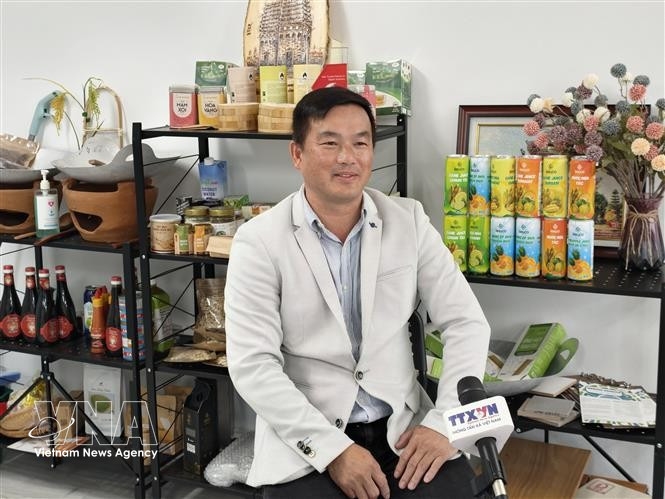
Speaking to Vietnam News Agency correspondents in Sydney on the occasion of Vietnam’s organization of the Spring Fair 2026, Nguyen Thanh Binh, CEO of KQ Trading and Chairman of the Vietnam - Australia Logistics and Investment Association, noted that Australian consumers are increasingly open to Vietnamese imports. He attributed this trend to improved product quality, distinctive flavors and compliance with Australia’s stringent standards, alongside the country’s highly multicultural society and rising demand for Asian foods.
    |
 |
|
Nguyen Thanh Binh, CEO of KQ Trading and Chairman of the Vietnam - Australia Logistics and Investment Association |
According to Binh, Vietnam’s key export items to Australia include textiles, tropical fruits such as dragon fruit, mango and coconut, coconut water, processed foods, spices, coffee and cashew nuts.
Specific products such as sugarcane juice from Lasuco (Thanh Hoa province), Viet Cuong vermicelli (Thai Nguyen province), Huynh Khoa fish sauce (Phu Quoc), Madam 6 banh hoi and Miss Banh Trang (Ho Chi Minh City) have gradually entered Australian distribution networks and received positive feedback from local consumers.
He stressed that beyond the growing number of Vietnamese products in Australia, there has been a marked improvement in quality, packaging, traceability and compliance with strict quarantine requirements. These factors are decisive for securing stable shelf space in major supermarket chains, rather than limiting distribution to Vietnamese community outlets.
With both countries participating in several new-generation free trade agreements, Binh said tariff reductions have strengthened the competitiveness of Vietnamese goods compared to products from Thailand, Malaysia, Indonesia and China. However, he emphasized that preferential tariffs are only a necessary condition. The sufficient condition lies in meeting strict technical standards on quarantine, certification, product quality and professional supply chain management.
Australia is widely regarded as one of the region’s most stringent markets in terms of quality control, particularly biosecurity and plant quarantine. Therefore, Vietnamese firms seeking deeper market penetration must standardize production processes, ingredients, labelling, packaging and logistics. Experienced intermediaries in the host country can help reduce risks, shorten market entry time and optimize costs, he added.
Binh also highlighted the role of multicultural trade fairs in Australia, which allow Vietnamese enterprises to reach not only the Vietnamese community but also local consumers and other Asian communities. This approach is essential for long-term brand building and market expansion.
In the opposite direction, Australia’s strengths lie in high-end agricultural and food products such as beef, lobster, wine, dairy and seasonal fruits including cherries, apples, grapes and blueberries. While highly regarded in Vietnam for quality and strict production controls, their higher production and labor costs position them in premium segments, requiring appropriate market strategies.
Against the backdrop of Spring Fair 2026, Binh underscored the need for professionally designed trade promotion events aligned with market demand and focused on substantive connections. Drawing from Australian experience, he said fairs should combine product displays with B2B matchmaking, specialized seminars and post-event follow-up mechanisms to ensure concrete cooperation outcomes.
In an increasingly competitive environment, he noted, the presence of international products at events like the Spring Fair will create positive pressure for domestic firms to improve quality, upgrade designs and keep pace with global consumption trends. Over the long term, this shift will help Vietnamese goods move from competing on price to competing on quality and brand value.
Source: VNA