From childhood memories to lifelong mission
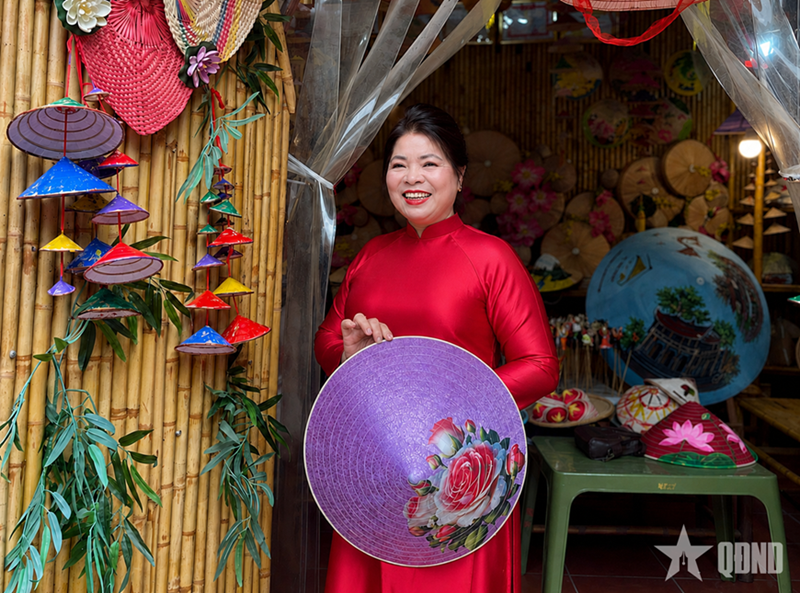
In the heart of Chuong village, Thanh Oai commune, Hanoi, the home of artisan Ta Thu Huong is always filled with countless conical hats in various styles and colors. Some retain the simple elegance of the traditional conical hats, while others are covered with silk, painted with landscapes, or adorned with motifs that reflect Vietnam’s rich cultural identity. Each hat represents the result of a decades-long journey that began when she first learned the craft from her mother.
    |
 |
|
Artisan Ta Thu Huong with her handcrafted conical hats |
Born into a family that had practiced hat making for generations, Huong grew up surrounded by the rhythmic sound of sewing needles and stacks of freshly made hats filling the family home. At the age of seven or eight, she began learning the trade. After school each day, she would sit beside her mother, patiently practicing every stitch.
As she grew older, Huong remained devoted to the family craft, but the journey was far from easy. A major turning point came in 1998 when she happened to meet a foreign customer who admired Vietnam’s traditional conical hats and placed an order for nearly 10,000 pieces. It was the largest order she had ever received, bringing new hope not only to her family, but also to many hat-making households in Chuong village. However, the excitement was short-lived. After the production was completed, the hats repeatedly developed mold during storage. Thousands of finished products piled up in the warehouse, making it impossible to deliver the order on time. The family's investment and the hard work of many local artisans seemed to be on the verge of being lost.
|
|
 |
|
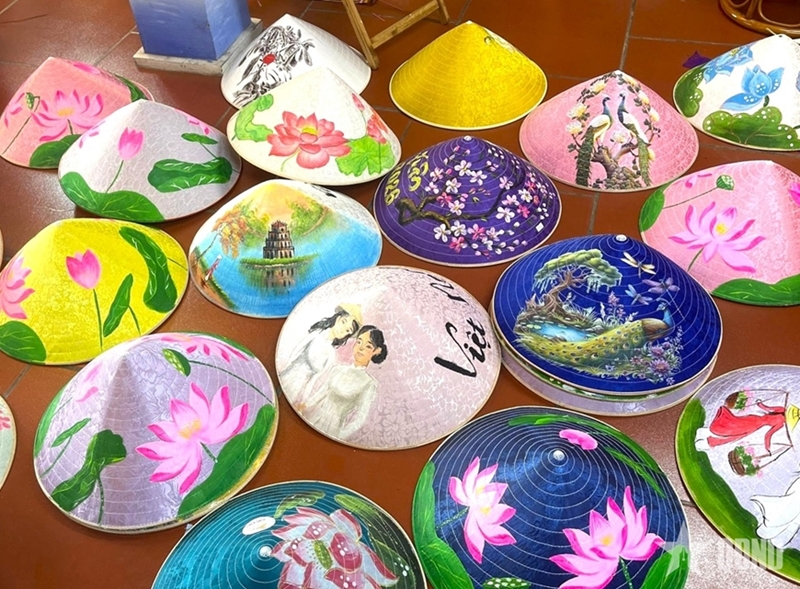
Conical hats of various sizes, colors, and designs displayed at artisan Ta Thu Huong's workshop |
Recalling that difficult period, artisan Ta Thu Huong shared that she was so discouraged that she even thought about giving up the craft altogether. Looking at the warehouse filled with stacks of hats, all she could do was sit there in silence. At what appeared to be the lowest point, she found encouragement from her husband, the local Craft Village Association, and fellow artisans in Chuong village.
Their support gave her the determination to start over. She gradually improved the production process, solved quality-control issues, and actively sought out new markets. Her perseverance eventually paid off. Today, her family exports more than 5,000 conical hats each month to numerous countries across Europe and Asia.
From those first export orders, Chuong village’s iconic conical hats gradually found their way to Japan, France, Russia, the Republic of Korea, Thailand, and many other countries. This success not only strengthened Huong’s commitment to preserving the traditional craft but also inspired her to continue exploring new opportunities for bringing Chuong village’s conical hats to even more international markets.
Breathing new life into traditional conical hat
Holding a newly-finished conical hat in her hands, artisan Ta Thu Huong enthusiastically described every stage of the craft. Producing a traditional Vietnamese conical hat involves numerous meticulous steps, including selecting palm leaves and bamboo sheaths, shaping the frame, assembling the rings, sewing the hat, attaching the rim and top, applying a protective oil coating, and decorating the finished product. The palm leaves and bamboo sheaths are sourced from the forests of Huong Son in Ha Tinh province before being carefully processed to transform their natural green color into a smooth, ivory-white finish. Hat makers must also carefully select the inner and outer layers of leaves and stitch them with great precision so that the seams remain nearly invisible while ensuring the hat is durable enough to protect the wearer from both sun and rain.
|
|
 |
|
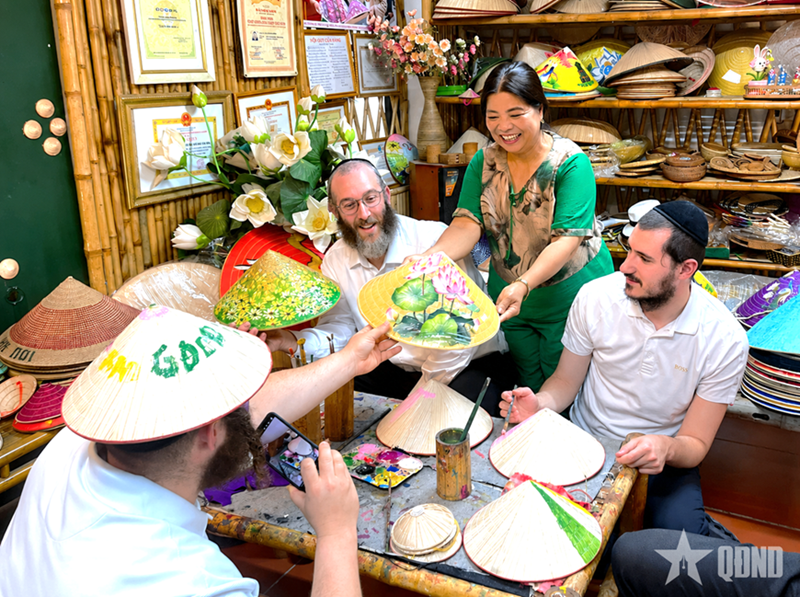
Artisan Ta Thu Huong (in blue) introduces traditional conical hats of Chuong village to international visitors. |
As consumer tastes evolved, however, Huong realized that preserving tradition alone was not enough. While continuing to produce classic conical hats, she began experimenting with new materials and designs to increase the products’ artistic and commercial value. The hat frame is still handcrafted using the centuries-old techniques of Chuong village, but the outer layer may be covered with colorful silk instead of traditional palm leaves. Some hats feature the elegant purple associated with Hue, others are decorated with lotus flowers on an ivory-white background, while emerald-green designs are embellished with carefully arranged traditional motifs.
Beyond introducing new materials, many of her hats are hand-painted with images of Vietnam’s famous spots, including Ha Long Bay, the Imperial City of Hue, and the peaceful countryside of northern Vietnam, and others.
Her innovations have enabled the products to appeal to a much broader customer base. In addition to domestic consumers, many organizations now choose her conical hats as gifts for cultural exchanges and diplomatic events. Each year, around 60,000 hats are produced and sold to the market. To meet growing demand, Huong has steadily expanded her business. Apart from her family’s main workshop, she has invested in additional raw materials, a showroom, and an export packaging facility. Her workshop has also created employment opportunities for local people.
She is currently developing the Bamboo and Conical Hat Cooperative, which features a traditional craft experience area, an exhibition space, photo check-in spots for visitors, a rest area, parking facilities, and an export packaging center. The cooperative has gradually become a popular destination for both domestic and international visitors interested in learning about the centuries-old hat-making tradition of Chuong village.
At the same time, Huong offers free training classes for students, and schools wishing to explore the traditional craft. In her view, passing on the profession is about far more than teaching people how to sew hats, it is about helping younger generations appreciate the cultural value of Vietnam’s traditional handicrafts.
Translated by Quynh Oanh