Amidst the resonating sounds of drums, gongs, and bronze bells, accompanied by solemn prayers in the Nom Dao script, the shaman represented the community in reporting its achievements to deities and ancestors while praying for favorable weather, bountiful harvests, and peace and prosperity for the village.
At the Cham cultural space, artisans and performers from the Cham Balamon community in Khanh Hoa province reenacted several rituals and traditional dances from the Rija Praong Festival. Beyond its religious significance, the festival reflects the community’s respect for its roots, gratitude to ancestors, intergenerational solidarity, and shared responsibility for preserving Cham cultural identity.
    |
 |
|
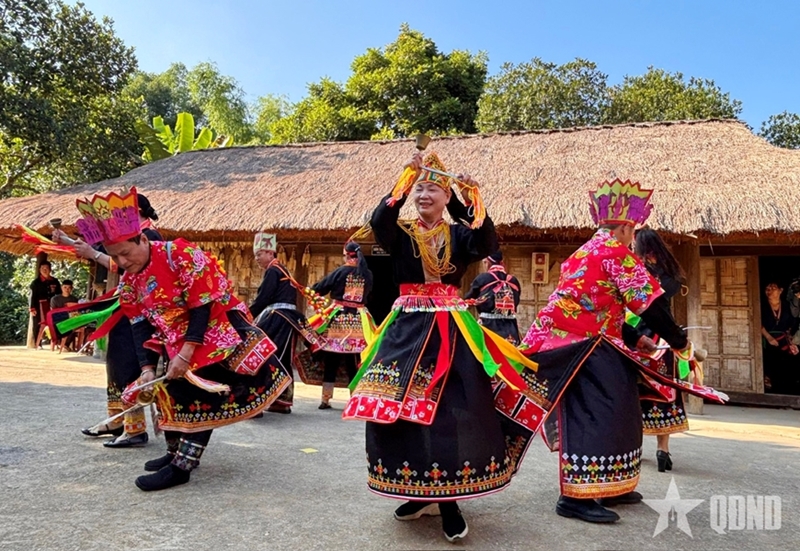
The traditional Song Mun ritual for peace and well-being of the Dao ethnic community in Quang Ninh city is reenacted at the Viet Nam National Village for Ethnic Culture and Tourism. |
The sound of ginang drums and saranai horns blended with the ritual singing of the maduen and the dancers’ movements, bringing ritual and traditional performance together.
Dang Chi Quyet, a respected representative of the Cham community in Khanh Hoa province, expressed his happiness at returning to the Viet Nam National Village for Ethnic Culture and Tourism to meet visitors and introduce the cultural heritage of his community. He shared stories about ancient Cham towers, the Kate Festival, the sounds of ginang drums and saranai horns, the My Nghiep brocade-weaving craft, and particularly the Bau Truc pottery tradition.
“We hope more cultural exchange, performance, and traditional knowledge-sharing activities will be organized so that younger generations can better understand their roots and carry forward the values inherited from their ancestors,” he said.
Over the years, the Viet Nam National Village for Ethnic Culture and Tourism has become a common home for the country’s 54 ethnic groups, helping preserve their traditional cultural heritage and introduce it to the public and visitors.
To mark Viet Nam Culture Day (November 24), the village has organized a series of distinctive cultural activities. The program began with the launch of activities in response to Viet Nam Culture Day 2026 in Ha Noi on October 3, accompanied by exhibitions, performances, cultural exchanges, and interactive experiences.
Other highlights include “Heritage Roots in the Heart of the Capital,” which showcases the traditions of 16 ethnic communities with a regular presence at the village, “Cultural Colors of Viet Nam’s Ethnic Groups,” and cultural exchanges with Central Highlands and Northern communities.
Ngo Thi Hong Tham, Director of the Viet Nam National Village for Ethnic Culture and Tourism, emphasized that the series of activities not only provides a diverse platform for cultural exchange and experiences but also plays a practical role in honoring and promoting the traditional cultural values of Viet Nam’s 54 ethnic groups.
By directly involving artisans, respected community members, and cultural practitioners in performances and heritage presentations, the activities help bring traditional culture closer to the public. Visitors are given opportunities not only to enjoy the performances but also to explore, experience, and gain a deeper appreciation of the cultural heritage of each ethnic community.
Translated by Quynh Oanh