The courses focus on the application of artificial intelligence (AI) tools in multi-platform and multimedia journalism, and on journalism skills for producing news and media content using portable devices.
The launching event represents a significant step in implementing strategic cooperation commitments between Vietnam and Laos in the field of media and communications, contributing to the development of a modern revolutionary press capable of meeting the demands of digital transformation.
In his remarks, Vansy Kuamoua, member of the LPRP Central Committee and Vice Chairman of its Commission for Information and Education, described the training programs as a concrete outcome of the memorandum of understanding on bilateral cooperation signed by the two sides on May 13.
    |
 |
|
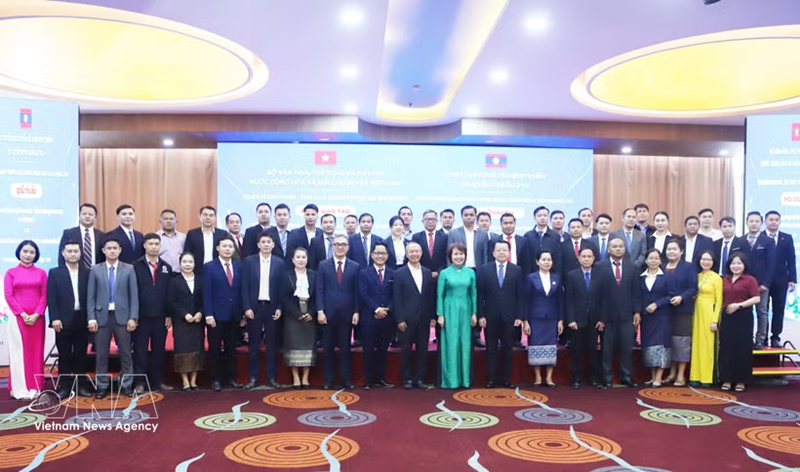
Delegates of Laos and Vietnam at the ceremony launching two specialized training courses for Lao journalists in Vientiane on June 22 |
He noted that the courses mark the first practical step in a broader five-year cooperation program for 2026 – 2030, which includes 15 major joint initiatives. The participation of 40 key journalists, including eight women, from central, military, police and provincial media organizations demonstrates the Lao press sector’s determination to advance digital transformation in a coordinated manner, he said.
Deputy Director of the Authority of Press under Vietnam’s Ministry of Culture, Sports and Tourism Dang Thi Phuong Thao highlighted the profound impact of digital technologies, artificial intelligence, social media platforms and mobile devices on journalism, noting that they are fundamentally reshaping content production, distribution and audience engagement.
In this context, she said, modern journalists must not only possess traditional reporting and writing skills but also be capable of utilizing new technologies, analyzing data, effectively applying artificial intelligence tools, producing multimedia content and adapting to increasingly diverse communication platforms.
While artificial intelligence offers significant opportunities to improve productivity, support complex data analysis and enhance creative processes, technology can never replace the professional integrity, judgment and ethical responsibility of journalists, she stressed. In an era marked by the rapid spread of misinformation and disinformation online, the core values of revolutionary journalism – accuracy, objectivity, social responsibility, professional ethics and political mettle – remain more important than ever.
The five-day training program includes practical and advanced modules on the applications of artificial intelligence (AI) in journalism, such as prompt engineering for text, image, audio and video production, the creation of personalized AI assistants without coding requirements, and awareness of legal and ethical issues associated with AI use.
Participants in the mobile journalism course will also receive hands-on training in producing multimedia content quickly and effectively using mobile devices in field-reporting environments.
According to Thao, since 2011, Vietnam has coordinated the organization of 25 professional training courses for nearly 1,000 Lao journalists on a wide range of topics aligned with global media trends.
Source: VNA