Following Uncle Ho’s footsteps in Thailand
Whether in modern Bangkok or the Northeastern provinces with large Vietnamese communities, affection for Vietnam is clearly visible. In conversations, overseas Vietnamese in Thailand continue to speak of the motherland with heartfelt emotion.
In Udon Thani province’s Vietnam Town, Vietnamese signs, national flags, and children learning Vietnamese create the atmosphere of a small homeland abroad.
    |
 |
|
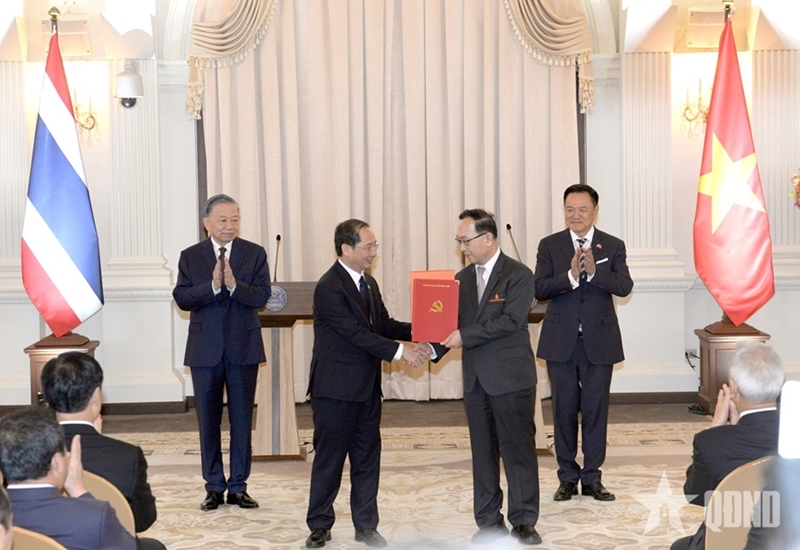
General Secretary and State President To Lam and Thai Prime Minister Anutin Charnvirakul witness the exchange of cooperation agreements. |
For several days, Thai media and the local Vietnamese community eagerly awaited the visit of General Secretary and State President To Lam. Many overseas Vietnamese travelled long distances to welcome the delegation. The presence of the Party and State leader To Lam, his spouse, and the high-ranking Vietnamese delegation at the VT Nam Nueng Center that late afternoon created moments of warmth and sincerity.
At the center, the top leader shared Vietnam’s transformation and development aspirations in the new era, inspiring pride and confidence among overseas Vietnamese. Vietnamese Ambassador to Thailand Pham Viet Hung happily noted that around 100,000 Vietnamese and Thai-Vietnamese in Thailand continue preserving national identity while serving as a bridge to promote bilateral friendship and sustaining respect for President Ho Chi Minh.
Despite a tight schedule, General Secretary and State President To Lam visited sites linked to President Ho Chi Minh and Vietnam’s revolutionary history. At the Ho Chi Minh Memorial Site in Udon Thani, stories of Uncle Ho’s revolutionary activities under the alias “Thau Chin” deeply moved the delegation.
Standing beside the well and simple wooden house where Uncle Ho once lived, the General Secretary and State President asked about the support local people and overseas Vietnamese gave the leader during difficult years.
During his time in Udon Thani from 1928, Uncle Ho encouraged overseas Vietnamese to work hard, remain united, respect Thai laws, and build good relations with local residents. He also urged them to learn Thai language and culture. His philosophy of “more friends, fewer adversaries” remains a guiding principle today.
In the visitors’ book, Party and State leader To Lam described the memorial site as both a sacred historical and cultural landmark for overseas Vietnamese and a vivid symbol of Vietnam-Thailand close bond.
Nearly a century later, the “seeds of friendship” planted during those years continue to grow. The diplomatic ties established in 1976 were elevated to a strategic partnership in 2013 and a comprehensive strategic partnership in 2025. Thailand is now one of Vietnam’s leading economic partners.
Advancing “Three Connections” Strategy
During two days of intensive activities, leaders of both countries demonstrated openness, trust, and determination to deepen bilateral cooperation in a more practical and effective manner within ASEAN’s development framework.
At the Vietnam - Thailand Business Forum themed “Growing Together,” both sides stressed the importance of stronger ASEAN cooperation in a world increasingly fragmented by strategic competition, supply-chain disruptions, and growth pressures.
General Secretary and State President To Lam called for deeper and more sustainable Vietnam - Thailand relations through the “Three Connections” Strategy which focuses on supply chains, businesses and localities, and sustainable development strategies.
A positive sign of growing economic integration within regional supply chains is that Vietnam’s exports of computers, electronics, and components to Thailand exceeded USD 1 billion in the first four months of 2026, up 29.2 per cent. Meanwhile, Thai high-tech products, household electrical appliances and automobile parts, remain popular in Vietnam.
At the meeting with Executive Chairman of TCC Group and CEO of ThaiBev, the Vietnamese top leader reaffirmed Vietnam’s commitment to improving the investment and business environment and prioritizing projects with high quality, advanced technology, modern governance, while encouraging the Thai group to integrate more deeply into supply chains.
He noted that Vietnam’s dynamism and Thailand’s experience could complement each other to build supply chains, production and distribution hubs, trade and service platforms and new growth drivers for both countries and ASEAN.
With over USD 15 billion in investment, bilateral trade exceeding USD 22 billion, and nearly 20 pairs of localities linked through cooperation agreements, Vietnam - Thailand relations have surpassed a normal partnership. However, Secretary General and State President To Lam stressed the need to deepen practical connectivity among businesses, localities, logistics systems, and supply chains while translating strategic commitments into concrete cooperative programs that create tangible value for both economies.
The visit also reflected a broader vision of strengthening ASEAN connectivity to improve the region’s competitiveness, resilience, and global standing in an increasingly volatile world.
Seen in historical perspective, the Vietnamese top leader’s visit has marked a new stage in Vietnam - Thailand relations, moving toward deeper, more dynamic, and more substantive cooperation for sustainable development future of ASEAN.
By Pham Kien (from Bangkok, Thailand)
Translated by Mai Huong