Mounting pressure for transformation
Reviewing the current growth model, Assoc. Prof., Dr. Tran Dinh Thien, former Director of the Vietnam Institute of Economics, said sustaining high growth over the long term is an ambitious objective that cannot be achieved through incremental adjustments to conventional policy tools. Instead, it requires a fundamental shift in development mindset.
    |
 |
|
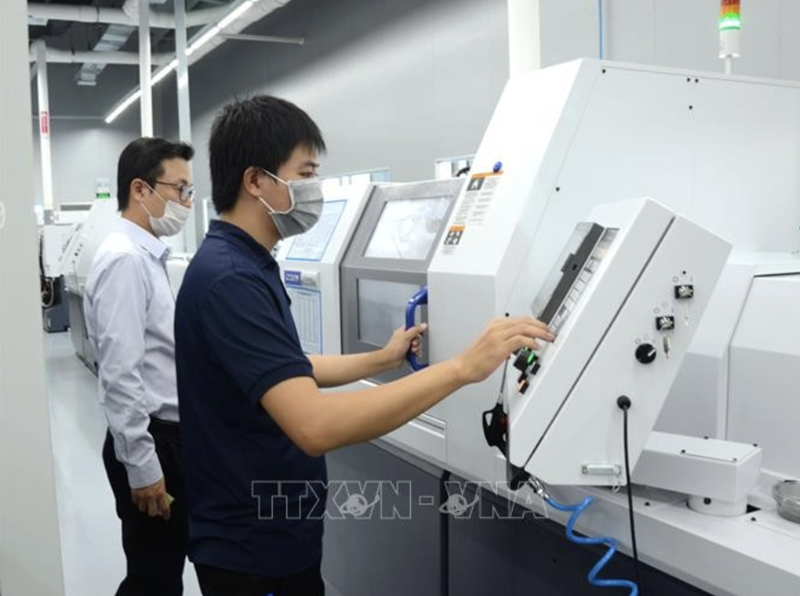
Operation of a modern machine learning system at Da Nang Hi-Tech Park (Photo for illustration) |
He noted that today’s economic landscape bears little resemblance to the past. Rapid technological advances and digital transformation are restructuring production, governance and social organization at an unprecedented pace. In this context, clinging to established trajectories will not generate sufficient momentum to meet future targets.
Resolution 57, therefore, positions digital transformation and innovation not as supporting measures, but as core components of the development model itself. Realizing this vision, however, requires a comprehensive reassessment of the capacity of all actors, from state agencies and enterprises to research institutions, to determine priority areas for concentrated investment.
Yet, translating ambition into reality remains complex. Dr. Thien underscored that implementation capacity and organizational effectiveness are the decisive factors. Without clearly defined priorities and disciplined resource allocation to key sectors, the transition risks losing speed and coherence.
Against this backdrop, he argued, the social sciences must move beyond commentary to play a more strategic role. By analyzing emerging challenges, anticipating risks and offering policy options, they can help lay the intellectual groundwork for a renewed development strategy suited to a rapidly evolving environment.
Institutions as the critical enabler
Prof. Vo Khanh Vinh, former Vice President of the Vietnam Academy of Social Sciences (VASS), stressed that the success of Resolution 57 hinges not only on technology or funding, but fundamentally on institutional reform.
As the digital economy and knowledge-based sectors expand, institutions must evolve accordingly, regulating not only traditional economic relationships but also new resources such as data and intellectual capital.
At VASS, implementation has included organizational restructuring, revisions to internal governance regulations, improvements in policy advisory procedures and the development of scientific management mechanisms to strengthen research performance. These measures are intended to align institutional capacity with the Resolution’s higher standards.
Nonetheless, bottlenecks persist. Some assigned tasks have progressed more slowly than planned, certain research outputs and policy advisory reports have yet to meet rising expectations, digital transformation efforts remain uneven, and research infrastructure continues to show disparities.
Prof. Vinh emphasized the need to shift from an administrative management mindset to a development-oriented governance approach, with the State serving as an enabler that cultivates a supportive ecosystem for science, technology and innovation.
He also called for stronger forecasting capabilities and more robust policy design, alongside expanded programs to review practical experience, conduct large-scale surveys and build comprehensive social science databases. These steps are essential to ensure that strategic decisions are grounded in reliable evidence and aligned with on-the-ground realities.
Initial outcomes suggest that Resolution 57 is gradually being embedded into practice. However, the experience to date underscores the necessity of continued institutional refinement, capacity enhancement and fresh thinking to secure sustained growth in the years ahead.
Ultimately, the Resolution represents more than a technical recalibration. It signals a deeper transformation in development philosophy and methodology – one in which the social sciences assume a central role in shaping the policy architecture for Vietnam’s next phase of growth.
Source: VNA