“As clear as a cloudless sky”
In New Delhi, talks between Party General Secretary and State President To Lam and Indian Prime Minister Narendra Modi took place in a friendly, open, trusting, and effective atmosphere, reflecting both sides’ determination to strengthen bilateral relations.
Built on traditional friendship and strong political trust, the two leaders discussed key strategic issues and concrete cooperation areas. They agreed to elevate ties to an enhanced comprehensive strategic partnership in the spirit of “shared vision, strategic convergence, and substantive cooperation.”
    |
 |
|
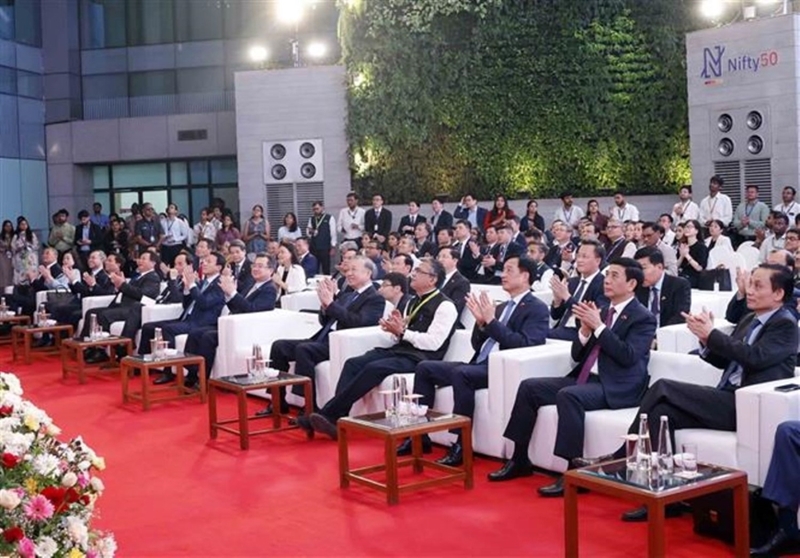
Party General Secretary and State President To Lam and delegates at the National Stock Exchange of India (Photo: VNA) |
Following the signing ceremony of cooperation documents, the two leaders announced new progress in bilateral relations at a press briefing. Only minutes later, Indian and international media widely praised the visit’s outcomes, with The Hindu (India) calling it a milestone marking a new phase of cooperation.
Despite being only the second day of the visit, the intensive schedule of Party and State leader To Lam and the Vietnamese delegation demonstrated a strong commitment to developing cooperation opportunities in an intensive and effective manner.
The Vietnamese leader expressed confidence that the outcomes would open a new stage in bilateral ties. This confidence is rooted in the time-tested friendship between the two countries, laid by President Ho Chi Minh of Vietnam and Prime Minister Jawaharlal Nehru of India who shared profound empathy and common ideals in the struggle for national independence and freedom, cultivated by generations of the two countries’ leaders and tempered through historical upheavals. The bilateral friendship is flourishing vibrantly.
In his speech at the Indian Council of World Affairs (ICWA), General Secretary and State President Lam emphasized that the shared historical journeys of struggle for national independence and construction forged deep empathy, solidarity and close ties between the two countries. He stressed that Vietnamese people still remember the slogan “Mera Nam, Tera Nam, Vietnam-Vietnam,” once echoed across streets in many Indian cities as a testament to Indian people’s support for Vietnam during wartime. India established diplomatic relations with Vietnam in 1972 despite external political pressure. Late Prime Minister Pham Van Dong of Vietnam once described this rare relationship as “as pure as a cloudless sky.”
Over the past decade, Vietnam - India relations have become one of the most stable and positive cooperation models in the Indo-Pacific. Especially, the comprehensive strategic partnership established in 2016 and the “Five orientations” have further strengthened the relationship.
Creating new momentum for development
During the three-day visit, General Secretary and State President To Lam and the Vietnamese delegation carried out an intensive and effective agenda. The visit was especially significant as it marked the Vietnamese leader’s first trip to India in his new positions and coincided with the 10th anniversary of the two countries’ comprehensive strategic partnership. The visit became an important milestone, creating new momentum and shaping a new framework for bilateral cooperation between Vietnam and India at a higher level.
In meetings with Indian President, PM, and other senior leaders, both sides discussed cooperation across politics, diplomacy, defense, security, economy, trade, science and technology, innovation, and people-to-people exchanges, aiming to further deepen bilateral ties.
This stemmed from Vietnam’s high regard for its relationship with India while India considers Vietnam a key partner in its “Act East” policy. As dynamic developing nations with broad markets, shared strong aspirations for growth, aiming toward the centennial milestones of national founding, both countries are well positioned to elevate their partnership further.
Amidst global uncertainties, digital transformation, and shifts in global supply chains, Vietnam and India are expanding cooperation into strategic sectors, including high technology, new energy, and innovation.
During meetings and policy forums, General Secretary and State President To Lam highlighted the need to make science, technology, and innovation new driving forces of bilateral relations, prioritizing artificial intelligence, semiconductors, and digital transformation aligned with each country’s development needs.
|
|
 |
|
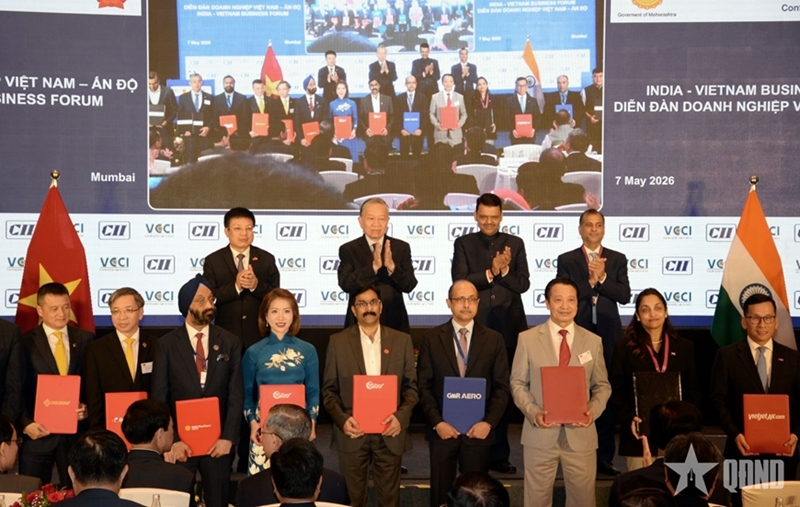
Party General Secretary and State President To Lam and senior leaders of both countries witness the exchange of cooperation agreements between Vietnamese and Indian businesses. (Photo: Pham Kien) |
As India rises as a global technology hub while Vietnam accelerates digital transformation and the development of a knowledge-based economy, similarities in development vision of the two nations are opening new, deeper, and breakthrough cooperation opportunities.
During the top leader of Vietnam’s visit, economic ties were also promoted in a more practical and market-oriented direction. Bilateral trade has surpassed USD 16 billion and continues to grow strongly. However, the highlight lies not only in the figure, but also in how both sides are proactively creating “new drivers” for these economic flows. It was no coincidence that the Vietnamese delegation chose Mumbai, India’s leading financial, industrial, and technological hub, where capital, technology, and development aspirations converge.
In Mumbai, Party and State leader To Lam engaged in a series of highly symbolic activities, including ringing the bell at the National Stock Exchange of India, attending a business forum, and meeting leading Indian investors, thereby directly promoting market connectivity and strengthening business cooperation between the two countries.
As Prime Minister Narendra Modi noted, shared values, visions, and aspirations form the foundation for both countries to support each other and contribute to regional and global peace, stability and development.
The state visit to India by General Secretary and State President To Lam and the high-ranking Vietnamese delegation was highly successful, reaffirming Vietnam’s foreign policy of independence, self-reliance, self-strengthening, peace, friendship, cooperation, multilateralization and diversification of external relations, and being responsible member of the international community.
By Pham Kien (from Mumbai, India)
Translated by Mai Huong