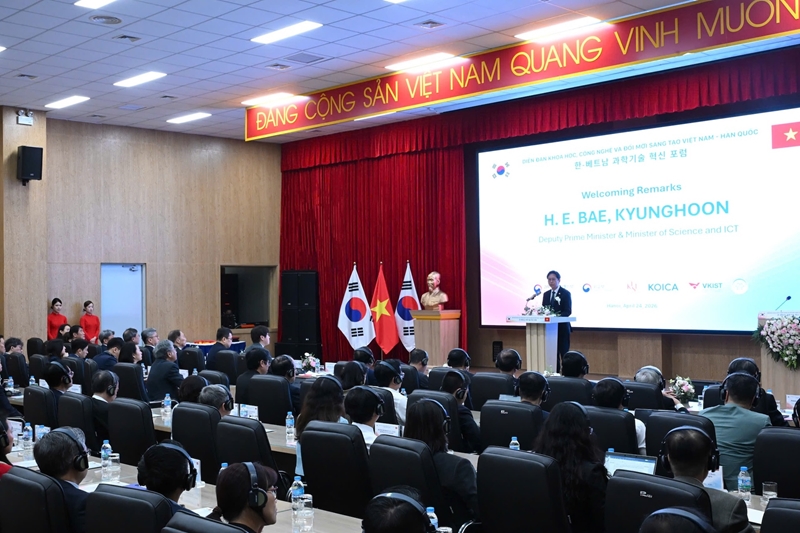
Co-chaired by Vietnamese Minister of Science and Technology Vu Hai Quan and RoK Deputy Prime Minister and Minister of Science and ICT Bae Kyung Hoon, the event focused on matching demand, forging partnerships and accelerating concrete joint projects to deliver actual results for both economies.
Advancing strategic technology development
In his opening speech, Quan said science, technology, innovation, and digital transformation have been designated as one of the top pillars of bilateral cooperation in the time ahead. Both sides agreed to deepen collaboration, with a focus on delivering concrete products.
    |
 |
|
An overview of the forum (Photo: VGP) |
The two ministries will increase the sharing of experience in building and rolling out strategic technology portfolios, thus maximizing similar development goals, he noted.
At the same time, the Korea Institute of Science and Technology (KIST) and the Vietnam – Korea Institute of Science and Technology (VKIST) will beef up cooperation. VKIST is expected to pilot breakthrough policies in science – technology and innovation, while KIST will lend a hand on strategy development and policymaking to turn VKIST into a flagship symbol of bilateral teamwork in these fields, he said.
Manpower training in science and technology was highlighted as a top priority to produce skilled experts and scientists capable of mastering and integrating advanced technologies. The minister noted that both sides have largely agreed on these priorities, setting a strong foundation for future collaboration.
Echoing these views, Bae said both sides will push harder on strategic cooperation, develop VKIST into a central hub, and expand the collaboration network nationwide to promote such areas as artificial intelligence, semiconductors, and high technology while accelerating the commercialization of research outcomes.
Expanding cooperation mechanisms
Prof., Dr. Tran Hong Thai, President of the Vietnam Academy of Science and Technology (VAST), said the academy isn’t just about pure scientific research; it has engaged in developing core technologies, setting technology priorities, linking innovation ecosystems, and advising on policy.
VAST has already teamed up with several Korean partners, including Chungnam National University, Seoul National University, Wonkwang University, KIST and the Korea Research Institute of Chemical Technology, creating a strong base for joint research and training.
|
|
 |
|
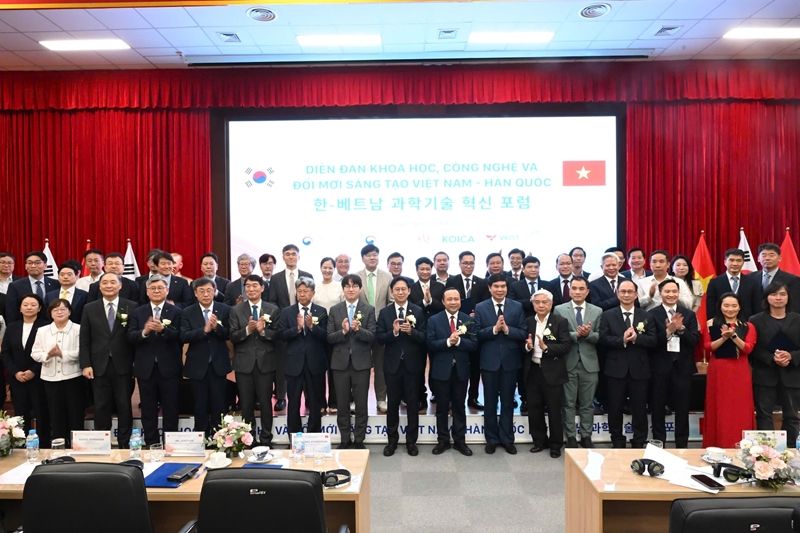
Delegates pose for a joint photo at the forum. (Photo: VGP) |
In hydrogen technology, while VAST has conducted initial studies on storage materials and carriers, mainly at laboratory scale, the RoK has developed a relatively complete ecosystem from research to real-world application. This provides a basis for expanded cooperation linking research with technology development and pilot projects.
Similarly, in biopharmaceuticals and cosmetics, VAST boasts strengths in natural compounds, organic synthesis, microbiology, and cell technology, but it still lags in deep processing, formulation, and bringing products up to international standards, exactly where the RoK has serious expertise.
Based on these strengths, VAST is ready to connect research institutes, universities and companies; launch joint studies, labs and manpower training; and make better use of existing cooperation mechanisms like the Korea International Cooperation Agency (KOICA) and the VKIST model, he said.
At the event, participants highlighted the importance of introducing new ways to collaborate such as joint postgraduate programs in advanced technologies, increasing scientist exchanges between institutes and businesses, attracting foreign experts, and encouraging companies to invest directly in university labs and training facilities.
|
|
 |
|
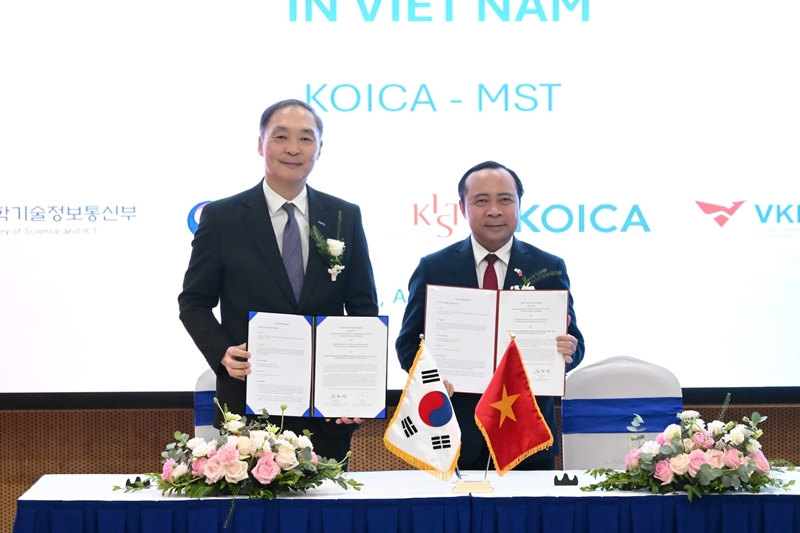
The Vietnamese Ministry of Science and Technology and KOICA sign a record of discussion on the Vietnam – Korea Institute of Science and Technology (VKIST) project. (Photo: VGP) |
On the occasion, the Vietnamese Ministry of Science and Technology and KOICA signed a record of discussion on the VKIST project, kicking off its second phase. The project will roll out under the framework agreement on non-refundable aid signed between the two governments on May 29, 2009. The second phase is expected to use about 30 million USD in grant aid from the Korean Government and run through 2033.
Source: VNA