In her welcome remarks, Veronica Squinzi, Vice President for International Affairs of the Lombardy Business Association under the General Confederation of Italian Industry, emphasized that the official visit of N.A. Chairman Man to Italy marks an important milestone in the strong relationship between the two countries. It provides an opportunity to reaffirm their shared commitment to strengthening political dialogue and deepening economic and technological cooperation based on shared values, mutual respect, and a forward-looking vision.
    |
 |
|
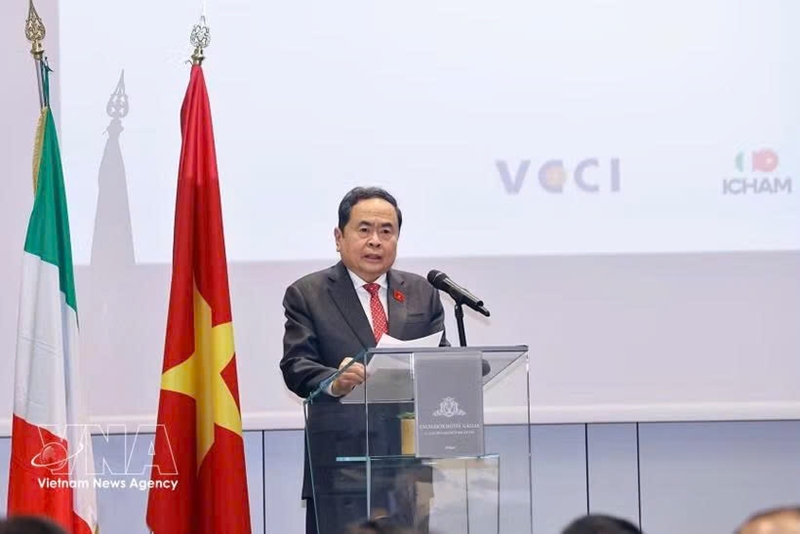
Chairman of the National Assembly Tran Thanh Man speaks at the policy dialogue. |
According to Veronica Squinzi, amid global economic instability, geopolitical tensions, and ongoing transformations in global value chains, cooperation among reliable partner countries is more necessary than ever. Enhanced Vietnam–Italy cooperation will foster innovation and support sustainable and inclusive development in both countries.
Italy and Vietnam have established diplomatic relations for more than 50 years and have maintained a Strategic Partnership for over a decade. Italy is one of Vietnam’s key partners in Europe, and bilateral relations have continued to strengthen following the entry into force of the E.U.–Vietnam Free Trade Agreement (EVFTA). For Italy, Vietnam serves as a gateway to the ASEAN market.
As Italy’s leading economic region, Lombardy is the heart of the country’s industrial and technological system. Milan, its capital, is Italy’s premier financial and business hub and a gateway to the European market for international enterprises and investors. Lombardy is also Italy’s leading region in trade relations with Vietnam. The launch of a direct flight between Hanoi and Milan has further enhanced connectivity and created new opportunities for economic and investment cooperation.
Notably, she said many Italian companies operating in Vietnam originate from Lombardy. These companies are active in strategic sectors such as mechanical engineering, industrial automation, infrastructure development, renewable energy, agriculture, and advanced manufacturing. They not only contribute to strengthening trade and investment ties but also facilitate technology transfer, management expertise, and professional standards. At the same time, Lombardy offers Vietnamese businesses and organizations an excellent entry point into Italy’s industrial and innovation ecosystem in Europe.
Raffaele Cattaneo, Undersecretary of the Lombardy Region, stated that relations between Lombardy and Vietnam go beyond a conventional trade partnership, representing a historically grounded and strategically significant connection. Since 2003, Lombardy has identified Vietnam as a priority partner in ASEAN. The inauguration of the direct Milan–Hanoi flight stands as clear evidence of successful cooperation, not only to boost tourism but also to serve as a vital bridge for trade, cultural exchange, and the narrowing of geographical distance.
He stated that with strong technological capacity and expertise, Lombardy sees significant development opportunities in Vietnam - a country experiencing impressive GDP growth (over 8% in 2025). Lombardy-based enterprises are ready to support Vietnamese partners in high-tech expertise, particularly in mechanical manufacturing, green transition and renewable economy for sustainable development, education and workforce training cooperation, as well as the restoration of architectural and cultural heritage.
In the context of Vietnam streamlining its administrative apparatus, Lombardy has expressed particular interest in establishing cooperative relations with several Vietnamese localities, Cattaneo said, expressing confidence that with the visit by N.A. Chairman Man, Italy–Vietnam cooperation will continue to strengthen, bringing practical benefits to businesses and people in both countries.
Speaking at the dialogue, N.A. Chairman Man stressed that the policy dialogue on enhancing Vietnam–Italy cooperation is of special significance as bilateral relations enter a new phase of deeper, more effective, and more substantive development.
He affirmed that the dialogue is not only an important occasion for enterprises from both countries to meet and explore investment and trade opportunities, but also a vivid symbol of over 50 years of traditional friendship and more than a decade of Strategic Partnership - nurtured by generations of leaders and people of both nations through trust, sharing, and sincere goodwill.
The top legislator noted that after four decades of renewal, door-opening, and integration, Vietnam has made remarkable progress. The country is currently implementing three strategic breakthroughs: developing strategic infrastructure; improving institutions and building a transparent, favorable investment environment; and developing high-quality human resources alongside innovation, science and technology application, digital transformation, and the advancement of green, circular, and knowledge-based economies.
As a result, Vietnam has risen from a poor, war-torn country to achieve significant accomplishments. From an economy of about 4 billion USD at the start of the reform period, it has grown to an estimated 514 billion USD today, ranking 32nd globally and 4th in ASEAN. Vietnam’s per capita income in 2025 hit 5,026 USD, placing it among upper-middle-income countries, while GDP growth in the first quarter of 2026 reached 7.83%.
According to the Vietnamese leader, Vietnam is among the top 15 developing countries attracting the largest foreign direct investment (FDI), with cumulative registered FDI reaching about 530 billion USD. In 2025, Vietnam remained a stable and sustainable destination for international investment flows, with total registered capital exceeding 38.4 billion USD.
Total trade turnover between Vietnam and its partners reached 930 billion USD last year, placing it among the world’s top 20 most open economies. Vietnam has signed 17 free trade agreements with over 60 countries and territories, including major global markets, while continuously diversifying markets, products, and supply chains. Energy and food security are firmly ensured.
On that basis, N.A. Chairman Man revealed that Vietnam aims for GDP growth exceeding 10% in 2026 and sustained double-digit growth during 2026–2030. The country is determined to successfully implement administrative reforms; address institutional, human resource, and infrastructure bottlenecks; and create a favorable environment for production, investment, and business. Efforts to combat corruption and negative practices are being strengthened to bolster investor confidence.
Vietnam is also striving for breakthroughs in science and technology development, innovation, and national digital transformation to achieve two strategic goals: becoming a developing country with modern industry and upper-middle income by 2030, and a developed, high-income country by 2045, he added.
To achieve these goals, he stressed that Vietnam will maximize internal strengths while effectively leveraging external resources through international integration and cooperation. Internal strengths include people, natural resources, and culture - the three fundamental pillars of national strength while external resources stem from international integration and the power of the times. The combination of these forces will create new momentum for national development.
“Vietnam seeks not only to move fast, but to move steadily, go far, and move forward together,” he noted.
According to the N.A. Chairman, Vietnam and Italy share a longstanding friendship built on trust, mutual respect and a shared commitment to peace, development and prosperity. In recent years, their Strategic Partnership has been steadily strengthened and expanded across areas including economy, trade, investment, cultural, educational and people-to-people exchanges.
|
|
 |
|
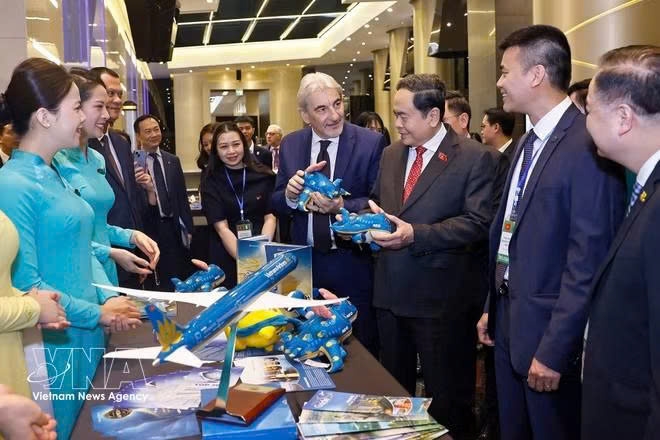
Chairman of the National Assembly Tran Thanh Man and delegates visit the booth of Vietnam Airlines. |
Italy is among Vietnam’s leading partners in Europe. Conversely, Vietnam ranks as one of the fastest-growing and most dynamic economies in the Asia-Pacific, with an improving investment climate, a young workforce, a large market and deepening global integration, providing favorable conditions for the two sides to expand complementary cooperation.
To date, Italian investors have poured capital into 167 projects in Vietnam, with total registered investment exceeding 633 million USD, ranking 31st out of 154 countries and territories investing in the country. Overall, while bilateral investment remains modest in scale, the potential for further cooperation is substantial.
Amidst accelerating globalization, green and digital transitions, Vietnam and Italy are well positioned to complement each other and optimize their respective strengths toward sustainable, inclusive and resilient growth.
On that basis, the leader urged both sides to translate cooperative intent into tangible outcomes, focusing on priority areas, including further refining institutional and legal frameworks to facilitate trade and investment, particularly as the EU-Vietnam Free Trade Agreement (EVFTA) is being effectively implemented.
He also called for stronger cooperation in areas where Italy has strengths and Vietnam has demand, such as manufacturing, high technology, green transition, renewable energy, infrastructure, supporting industries and food processing.
The chief legislator proposed enhancing business connectivity between the two countries, supporting small and medium-sized enterprises to integrate more deeply into global value chains, and stepping up cooperation in innovation and digital transformation.
He also underscored the role of the two legislatures in overseeing and refining mechanisms and policies, and in fostering a stable, transparent and conducive legal environment for long-term cooperation.
He noted hope that building on strong political foundations, enduring friendship and clear direction, businesses from both countries would step up engagement and cooperation, translating bilateral friendship into concrete, practical and sustainable outcomes that benefit both peoples.
Following the event, businesses should meet, connect, sign agreements and move to implementation, with each project clearly defining inputs and outputs, workforce, technology and financing, alongside specific timelines and performance benchmarks, he suggested.
The N.A. Chairman said the legislature would continue to work closely with the government and the business community to build and refine institutions, and to foster a transparent, competitive and conducive investment and business environment, thereby supporting more substantive, effective and sustainable Vietnam–Italy cooperation.
At the dialogue, representatives of businesses, organizations and associations from both countries exchanged views, shared experience and proposed practical measures to advance bilateral cooperation in the next phase.
Source: VNA