During the “Mundo en clave” (World in Focus) program, Fiorda shared positive assessments of Viet Nam’s socio-economic development achievements, foreign policy and increasingly prominent position on the international stage.
In the nearly 60-minute program, Fiorda, President of the Argentina-Viet Nam Cultural Institute (ICAV), highlighted Viet Nam’s remarkable transformation from a country that suffered the devastating consequences of war into a dynamic, highly open economy. He also described Viet Nam as a reliable partner in international relations.
    |
 |
|
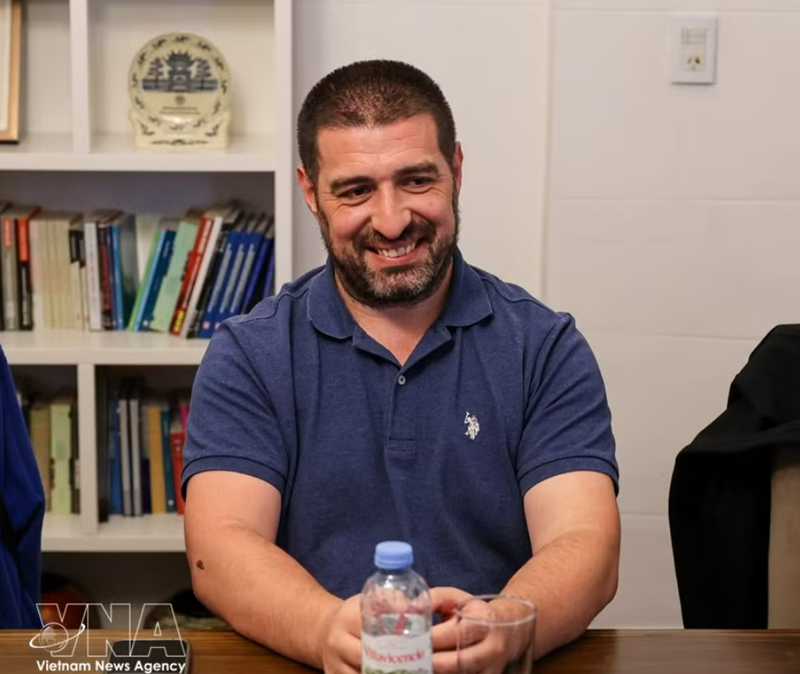
Argentine journalist and researcher Gastón Fiorda |
Fiorda observed that Viet Nam’s image in Argentina is no longer associated solely with historical memories of its struggle for independence, but is increasingly recognized for its notable achievements in national construction and development, as well as its growing role and standing internationally. He noted that Viet Nam experienced a difficult post-war reconstruction process but has achieved impressive growth through sustained efforts, bringing profound changes to social life.
Referring to the Doi Moi (Renewal) process launched in 1986, Fiorda described it as a major turning point that steered Viet Nam towards a socialist-oriented market economy, gradually expanding its economic relations and integration into the world.
He said Viet Nam has recorded notable achievements in economic management and development, maintaining high growth over an extended period while pursuing its long-term development goals. The country has also set a vision for 2045, aiming to become a developed, high-income nation.
According to Fiorda, one of the clearest signs of development was the improvement in living conditions and quality of life across generations. He pointed to changes in the physical stature, nutrition and living conditions of younger generations compared with their parents and grandparents, saying that socio-economic progress has been reflected directly in everyday life. He also commended Viet Nam’s efforts to invest in infrastructure, boost production and strengthen industrial capacity.
On trade and international economic integration, Fiorda said Viet Nam has built a highly open economy, proactively expanded ties with numerous partners and actively participated in free trade agreements. Viet Nam is not only a promising market but also an important link in global supply chains, with strong development in manufacturing, processing, textiles and garments, footwear and technology. He cited the presence of many international corporations, including Samsung, as evidence of the attractiveness of Viet Nam’s investment climate and manufacturing capacity.
The Argentine journalist also spoke highly of Viet Nam’s role in the Association of Southeast Asian Nations (ASEAN), a regional community with a large population and considerable economic potential. He said trade relations with Viet Nam could provide broader access to the Southeast Asian market. From Argentina’s perspective, he noted that the two countries still have considerable room to expand cooperation, particularly in agriculture, food and trade. He expressed a hope that Argentina will pay greater attention to Viet Nam and the Asia-Pacific region while promoting bilateral and inter-regional economic and trade cooperation mechanisms.
Assessing Viet Nam’s foreign policy, Fiorda underscored the consistency of its foreign policy of independence, self-reliance, peace, cooperation and development, as well as the diversification and multilateralization of external relations.
Fiorda also mentioned the development of relations between Viet Nam and the U.S. following the normalization of diplomatic ties, describing this as evidence of efforts to leave the past behind, look towards the future and expand mutually beneficial cooperation. He noted that Viet Nam has now established cooperative relations with numerous countries, not only in the region but also with partners in Europe, the Americas and major economic centers around the world.
One point Fiorda particularly emphasized was Viet Nam’s credibility and its reputation in partner relations. He observed that Viet Nam has taken a firm approach to negotiations, defending its core interests and values while seriously fulfilling the commitments it has signed. From his perspective as a Viet Nam researcher, the S-shaped country is increasingly becoming a trusted partner with an important role in international cooperation and trade networks.
Towards the end of the program, when asked about Viet Nam’s challenges and development orientations in the coming period, Fiorda mentioned the goals and tasks set following the 14th National Congress of the Communist Party of Viet Nam. He highlighted the need to continue renewing governance methods, improve the effectiveness and efficiency of the state apparatus and focus resources on strategic sectors. He also mentioned emerging technology fields such as artificial intelligence, information technology and communications, which he said will be important for boosting productivity, generating new growth drivers and developing a highly skilled workforce.
The discussion concluded with Fiorda reaffirming Viet Nam’s appeal to the international community. He said that a full understanding of the country requires a broader perspective that goes beyond perceptions associated with its wartime past and paid greater attention to a dynamic Viet Nam undergoing rapid development and proactively integrating into the world. He also stressed that Argentina should step up its efforts to learn about Viet Nam and strengthen ties with the country, which offers considerable potential for cooperation amid profound changes in the global economy and trade.
Source: VNA